 Durable Machinery
Get Price
Vertical Hoist Biomass Carbonization Furnace

The Vertical Hoist Biomass Carbonization Furnace is a popular and efficient design for producing high-quality charcoal. It gets its name from its two key features: its upright, vertical orientation and its use of a hoist (like a small crane or winch) for loading and unloading. This design is a significant upgrade from traditional earth kilns and is often favored for medium-scale production due to its efficiency and ease of operation.
Production materials:
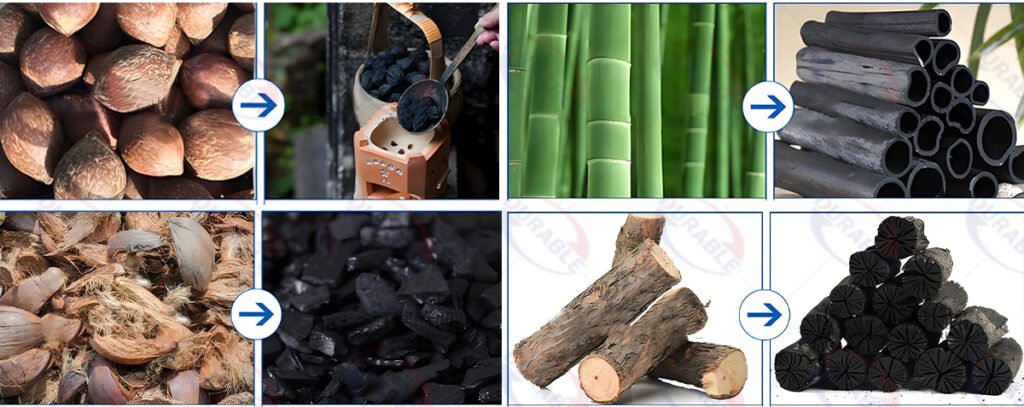
Any organic biomass raw material (such as wood, agricultural and forestry waste, fruit shells, etc.) that has been thoroughly dried and processed into suitably sized blocks or rods is an ideal material for this carbonization furnace.
Table of Contents
- How Does the Automated Feeding Process of a Vertical Hoist Furnace Work?
- Compared to Horizontal or Rotary Kilns, What Are Its Special Site and Foundation Requirements?
- With Material Stacked Vertically, How Does It Ensure Even Carbonization and Prevent Raw Cores?
- Does My Raw Material (Sawdust, Rice Husks, Coconut Shells) Need Pre-treatment?
- How Are Syngas and Biomass Tar Handled and Utilized?
- How Reliable Are the Hoist and Furnace Seals, and Is Daily Maintenance Complex?
- Is Its Return on Investment Really Higher?
- FAQs
How Does the Automated Feeding Process of a Vertical Hoist Furnace Work?
The process uses a hoist system to lift individual sealed crucibles (material bins) through different temperature zones inside a vertical shaft. It’s designed to be a continuous batch process.
- Feeding: At the bottom, raw material like sawdust or rice husks is automatically fed into a large steel crucible.
- Lifting: Once full, a hoist system (using chains or steel cables) lifts the crucible up into the first stage of the furnace. As one crucible is lifted, it pushes the entire stack of crucibles inside the furnace up by one level.
- Zoned Processing: The vertical shaft is divided into zones. As a crucible moves upwards, it passes through a pre-heating/drying zone, a high-temperature carbonization zone, and finally a cooling zone at the top.
- Discharging: Once a crucible reaches the top, it has cooled down. An automated mechanism removes it from the shaft, discharges the finished charcoal, and sends the empty crucible back down to the bottom to be refilled.


The heart of this system is the synchronous hoist mechanism. A veteran I trust calls this its most common point of failure. If the chains or cables are not perfectly synchronized, the heavy crucible will tilt and jam inside the shaft. Getting a multi-ton, hot crucible unstuck from the middle of a tall, dark shaft is a costly and dangerous repair that can shut you down for days.
Compared to Horizontal or Rotary Kilns, What Are Its Special Site and Foundation Requirements?
A vertical hoist furnace has a very small footprint, but it requires significant vertical height and a much more robust foundation. The “small footprint” claim is its biggest selling point, but it comes with trade-offs.
- Footprint and Height: It excels in saving floor space, making it attractive for facilities with limited area. However, the machine is essentially a tall tower. You need a factory with a very high ceiling or plan for an outdoor installation, which requires proper weatherproofing.
- Foundation: Unlike a horizontal furnace that spreads its weight, a Vertical Carbonization Furnace concentrates its entire weight—including the steel structure, insulation, and all the crucibles filled with material—onto a small base. This requires a specially engineered, deep, and reinforced concrete foundation to support the immense vertical load and prevent any tilting.
- Accessibility: The small footprint is achieved by packing all components tightly together. This makes maintenance a nightmare. Technicians have to work on narrow, multi-level platforms high off the ground, increasing repair time and safety risks.
While it saves ground space, the costs for a high-ceiling building, a heavy-duty foundation, and difficult maintenance can offset the initial advantage.
With Material Stacked Vertically, How Does It Ensure Even Carbonization and Prevent Raw Cores?
It relies on using very uniform, free-flowing raw materials and indirect heating, but achieving perfect uniformity is a major challenge. In a static vertical pile, heat must travel from the outer walls of the crucible to the center.
This design is extremely sensitive to the type of raw material used.
- Bridging and Clogging: It requires materials with excellent fluidity, like high-quality sawdust, rice husks, or coconut shells. Irregular materials like wood chips or chopped straw will “bridge” at the feed inlet, creating an arch and blocking the flow. This results in partially filled crucibles, ruining the process and requiring an operator to manually poke the blockage—defeating the purpose of automation.
- Heat Transfer: Heat is applied from the outside of the crucible. Like in a horizontal kiln, this can lead to the outer material being overcooked while the center remains raw. The design tries to solve this with long residence times, but it’s a fundamental physical limitation.
Therefore, for this furnace to work effectively, your raw material must be very consistent in size, shape, and moisture content. Any variation can lead to uneven carbonization and poor-quality charcoal.
Does My Raw Material (Sawdust, Rice Husks, Coconut Shells) Need Pre-treatment?
Yes, absolutely. Pre-treatment is not optional; it is mandatory for the successful operation of a vertical hoist furnace. This furnace is the least forgiving of all types when it comes to feedstock quality.
- Size and Shape: The material must be small and uniform to ensure it flows like a liquid and packs densely without bridging. This often means you need to invest in a crushing and screening system to prepare your raw material first.
- Moisture Content: The moisture level must be low and consistent, typically below 12%. High moisture will create excessive steam inside the sealed crucible, which can build up pressure and interfere with heat transfer. This means a rotary dryer is an essential piece of auxiliary equipment.
If you want to process diverse biomass, this is not the right machine. It is designed for a highly standardized production line where feedstock preparation is a critical first step.
| Feedstock Type | Suitability for Vertical Furnace | Required Pre-treatment |
|---|---|---|
| Fine Sawdust (<5mm) | Excellent | Drying |
| Rice Husks | Good | Drying |
| Coconut Shells | Good | Crushing, Screening, Drying |
| Wood Chips | Very Poor | Must be crushed to fine powder |
| Chopped Straw | Very Poor | Prone to bridging; not recommended |
How Are Syngas and Biomass Tar Handled and Utilized?
The system is designed as a closed loop, where the captured syngas is used to heat the furnace itself, but handling the byproducts is complex.
- Collection: Each crucible is designed to channel the syngas and vapors produced during carbonization out through a pipe system.
- Cleaning: The collected gas mixture is sent to a cleaning system, typically involving spray towers or condensers. This process cools the gas, causing the heavier biomass tar and wood vinegar to condense into a liquid.
- Utilization: The now-clean, combustible syngas is piped to burners that heat the furnace’s carbonization zone. After the initial start-up, the furnace can theoretically run on its own energy.
- Byproducts: You are left with two streams: the useful syngas and a liquid mixture of tar and wood vinegar. This liquid byproduct is acidic and requires further expensive processing to be useful or disposed of safely.
The reliability of this entire system depends on the seals of the moving crucibles and the efficiency of the gas cleaning system. Blockages from tar are a common problem.
How Reliable Are the Hoist and Furnace Seals, and Is Daily Maintenance Complex?
The reliability of the hoist and seals is a primary concern, and maintenance is significantly more complex and dangerous than with other furnace types.
- Hoist System: The chains, sprockets, and motors of the hoist operate in a hot, dusty environment. They require constant inspection and lubrication. A failure here is catastrophic, as it can jam the entire production line.
- Dynamic Seals: The furnace has moving seals at the top and bottom to let the crucibles in and out. These seals are a magnet for tar and dust, which hardens and causes leaks. Leaks let oxygen in (burning your charcoal) and toxic carbon monoxide out (endangering your workers). Cleaning these seals is a dirty, difficult job that requires shutting down the furnace.
Daily maintenance involves climbing a multi-story structure to inspect numerous mechanical parts, sensors, and seals in tight spaces. This is a far cry from the ground-level maintenance of a horizontal or rotary furnace.
Is Its Return on Investment Really Higher?
The claim of a higher ROI is highly debatable and depends on you having the perfect conditions: cheap, uniform feedstock and high labor costs. While it reduces the number of workers needed for loading, its higher initial cost, significant pre-treatment equipment costs, and higher maintenance budget can quickly erase those savings.
- High Initial Investment: The furnace itself is complex and expensive.
- Required Ancillary Equipment: You must add the cost of a crusher, a dryer, and screening equipment.
- High Maintenance Costs: You will need a higher budget for spare parts (especially for crucibles) and skilled maintenance personnel.
- Risk of Downtime: A single mechanical failure can cause days of downtime, which is a massive hidden cost.
Its ROI is only higher on paper. In the real world, the frequent downtime and high maintenance costs associated with this complex design often result in a lower actual return than a simpler, more robust system like a continuous rotary furnace.
Technical Parameters
| QHL-1 | QHL-2 | QHL-3 | QHL-4 |
| 1* outer stove | 2* outer stove | 3* outer stove | 4* outer stove |
| 3* inner stoves | 6* inner stoves | 9* inner stoves | 12* inner stoves |
| 1* crane | 1* crane | 1* crane | 1* crane |
| 1* electric hoist | 1* electric hoist | 1* electric hoist | 1* electric hoist |
| smoke recycle system | smoke recycle system | smoke recycle system | smoke recycle system |
| water purification | water purification | water purification | water purification |
| 1* draght fan | 1* draght fan | 1* draght fan | 1* draght fan |
| 2000kg/day | 4000kg/day | 6000kg/day | 8000kg/day |
FAQs
Q1: What is the main advantage of a vertical hoist furnace?
A: Its main advantages are its small factory footprint and its high level of automation, which can reduce direct labor costs for material handling, assuming the system runs perfectly.
Q2: What are the key components of a complete biomass charcoal powder production line using this furnace?
A: A complete line includes: a raw material silo, a crusher, a dryer, a conveyor to the furnace, the Vertical Lifting Carbonization Furnace itself, a cooling system for the charcoal powder, and a packaging machine.
Q3: What is the typical capacity of these furnaces?
A: They are typically designed for medium to large-scale production, often processing 1-2 tons of raw material per hour. The capacity is limited by the size of the crucibles and the speed of the hoist system.
Q4:Is it truly a “smokeless” process?
A: Like any modern carbonizer, it can be smokeless if the syngas collection and burning system works perfectly. However, due to the complexity of its moving seals, it is more prone to developing leaks over time, which can release smoke and fugitive emissions.
Request A Quote