 Durable Machinery
Get Price
Disc Chipper vs Drum Chipper: Which Produces Better Wood Chips?
When buyers compare a disc chipper and a drum chipper, the first question is usually simple:
Which one produces better wood chips?
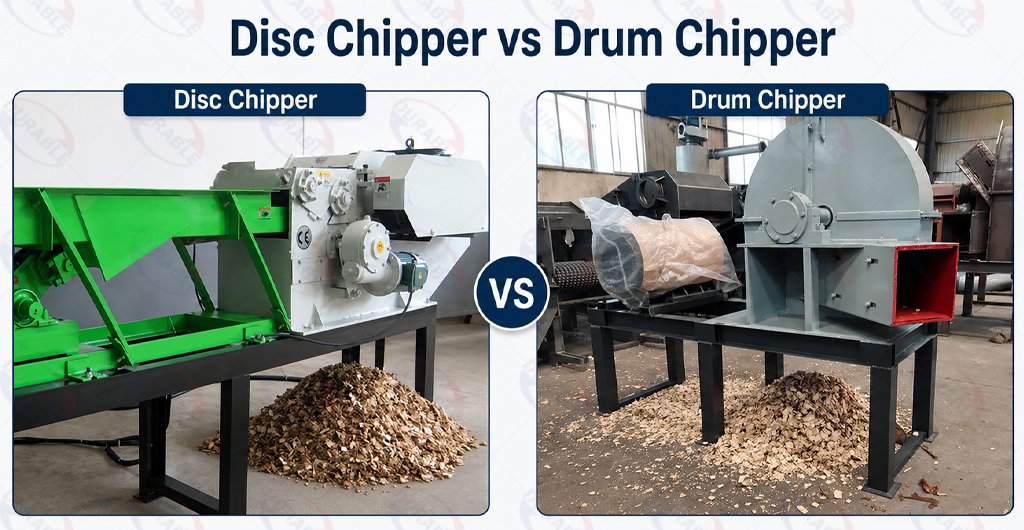
But in real biomass, pellet, boiler fuel, pulp, and wood processing projects, “better wood chips” does not always mean the same thing.
For one factory, better chips may mean more uniform size. For another, it may mean higher output. For a pellet plant, it may mean easier drying and grinding. For a large biomass fuel plant, it may mean stable feeding and fewer interruptions.
That is why choosing between a disc chipper and a drum chipper should not be based on one simple answer.
In general, a disc chipper usually produces more uniform wood chips from clean logs and branches. A drum chipper is often more practical for high-capacity plants that process larger, heavier, or more irregular wood materials.
This guide compares disc chippers and drum chippers by wood chip quality, raw material suitability, capacity, price factors, maintenance needs, downstream applications, and common buying mistakes. It will help you decide which machine fits your production goal instead of simply asking which one is “better.”
What Does “Better Wood Chips” Actually Mean?
Before comparing machines, it is important to define what “better wood chips” means.
Many buyers assume better chips simply mean smaller chips. That is not always true. A chip that is too small may create too many fines. A chip that is too large may block conveyors or feed systems. A chip that is uneven may cause drying, grinding, combustion, carbonization, or pelletizing problems.
In most projects, wood chip quality is judged by several factors.
| Quality Factor | Why It Matters |
|---|---|
| Chip Size Uniformity | Affects drying, feeding, and downstream processing |
| Chip Thickness | Important for controlled processing and combustion |
| Fines Content | Too many fines may affect handling and fuel quality |
| Oversized Chips | May cause feeding problems or require reprocessing |
| Cutting Cleanliness | Helps reduce dust and irregular broken pieces |
| Production Stability | Important for continuous biomass plants |
| Raw Material Tolerance | Matters when processing branches, slabs, and mixed wood |
For a pellet plant, uniform chips are useful because the material usually needs to be dried and further reduced before entering a pellet mill.
For a boiler fuel project, chips must match the feeding and combustion system.
For biomass briquette production, chips may still need further crushing before pressing.
So the real question is not only:
Which chipper produces better chips?
The better question is:
Which chipper produces the right chips for your material and final use?
How a Disc Chipper Produces Wood Chips
A disc chipper uses a rotating disc fitted with knives. Wood enters the cutting area and is cut by the knives on the disc. Because the cutting angle is more controlled, a disc chipper is often able to produce cleaner and more uniform wood chips from suitable raw materials.
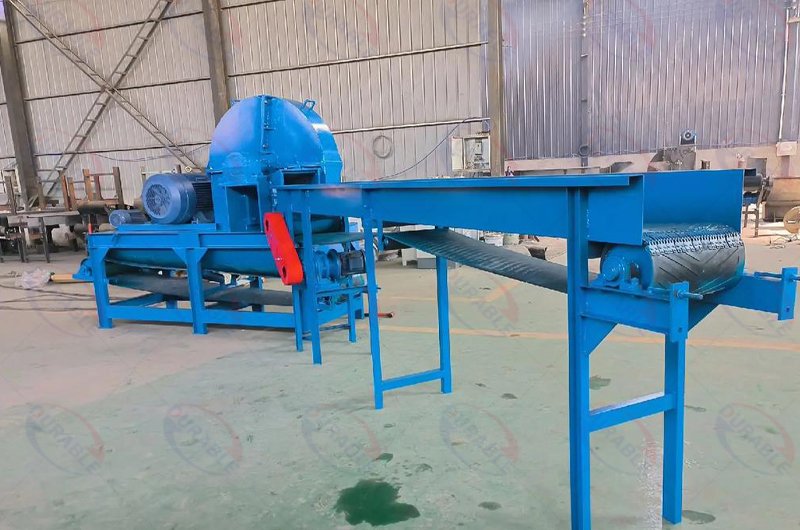
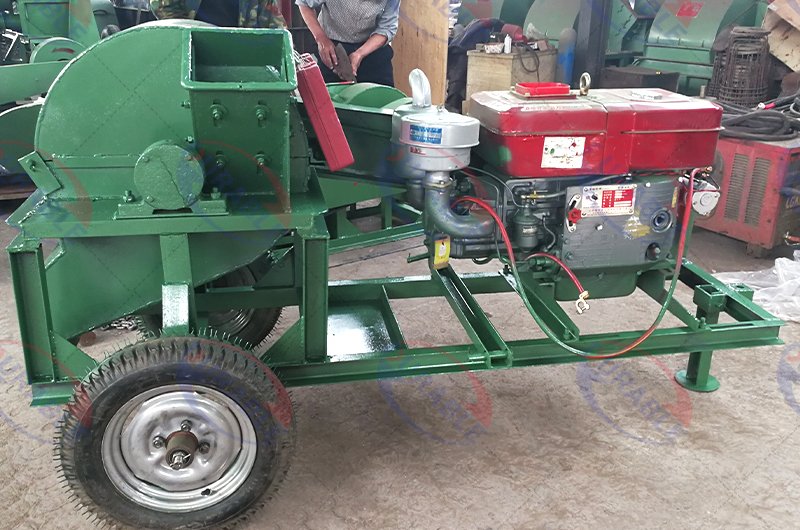
A Disc Wood Chipper is commonly used for logs, branches, and wood materials that can be fed in a relatively stable direction.
Disc chippers are often selected when buyers care about:
- More uniform chip size
- Cleaner cutting
- Controlled chip thickness
- Lower fines content
- Better chip appearance
- Stable material preparation for downstream processing
This makes disc chippers useful for applications such as biomass fuel preparation, pellet raw material preparation, boiler fuel, pulp-related wood chips, and clean wood recycling projects.
However, a disc chipper also has limits.
It performs best with relatively regular wood materials. If your plant processes bulky, mixed, or irregular waste wood, feeding may become less efficient. In that case, a drum chipper or another wood waste crushing system may be more practical.
How a Drum Chipper Produces Wood Chips
A drum chipper uses a rotating cylindrical drum with knives to cut wood into chips. The drum structure is usually designed for strong feeding and continuous processing. This makes it attractive for larger biomass plants and wood waste projects.
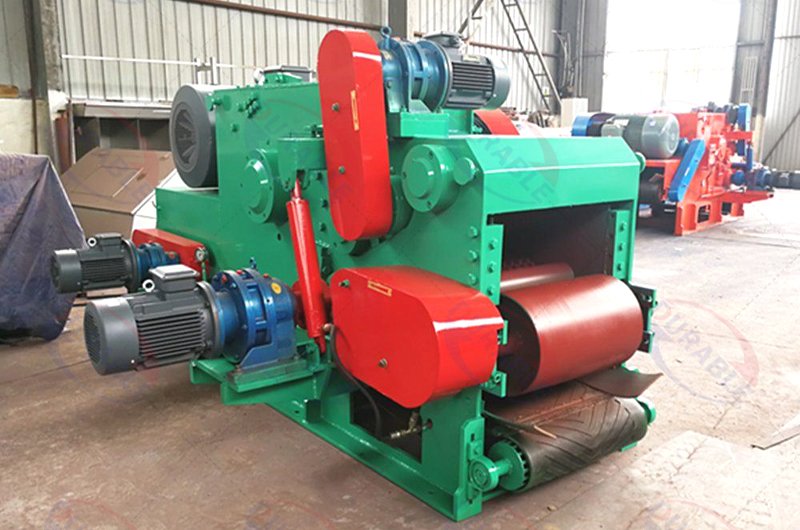
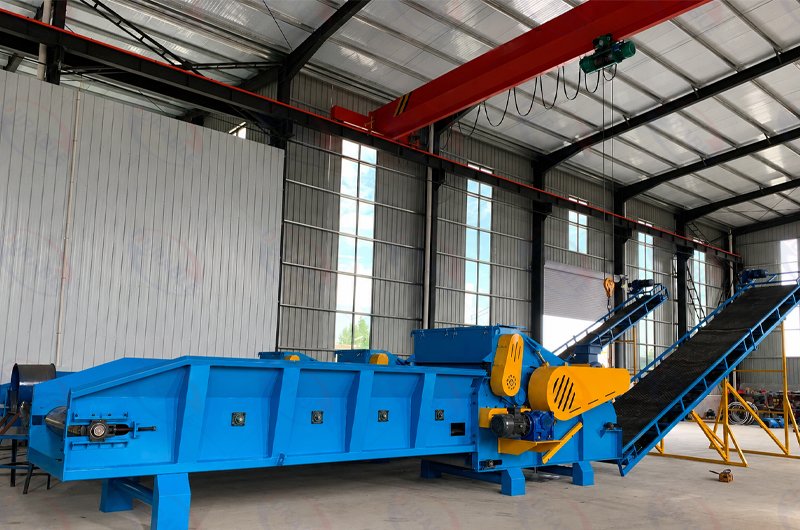
A Drum Chipper is often used for:
- Logs
- Branches
- Sawmill slabs
- Forestry waste
- Wood offcuts
- Veneer scraps
- Larger-volume biomass material
- Mixed wood materials with less regular shapes
Compared with a disc chipper, a drum chipper is often chosen when the main priority is capacity and feeding strength. It can be a strong solution for plants that need to process large amounts of wood material every day.
However, drum chippers may produce chips that are less precise than disc chippers, depending on machine design, blade condition, raw material, feeding system, and screening system.
This does not mean drum chips are poor quality. It means the definition of “quality” changes.
For large biomass fuel plants, stable high-volume output may be more valuable than extremely precise chip thickness.
Disc Chipper vs Drum Chipper: Key Differences
A disc chipper and a drum chipper are both wood chipping machines, but they serve different production priorities.
The table below gives a practical comparison.
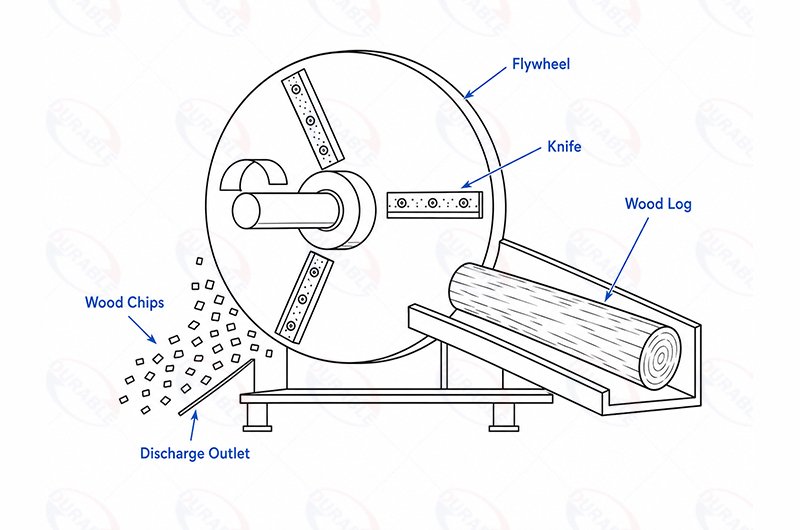
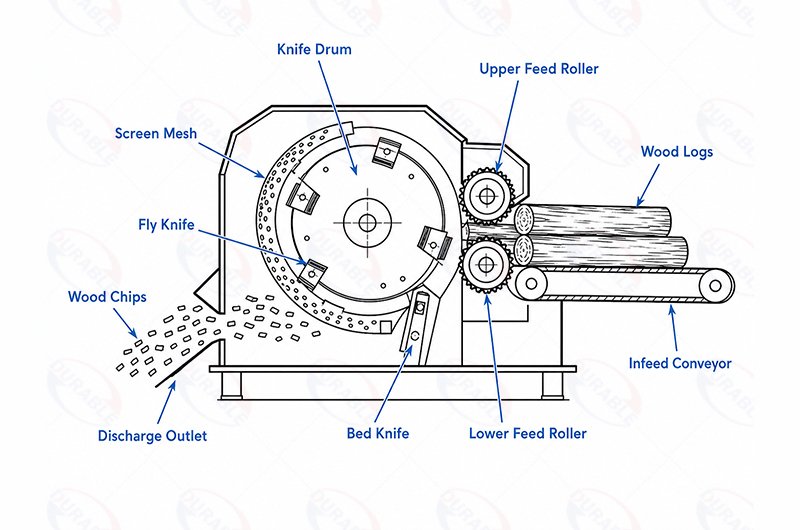
| Factor | Disc Chipper | Drum Chipper |
|---|---|---|
| Cutting Structure | Rotating disc with knives | Cylindrical drum with knives |
| Best Raw Material | Clean logs, branches, regular wood | Logs, branches, slabs, mixed biomass |
| Chip Uniformity | Usually better | Good, but usually less precise |
| Capacity | Medium to high | High to very high |
| Feeding Stability | Good for regular wood | Better for continuous large-volume feeding |
| Best Use | Pellets, pulp, boiler fuel, clean chips | Biomass fuel, large plants, rougher preparation |
| Raw Material Flexibility | Medium | Higher |
| Investment | Usually lower to medium | Usually higher |
| Maintenance Focus | Disc knives and feeding angle | Drum knives, feeding system, discharge |
The key difference is not simply the shape of the machine. It is the operating goal.
A disc chipper is usually selected when the buyer wants better control over chip uniformity.
A drum chipper is usually selected when the buyer needs stronger continuous processing for larger material volumes.
If your raw material is clean and regular, disc chipping may give you better chip quality. If your raw material is heavy, irregular, or high-volume, drum chipping may help your plant run more smoothly.
How Material Type Shapes Your Wood Chipper Choice
Your raw material type is one of the most important factors in wood chipper selection.
A disc wood chipper usually works better with relatively straight, clean, and regular wood materials. These may include round logs, trimmed branches, and uniform wood sections. When the feeding direction is stable, the disc knives can cut more cleanly and produce more consistent chips.
A drum chipper is usually more tolerant of irregular materials. It is often selected for sawmill slabs, branches, forestry residues, veneer scraps, and larger-volume biomass waste. The stronger feeding structure helps the machine handle materials that are less uniform in shape.
Use this table as a practical guide.
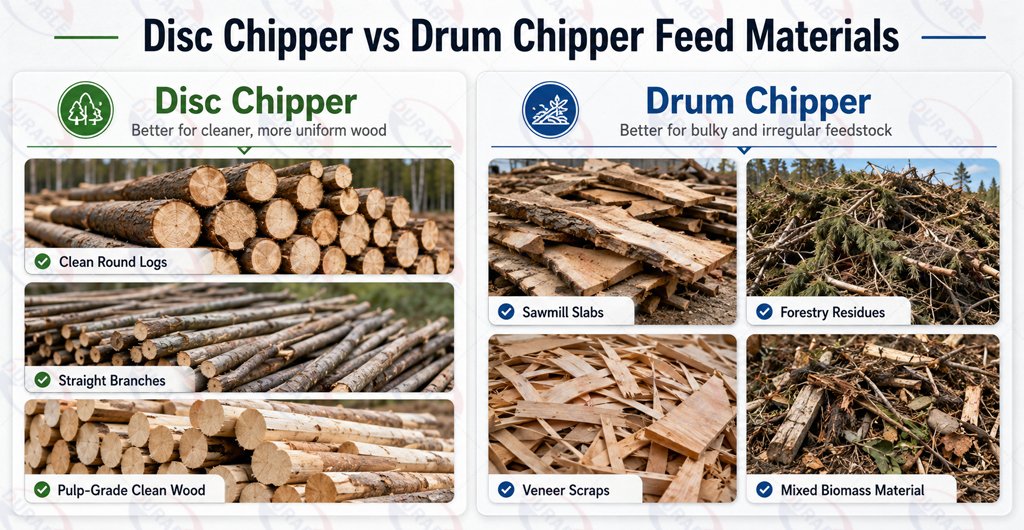
| Raw Material | Better Choice | Reason |
|---|---|---|
| Clean round logs | Disc Chipper | Better chip uniformity |
| Straight branches | Disc Chipper | Cleaner cutting and controlled chip size |
| Sawmill slabs | Drum Chipper | Stronger feeding for bulky material |
| Forestry residues | Drum Chipper | Better tolerance for irregular shapes |
| Veneer scraps | Drum Chipper | Suitable for larger-volume processing |
| Mixed biomass material | Drum Chipper | More practical for variable feedstock |
| Pulp-grade clean wood | Disc Chipper | Better control of chip size and thickness |
However, neither machine should be fed with heavily contaminated materials.
If the wood contains nails, stones, sand, metal pieces, or construction waste, pre-sorting is necessary. Contaminants can damage knives, increase maintenance costs, and reduce chip quality.
Which Chipper Produces More Uniform Chips?
If the main goal is uniform chip size and cleaner cutting, a disc chipper usually has the advantage.
This is because the cutting action is more controlled. When logs or branches enter the disc chipper properly, the machine can produce chips with more consistent size and shape.
Uniform chips are important for many downstream processes.
For example:
- Dryers work more evenly when chip size is consistent.
- Pellet plants can prepare material more efficiently.
- Boiler systems may feed more smoothly.
- Pulp-related uses often require better chip control.
- Storage and transport become easier when chips are more predictable.
A disc chipper is not automatically better for every project, but it is often the better choice when chip quality is measured by uniformity.
However, chip uniformity is not only controlled by machine type. It also depends on:
- Raw material quality
- Knife sharpness
- Feeding angle
- Machine adjustment
- Moisture content
- Operator skill
- Screening after chipping
Even a good disc chipper will not produce ideal chips if the raw material is dirty, twisted, oversized, or poorly fed.
Which Chipper Is Better for Biomass Fuel and Pellet Plants?
For biomass fuel and pellet production, the better choice depends on the raw material and the next processing step.
A pellet plant usually does not feed large wood chips directly into a pellet mill. Wood chips often need drying and further grinding before entering a Pellet Making Machine.
Since pellet quality depends on consistent material preparation, uniform chips can make the downstream process easier.
A biomass briquette plant also needs controlled raw material. If the material will enter a Biomass Briquette Machine, the chips may need further crushing and drying before pressing.
Use this table as a practical guide.
| Application | Better Choice | Reason |
|---|---|---|
| Wood Pellet Plant | Disc Chipper or Drum Chipper + Hammer Mill | Needs stable material before pelletizing |
| Biomass Briquette Plant | Depends on raw material | May need further crushing after chipping |
| Boiler Fuel | Disc or Drum Chipper | Depends on feeding system and chip size |
| Large Biomass Fuel Plant | Drum Chipper | Higher capacity and continuous feeding |
| Clean Wood Chip Supply | Disc Chipper | Better chip uniformity |
| Mixed Wood Waste Processing | Drum Chipper | Better raw material tolerance |
For clean logs and branches, a disc chipper may produce better chips for pellet and boiler fuel preparation.
For large biomass plants handling slabs, branches, and irregular materials, a drum chipper may provide better production stability.
If the chips need to be reduced further before pelletizing or briquetting, a Hammer Mill Crusher may be used after chipping.
So the choice should be made from the full production line, not from the chipper alone.
Which Chipper Is Better for High-Capacity Wood Processing?
For large-scale continuous wood processing, a drum chipper is usually more practical.
The reason is simple: large plants need stable feeding, high throughput, and strong material handling ability. When raw material comes in large volumes, chipper downtime can affect the whole line.
A drum chipper is often preferred when the plant processes:
- Large quantities of wood waste
- Sawmill slabs
- Forestry residues
- Mixed branches
- Biomass fuel material
- Heavy feedstock for continuous production
However, higher capacity does not automatically mean better wood chip quality.
A large drum chipper may process more material per hour, but if the project requires very uniform chips, screening or secondary processing may still be needed. In some cases, a disc chipper with lower capacity may produce chips that better match the final product.
This is why buyers should compare actual production needs rather than only rated capacity.
Ask these questions before choosing:
- How many tons per hour do I need?
- Is my material clean or mixed?
- Do I need uniform chips or rough biomass feedstock?
- Will the chips go to drying, pelletizing, briquetting, boiler fuel, or carbonization?
- Do I need further crushing after chipping?
- How many hours per day will the machine run?
The answers will usually point toward the right machine.
How Much Does a Wood Chipper Cost?
The price of a wood chipper depends on much more than whether it is a disc chipper or a drum chipper.
The final cost is affected by capacity, motor power, feeding system, blade material, steel structure, automation level, and whether the machine is used as a standalone unit or part of a complete biomass processing line.
| Price Factor | Why It Matters |
|---|---|
| Machine Type | Disc and drum chippers use different cutting structures |
| Processing Capacity | Higher output requires stronger motors and heavier frames |
| Maximum Feed Size | Larger logs or slabs require larger feeding openings |
| Feeding System | Hydraulic feeding improves stability but increases cost |
| Knife Material | Better knives improve service life and chip quality |
| Motor or Diesel Engine | Power source affects price and operating cost |
| Conveyor System | Feeding and discharge conveyors add investment |
| Control System | Automation improves operation but increases initial cost |
| Spare Parts Package | Helps reduce future downtime |
| Shipping and Installation | Affects total delivered cost |
In general, a smaller disc chipper for clean logs may require a lower initial investment than a heavy-duty drum chipper for mixed biomass material.
However, the lowest purchase price is not always the best choice.
A machine that matches your material and output target can often provide better long-term value because it reduces downtime, knife damage, and secondary reprocessing.
When comparing quotations, buyers should evaluate:
- Cost per ton
- Knife consumption
- Power consumption
- Downtime risk
- Spare parts availability
- Labor requirement
- Compatibility with downstream equipment
This is more useful than comparing machine price alone.
How to Maintain a Disc Chipper or Drum Chipper
Industrial chipping involves cutting force, friction, vibration, and impact. Regular maintenance is important for stable output and chip quality.
A poorly maintained chipper may produce uneven chips, increase energy consumption, damage knives faster, or cause unexpected downtime.
Key maintenance points include:
- Check knife sharpness regularly.
- Keep the anvil clearance within the recommended range.
- Remove metal, sand, stones, and hard contaminants before feeding.
- Lubricate bearings and feeding components on schedule.
- Check hydraulic feeding rollers if the machine uses hydraulic feeding.
- Inspect drive belts, bolts, and guards.
- Clean the discharge area to avoid material blockage.
- Replace worn knives before they seriously affect chip quality.
- Train operators to feed material evenly.
Knife life depends heavily on wood species, moisture content, bark content, cleanliness, and working hours.
Clean logs usually help extend knife life. Dirty wood, sandy bark, metal pieces, and stone contamination will shorten knife life quickly.
For both disc chippers and drum chippers, maintenance should not be treated as an afterthought. It directly affects chip quality, production stability, and long-term operating cost.
Common Mistakes When Comparing Chip Quality
Many buyers make the wrong decision because they compare disc chippers and drum chippers using only one factor.
Here are the most common mistakes.
Mistake 1: Thinking Smaller Chips Are Always Better
Smaller chips are not always better. Too many fines may create dust, reduce fuel quality, or cause feeding problems. The best chip size depends on the final application.
Mistake 2: Comparing Capacity Without Material Type
A chipper may perform very differently with clean logs, crooked branches, slabs, bamboo, or mixed wood waste. Always compare machines based on your real material.
Mistake 3: Using a Disc Chipper for the Wrong Material
A disc chipper can produce uniform chips, but it may not be ideal for large volumes of mixed, irregular, or contaminated wood waste.
Mistake 4: Using a Drum Chipper When Uniformity Is the Main Goal
A drum chipper can provide high capacity, but if your main goal is very uniform chips, a disc chipper may be more suitable.
Mistake 5: Ignoring Downstream Equipment
The chipper output should match the next machine. If the chip size is wrong, the dryer, hammer mill, pellet machine, briquette machine, boiler, or carbonization furnace may not perform well.
Mistake 6: Confusing Chippers with Crushers
A wood chipper cuts wood into chips. A crusher breaks material into smaller, less regular pieces.
If you are unsure which one you need, the guide Wood Chipper vs. Crusher: Which Machine Do You Actually Need? can help clarify the difference.
How to Choose the Right Wood Chipper for Your Project
The right wood chipper should match your raw material, target chip quality, production capacity, and downstream process.
Use this table as a simple selection guide.
| Project Situation | Better Choice | Why |
|---|---|---|
| Clean logs and branches | Disc Chipper | Produces more uniform chips |
| Pellet plant raw material preparation | Disc Chipper or Drum + Hammer Mill | Depends on capacity and material |
| Boiler fuel from clean wood | Disc Chipper | Good chip consistency |
| Large biomass fuel plant | Drum Chipper | Better continuous high-capacity processing |
| Mixed forestry waste | Drum Chipper | Better tolerance for irregular material |
| Sawmill slab processing | Drum Chipper | Stronger feeding for bulky material |
| Pulp or controlled chip supply | Disc Chipper | Better chip uniformity |
Before requesting a quotation, prepare the following information:
- Raw material type
- Maximum material diameter
- Average material length
- Moisture content
- Required chip size
- Required hourly capacity
- Final chip application
- Power source
- Feeding method
- Factory layout
- Expansion plan
If your main goal is clean and uniform chips from logs or branches, a disc chipper is often the better choice.
If your main goal is high-volume processing of irregular biomass material, a drum chipper may be more practical.
If your project includes biomass pellets, briquettes, boiler fuel, or carbonization, the chipper should be selected as part of the full production line rather than as a standalone machine.
How to Choose a Reliable Wood Chipper Supplier
When buying an industrial wood chipper, choosing a reliable supplier is just as important as choosing the machine type.
A low-cost machine may look attractive at first, but weak steel structure, poor knife material, unstable feeding, or insufficient after-sales support can increase long-term production costs.
Before choosing a supplier, check the following points.
| Supplier Factor | What You Should Check | Why It Matters |
|---|---|---|
| Manufacturing Ability | Workshop, welding quality, machining ability, assembly process | Affects machine strength and stability |
| Technical Matching | Feed size, motor power, blade material, downstream process | Ensures the machine matches your material |
| Real Application Experience | Biomass, pellet, boiler fuel, sawmill, or recycling cases | Helps avoid wrong machine selection |
| Spare Parts Support | Knives, bearings, screens, belts, hydraulic parts | Reduces downtime after purchase |
| Export Experience | Packing, shipping, documentation, installation guidance | Reduces international purchase risk |
| Customization Ability | Hoppers, conveyors, feeding systems, layout design | Helps match your factory site |
A good supplier should not only sell a standard machine.
They should first understand your raw material, production capacity, chip size requirement, downstream process, and budget. Then they should recommend a suitable configuration.
For B2B buyers, this engineering support often matters more than a small difference in machine price.
Buyer Self-Check List Before Requesting a Quote
Before contacting a supplier, prepare your basic project information. This will help engineers recommend a practical machine instead of guessing your needs.
Use this checklist:
- What specific wood species or wood waste material will you process?
- Is the material clean, mixed, wet, dirty, or contaminated?
- What is the maximum diameter of the incoming wood?
- What is the average length of the raw material?
- What hourly or daily production capacity do you need?
- What chip size do you want?
- What is the final application: pulp, pellets, boiler fuel, briquettes, carbonization, or general biomass fuel?
- Do you need a stationary electric unit or a mobile diesel-engine unit?
- Do you need feeding and discharge conveyors?
- Will the chipper connect to a dryer, hammer mill, pellet machine, or briquette machine?
- What is your project country and installation site condition?
- Do you have a future expansion plan?
The more complete your project information is, the more accurate the equipment selection and quotation will be.
Frequently Asked Questions
Which produces more uniform wood chips, a disc chipper or drum chipper?
A disc chipper usually produces more uniform chips when processing clean logs, branches, or regular wood materials.
Which chipper has higher capacity?
A drum chipper is usually better for high-capacity continuous processing, especially when handling large volumes of wood or irregular biomass material.
Is a drum chipper better for biomass plants?
It depends on the plant. Drum chippers are often better for large biomass plants with high-volume material preparation needs. Disc chippers may be better when chip uniformity is more important.
Is a disc chipper better for pellet production?
A disc chipper is often a good choice for pellet raw material preparation when the material is clean and regular. However, pellet production usually still requires drying and fine grinding before pelletizing.
Can wood chips go directly into a pellet machine?
Usually no. Wood chips normally need further drying and grinding before entering a pellet machine.
Final Thoughts
There is no single winner in the disc chipper vs drum chipper comparison.
A disc chipper is often better when your main goal is clean, uniform wood chips from logs, branches, or regular wood materials. It is a good choice for projects where chip size consistency, cutting cleanliness, and downstream material preparation are important.
A drum chipper is often better when your main goal is high-capacity processing, stronger feeding, and better tolerance for slabs, forestry residues, mixed branches, or larger biomass materials.
The best choice depends on your raw material, required chip size, hourly capacity, downstream process, and long-term operating cost.
Before purchasing, do not only compare machine price. Compare the full production result:
- Can the machine handle your real material?
- Can it produce the chip size you need?
- Can it match your dryer, hammer mill, pellet machine, boiler, or briquette machine?
- Can spare parts be supplied quickly?
- Can the supplier provide layout and technical support?
When the chipper is correctly matched to your project, it can improve feeding stability, reduce reprocessing, support downstream production, and lower your long-term cost per ton.
About DURABLE
DURABLE provides biomass processing equipment for wood chip preparation, biomass fuel production, pellet making, briquetting, crushing, drying, and carbonization projects.
Our team helps buyers evaluate raw material type, chip size requirements, capacity target, downstream process, factory layout, and investment budget before recommending suitable equipment.
Whether you need a disc wood chipper for clean and uniform chips or a larger drum chipping solution for biomass raw material preparation, DURABLE can help you choose a practical equipment configuration for your project.
If you want a detailed quotation and technical proposal, please send our engineering team your raw material type, maximum wood diameter, required hourly capacity, final chip application, and project location.
DURABLE will help you design a suitable wood chipping and biomass processing solution based on your real production needs.