 Durable Machinery
Get Price
How Does a Biomass Briquette Machine Work? Process, Capacity, and Applications
A biomass briquette machine turns loose biomass materials into dense, uniform fuel briquettes through material preparation, feeding, pressing, shaping, cooling, and packaging. For farms, wood processing plants, fuel producers, and recycling projects, this machine helps convert low-value agricultural or forestry waste into a practical solid fuel product.
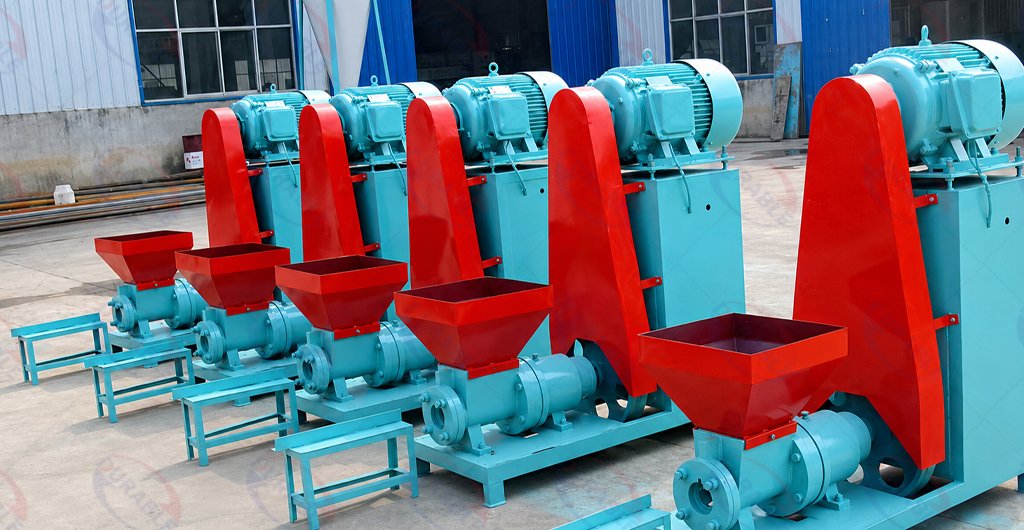
However, many buyers misunderstand how briquetting works. Some only focus on the press machine itself, while others ignore raw material size, moisture content, feeding stability, and final briquette use. In real production, these factors directly affect briquette density, output, machine performance, and long-term operating cost.
This guide explains how a Biomass Briquette Machine works, what process steps are usually required, which raw materials can be used, how to choose a suitable capacity, and where biomass briquettes are commonly applied. It is designed to help buyers understand the complete production logic before requesting a quotation.
What Is a Biomass Briquette Machine?
A biomass briquette machine is equipment used to compress loose biomass materials into solid briquettes with higher density, better shape, and easier storage performance.
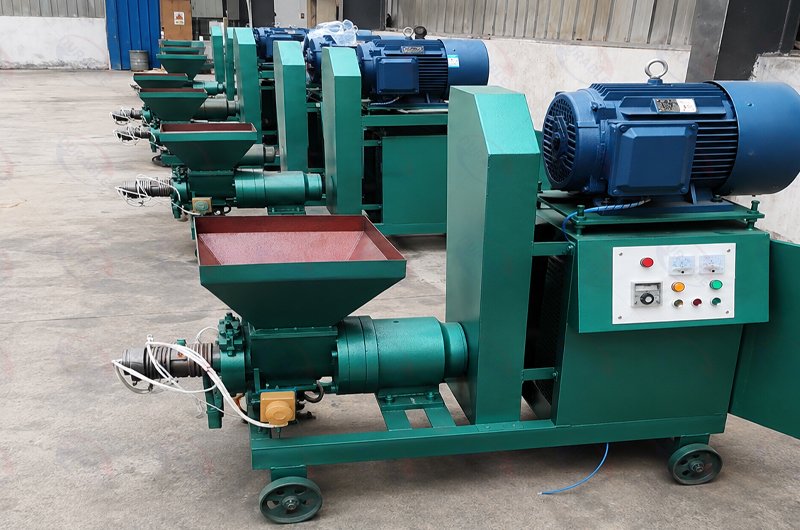
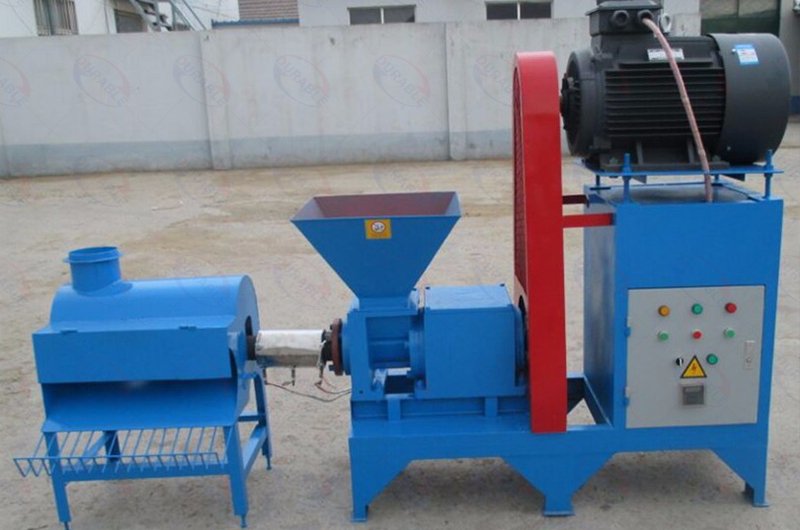
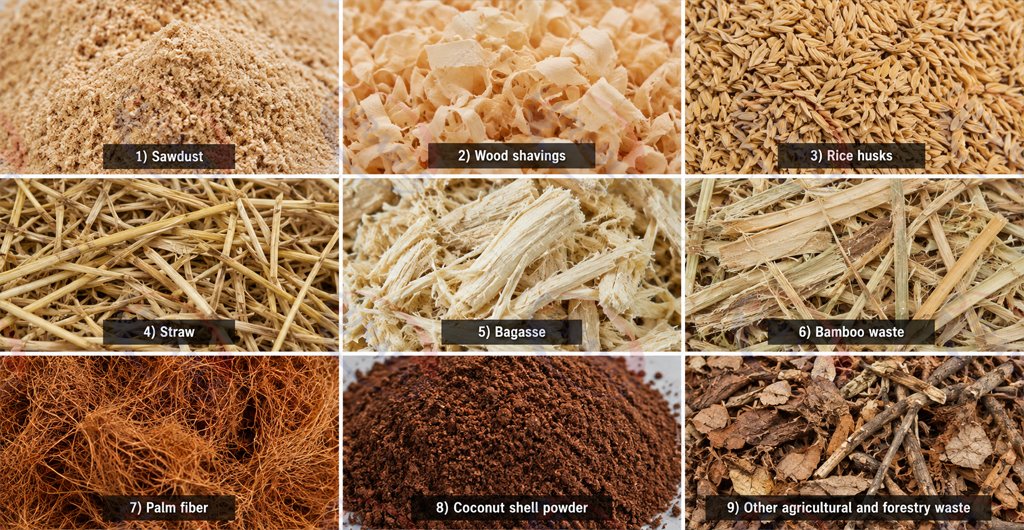
Common raw materials include:
- Sawdust
- Wood shavings
- Rice husks
- Straw
- Bagasse
- Bamboo waste
- Palm fiber
- Coconut shell powder
- Other agricultural and forestry waste
Instead of burning these materials directly, many producers first process them into briquettes. This makes the fuel easier to transport, store, sell, and use in boilers or heating systems.
The machine is different from a crusher, dryer, or carbonization furnace. A crusher reduces raw material size. A dryer controls moisture. A carbonization furnace turns biomass or briquettes into charcoal. The briquette machine focuses on densification, which means turning loose material into a compact fuel product.
For this reason, a briquette machine is often the core forming equipment in a biomass fuel production project.
How Does a Biomass Briquette Machine Work?
A biomass briquette machine works by forcing prepared biomass material into a forming chamber. Under mechanical, screw, or hydraulic pressure, the loose material is compressed into a dense briquette shape.
In many biomass fuel projects, the working process includes four basic stages:
| Working Stage | What Happens | Why It Matters |
|---|---|---|
| Feeding | Prepared biomass enters the press chamber | Keeps production continuous |
| Compression | Material is pressed under strong pressure | Forms dense briquettes |
| Shaping | Briquettes pass through the mold or die | Determines size and appearance |
| Discharge | Finished briquettes exit the machine | Affects output stability |
The final briquette quality depends on stable feeding, suitable moisture, correct particle size, enough pressure, and proper mold design.
If the raw material is too wet, briquettes may crack or become loose. If the material is too large, feeding may become unstable. If the pressure is not enough, the final briquettes may not hold their shape well.
Therefore, buyers should not evaluate the briquette machine alone. The full material preparation system is just as important.
Biomass Briquette Production Process Step by Step
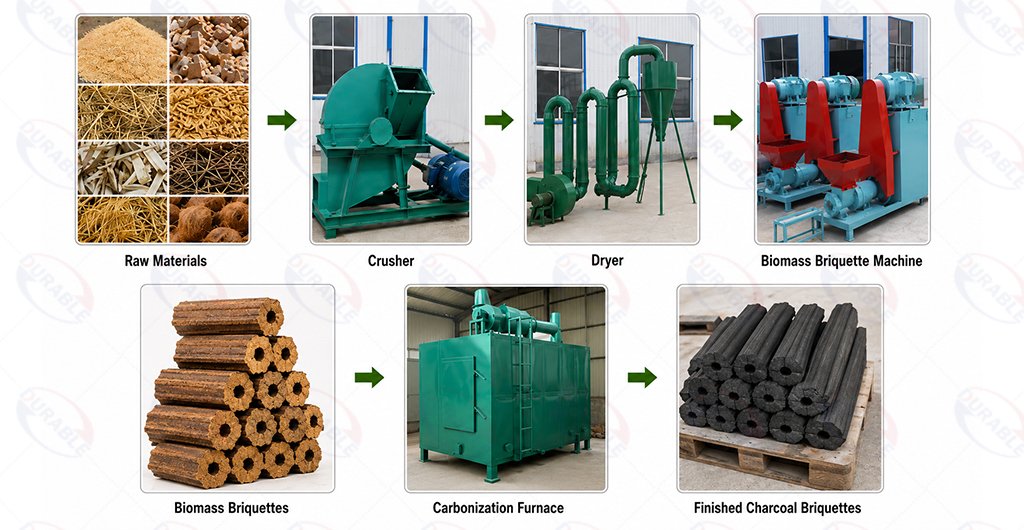
A complete biomass briquette production process usually includes crushing, drying, feeding, pressing, cooling, and packaging. Not every project needs every step, but most commercial production lines require proper preparation before pressing.
| Step | Function | Key Requirement |
|---|---|---|
| Crushing | Reduces raw material size | Uniform particle size |
| Drying | Controls moisture content | Stable moisture before pressing |
| Feeding | Sends material into the machine | Continuous and even feeding |
| Pressing | Compresses biomass into briquettes | Stable pressure and mold design |
| Cooling | Reduces briquette temperature | Prevents cracking and deformation |
| Packaging | Prepares products for storage or sale | Protects briquettes from moisture |
For wood logs, branches, or larger forestry waste, size reduction is usually required before briquetting. A Disc Wood Chipper can help prepare wood-based raw materials before further crushing, drying, or feeding.
If the raw material is already sawdust or fine powder, the preparation process may be simpler. However, moisture control is still important. Even good material can produce poor briquettes if it enters the machine at the wrong moisture level.
For buyers, the most important question is not only “Can the machine press my material?” but also “Can my material enter the machine in the right condition?”
What Raw Materials Can Be Used?
A biomass briquette machine can process many types of agricultural and forestry waste, but different materials do not behave the same way during pressing.
Some materials are easy to form because they have suitable fiber structure and good natural binding performance. Others may require better size reduction, drying, or pressure control.
| Raw Material | Briquetting Difficulty | Notes |
|---|---|---|
| Sawdust | Easy | Common fuel briquette material |
| Wood Shavings | Easy–Medium | Usually needs stable moisture |
| Rice Husk | Medium | May cause higher wear due to abrasive content |
| Straw | Medium | Usually requires crushing |
| Wood Chips | Medium | Needs size reduction first |
| Bagasse | Medium | Moisture control is important |
| Coconut Shell Powder | Easy–Medium | Suitable for dense fuel briquettes |
| Palm Fiber | Medium | Requires proper preparation |
Many buyers make the mistake of assuming all biomass waste can be pressed directly. In reality, raw material condition matters more than raw material name.
Before buying equipment, confirm:
- Raw material type
- Average moisture content
- Particle size
- Impurity level
- Daily available quantity
- Final briquette use
For example, sawdust from a wood factory may be suitable after drying. Straw may need cutting and crushing. Rice husk may require better wear-resistant parts because it can be abrasive. Coconut shell powder may produce dense briquettes, but it still needs stable feeding and moisture control.
What Capacity Range Should You Choose?
Capacity selection should be based on your real production target, not only the largest machine model available.
A small project may only need several hundred kilograms per hour. A commercial fuel factory may need one to three tons per hour. A large energy project may require a full production line with continuous feeding, drying, pressing, cooling, and packaging.
| Production Goal | Suggested Capacity | Suitable Buyer |
|---|---|---|
| Small fuel project | 200–500 kg/h | Farms and small workshops |
| Commercial production | 500–1,500 kg/h | Biomass fuel producers |
| Industrial fuel supply | 1.5–3 t/h | Medium to large factories |
| Large energy project | 3 t/h+ | Industrial and export projects |
When choosing capacity, consider:
- Working hours per day
- Raw material supply stability
- Moisture level
- Labor availability
- Power supply
- Future expansion plan
- Storage and packaging capacity
For example, a machine rated at 1 t/h does not automatically mean you will get 8 tons per day in real production. Downtime, feeding interruptions, raw material changes, maintenance, and operator skill can all affect actual output.
For most buyers, it is safer to choose equipment with about 20–30% spare capacity. This gives the project room to grow without forcing you to replace the core machine too soon.
Where Are Biomass Briquettes Used?
Biomass briquettes are mainly used as solid fuel. Compared with loose biomass, briquettes are easier to store, transport, feed, and burn in many heating or industrial systems.
Common applications include:
| Application | Why Briquettes Are Used |
|---|---|
| Industrial Boilers | Stable fuel supply and easier feeding |
| Heating Systems | Easier storage and cleaner handling |
| Farms | Converts waste into usable fuel |
| Drying Plants | Provides thermal energy |
| Brick Kilns | Supports fuel cost reduction |
| Food Processing Plants | Used for heat generation |
| Fuel Trading | Creates sellable biomass fuel products |
| Charcoal Production | Can be carbonized into briquette charcoal |
Some producers use biomass briquettes directly as fuel. Others use briquettes as raw material for charcoal production. If your project needs to turn biomass briquettes into charcoal, carbonization equipment such as a Vertical Carbonization Furnace or Rotary Drum Carbonization Furnace may be used after briquette forming.
This creates another business opportunity. Instead of selling loose biomass waste, producers can sell biomass fuel briquettes or further process them into higher-value charcoal products.
What Affects Briquette Quality and Machine Performance?
Many briquette quality problems are not caused by the machine alone. In many cases, the problem starts from raw material preparation, moisture control, feeding stability, or maintenance.
The most important factors include:
- Raw material moisture
- Particle size
- Feeding stability
- Machine pressure
- Mold design
- Heating or forming control
- Wear part condition
- Operator skill
- Impurity content
The table below shows common production problems and possible causes.
| Problem | Possible Cause |
|---|---|
| Loose briquettes | Moisture too high or pressure too low |
| Cracked briquettes | Material too dry or cooling too fast |
| Low output | Feeding is unstable |
| Uneven briquettes | Raw material size is inconsistent |
| High wear | Material contains sand or hard impurities |
| Frequent blockage | Material is too large or too wet |
| Poor surface finish | Mold wear or unstable pressure |
If your project uses biomass mixed with hard impurities, machine wear may increase. This is especially important for materials collected from outdoor storage yards, farms, or construction-related waste areas.
For powder preparation in some charcoal-related projects, a Charcoal Crusher may also support more uniform particle size before forming or further processing. However, the correct supporting machine should always depend on the actual material and final product.
Common Buying Mistakes
Many buyers compare briquette machines by price and motor power, but those two factors are not enough for a smart purchasing decision.
The most common mistakes include:
Buying only the press machine without checking the full process
A briquette machine cannot solve every material problem by itself. If the raw material is too wet, too large, or too inconsistent, the final briquettes may still fail.
Ignoring moisture content
Moisture affects forming quality, density, cracking, and machine stability. Before buying, test your raw material or ask the supplier to help evaluate it.
Choosing the lowest quotation
A low price may exclude key components, spare parts, control systems, installation support, or proper machine materials.
Not confirming actual output
Ask about practical hourly output, not only theoretical capacity. Real production depends on raw material and working conditions.
Forgetting wear parts
Molds, screws, dies, and other wear parts affect downtime and long-term operating cost. Confirm spare part supply before ordering.
Ignoring future expansion
If your material supply and market demand are growing, choose a machine or layout that allows future capacity upgrades.
Before buying, confirm:
- Raw material type
- Moisture content
- Required hourly output
- Final briquette size
- Available power supply
- Factory space
- Required supporting machines
- Spare parts supply
- Installation and training support
How to Choose the Right Biomass Briquette Machine for Your Project
The right biomass briquette machine should match your material, output target, factory conditions, and final product market.
Different buyers should focus on different priorities.
| Buyer Type | Recommended Focus |
|---|---|
| Farm or Small Workshop | Simple operation and lower investment |
| Wood Processing Plant | Stable output and sawdust compatibility |
| Fuel Producer | Higher capacity and continuous production |
| Industrial User | Durability and long operating hours |
| Export Supplier | Consistent briquette size and packaging |
If you are starting a small project, a simple and reliable machine may be enough. If you are building a commercial fuel plant, you should pay more attention to continuous operation, wear parts, drying, feeding, and output stability.
If your project may expand into biomass pellets, a Pellet Making Machine may also become part of your long-term biomass processing plan. Briquettes and pellets serve different markets, but both can help convert biomass waste into easier-to-use fuel products.
Before asking for a quotation, prepare the following information:
- Raw material name and photos
- Moisture content
- Particle size
- Required hourly or daily capacity
- Final briquette shape and size
- Local electricity condition
- Factory layout or available space
- Budget range
- Final use or target market
With this information, the supplier can recommend a more accurate machine configuration instead of giving a general price.
Frequently Asked Questions
What does a biomass briquette machine do?
A biomass briquette machine compresses loose biomass materials into dense fuel briquettes. These briquettes are easier to store, transport, sell, and use as solid fuel.
What raw materials are suitable for biomass briquetting?
Common materials include sawdust, rice husks, straw, wood shavings, bagasse, bamboo waste, coconut shell powder, palm fiber, and other agricultural or forestry waste.
Do I need a dryer before the briquette machine?
It depends on your raw material moisture. If the material is too wet, drying is usually required before pressing. Proper moisture control helps reduce cracking, blockage, and poor briquette quality.
Do I need a crusher before the briquette machine?
If your raw material is too large, crushing or chipping is required. Uniform particle size improves feeding stability and briquette quality.
What capacity should I choose?
Choose capacity based on your required hourly output, daily working hours, raw material supply, and future expansion plan. For many projects, 20–30% spare capacity is a practical choice.
Can biomass briquettes be used as boiler fuel?
Yes. Biomass briquettes are commonly used in industrial boilers, heating systems, drying plants, farms, and other thermal energy applications.
Can biomass briquettes be made into charcoal?
Yes. Biomass briquettes can be carbonized into charcoal using suitable carbonization equipment. This can create higher-value fuel products for some markets.
What affects briquette strength?
Briquette strength is affected by moisture content, particle size, pressure, mold design, raw material quality, and machine stability.
About DURABLE
DURABLE provides biomass briquette machines and related biomass processing equipment for fuel producers, farms, wood processing plants, and industrial energy projects.
Our team helps buyers evaluate raw materials, production capacity, factory layout, and investment budget before recommending a suitable machine configuration.
Whether you need a single biomass briquette machine or a complete biomass fuel production solution, DURABLE can help you build a practical and efficient project plan.
Contact DURABLE today to receive a customized biomass briquette machine recommendation and quotation.