 Durable Machinery
Get Price
How to Easily Boost Charcoal Profits With Square Furnaces
When biomass producers consider upgrading carbonization equipment, one question usually comes first:
Will a Square Continuous Biomass Carbonization Furnace make my charcoal business more profitable?
The answer often depends on production scale, raw material quality, labor cost, and final product market. A continuous furnace does not magically change the theoretical charcoal yield of biomass.
However, it can improve usable charcoal yield, reduce production loss, stabilize quality, lower operating costs, and increase the amount of saleable charcoal.
For commercial biomass plants, these improvements can make a clear difference over time.
This guide explains how a Square Continuous Biomass Carbonization Furnace improves charcoal yield and profitability, where the extra profit comes from, and when upgrading makes sense.
Why Profit Matters More Than Furnace Price
Many buyers start with one question:
How much does a Square Continuous Biomass Carbonization Furnace cost?
That question is important, but it is not enough.
A better question is:
How much profit can the system help create over several years?
Two factories may buy similar equipment but get very different results. The difference usually comes from production efficiency, raw material control, labor use, energy consumption, and product quality.
Profit is affected by many factors:
- Daily charcoal output
- Saleable product ratio
- Charcoal quality
- Selling price
- Labor cost
- Fuel consumption
- Equipment utilization
- Maintenance cost
- Production downtime
- Repeat customer orders
Therefore, a lower purchase price does not always mean a better investment.
For a commercial charcoal plant, stable output and lower operating cost often matter more than the initial furnace price.
A Square Continuous Biomass Carbonization Furnace is designed to improve several of these factors at the same time.
Does It Really Increase Charcoal Yield?
This is one of the most misunderstood questions in biomass carbonization.
Strictly speaking, a Square Continuous Biomass Carbonization Furnace does not change the theoretical carbon yield of biomass.
The theoretical yield mainly depends on the raw material itself, including material type, moisture, volatile content, ash content, and carbonization conditions.
So why do many factories see better output after upgrading?
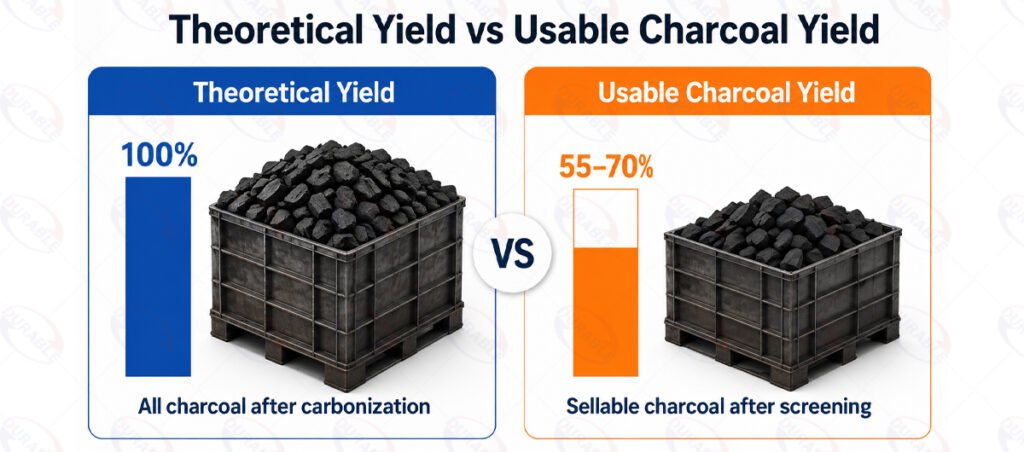
The answer is usable charcoal yield.
In real production, charcoal loss often comes from uneven carbonization, over-burning, under-carbonization, breakage, repeated handling, and rejected products.
A continuous system can reduce these losses by keeping material flow and heating conditions more stable.
| Yield Type | What It Means |
|---|---|
| Theoretical Charcoal Yield | Maximum charcoal possible from biomass under ideal conditions |
| Usable Charcoal Yield | Saleable charcoal after production loss and quality control |
| Finished Product Yield | Charcoal that meets customer requirements and can be shipped |
This distinction is very important.
The furnace does not create charcoal from nothing. Instead, it helps producers keep more of the charcoal that can actually be sold.
Where Does the Extra Profit Come From?
The extra profit usually comes from improving the full production process, not from one single machine claim.
A Square Continuous Biomass Carbonization Furnace supports continuous feeding, continuous carbonization, and continuous discharge. This helps reduce the stop-start cycle common in batch production.
As a result, the plant can often produce more stable output during daily operation.
Higher Equipment Utilization
Batch carbonization spends a lot of time waiting.
Operators load material, heat the furnace, complete carbonization, cool the furnace, unload charcoal, and prepare the next batch.
During cooling and unloading, production stops.
In contrast, a square continuous furnace keeps material moving through the system. This increases useful working time and helps improve daily production planning.
Less Material Waste
Every handling step can create loss.
Repeated loading, unloading, storage, and movement may increase breakage, contamination, or powder loss.
Continuous production reduces unnecessary handling. As a result, more carbonized material can remain suitable for sale or downstream processing.
More Consistent Product Quality
Buyers of BBQ charcoal, shisha charcoal, biochar, and industrial carbon care about consistency.
Stable carbonization can improve charcoal color, fixed carbon stability, burning performance, grading, and powder quality.
Better consistency usually leads to fewer rejected shipments and stronger repeat orders.
Better Selling Prices
Charcoal quality affects market value.
Products with stable burning performance, lower variation, and better appearance may compete in higher-value markets.
In many projects, the profit improvement comes not only from producing more material, but from producing material that customers are willing to buy again.
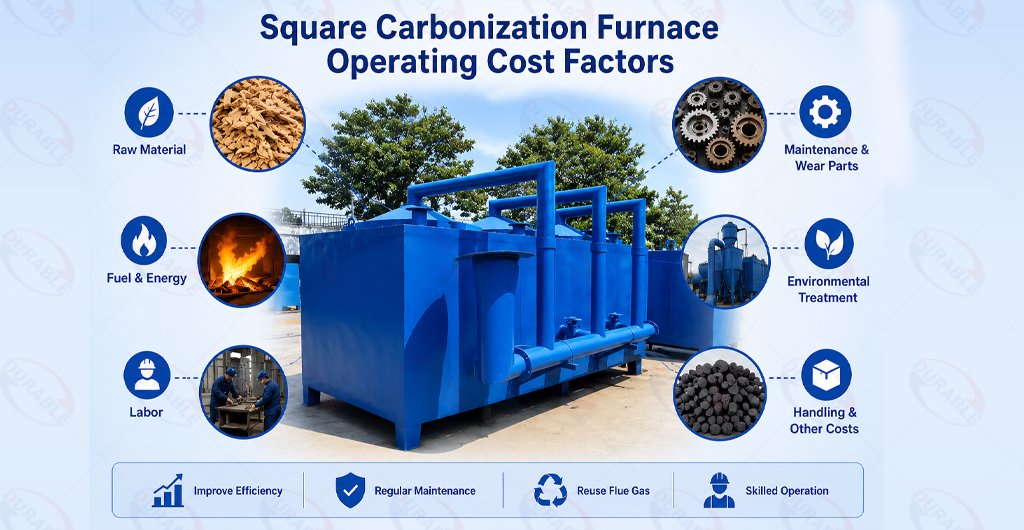
How Continuous Operation Reduces Costs
Lower operating cost is just as important as higher output.
A square continuous carbonization system can reduce costs through labor savings, better heat use, less downtime, and smoother production management.
Reduced Manual Labor
Traditional batch production requires repeated loading and unloading.
A square continuous furnace can connect with feeding equipment, discharge systems, cooling devices, and control panels. This reduces heavy manual work and allows operators to focus on monitoring the process.
For larger plants, this can lower labor cost per ton.
Better Energy Utilization
During carbonization, biomass releases combustible gases.
A properly designed continuous system can collect and reuse part of these gases for heating. This can reduce external fuel use after stable operation.
However, the actual fuel-saving effect depends on raw material moisture, gas content, furnace design, and operating conditions.
It is safer to say the system can reduce external fuel demand, not eliminate fuel cost in every project.
Less Downtime
Stopping production is expensive.
Every interruption reduces output while labor and energy costs continue.
Because a square continuous furnace is designed for stable operation, it can reduce unnecessary downtime when the material preparation and maintenance system are properly managed.
Why Stable Charcoal Quality Improves Profit
For many producers, quality consistency is the real profit driver.
Export buyers and distributors do not only care about price. They also need stable supply, predictable burning performance, clean appearance, and consistent product grades.
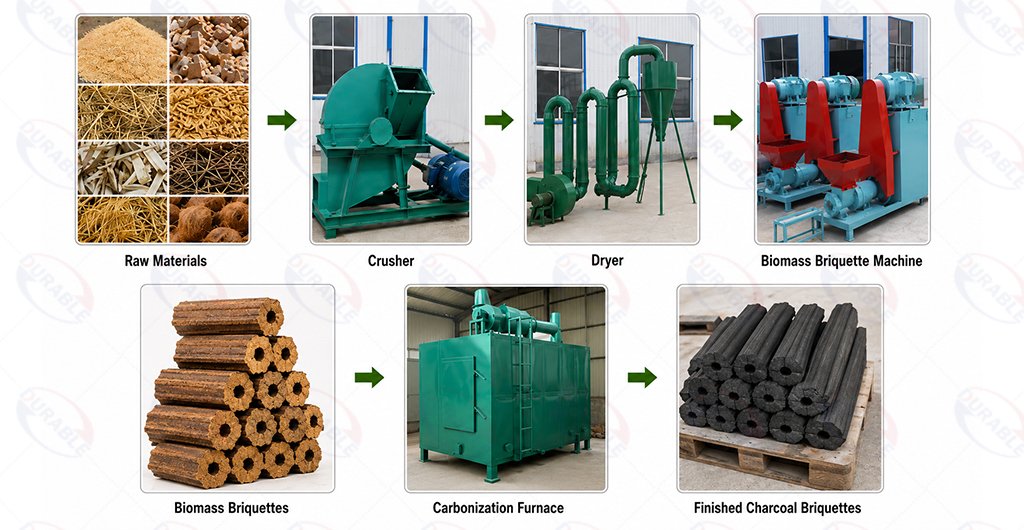
Unstable charcoal quality can lead to complaints, price reductions, or lost repeat orders.
A Square Continuous Biomass Carbonization Furnace helps create more stable production conditions. When raw material size and moisture are controlled, the furnace can reduce quality variation between production runs.
This can improve:
- Charcoal color consistency
- Fixed carbon stability
- Burning time
- Mechanical strength
- Powder quality after crushing
- Product grading
- Packaging consistency
For BBQ charcoal production, consistent carbonization supports better burning performance and appearance.
For shisha charcoal production, stable carbonized material helps improve powder preparation, pressing strength, and finished cube quality.
After carbonization, many factories use a Charcoal Crusher to prepare charcoal powder before mixing and briquette forming. More uniform carbonized material usually makes this step easier to control.
In some projects, producers first compress loose biomass with a Biomass Briquette Machine before carbonization. This can improve material density and support more stable carbonization results.
Which Raw Materials Work Best?
A Square Continuous Biomass Carbonization Furnace works best with prepared biomass materials.
The best materials usually have stable size, controlled moisture, and low contamination.
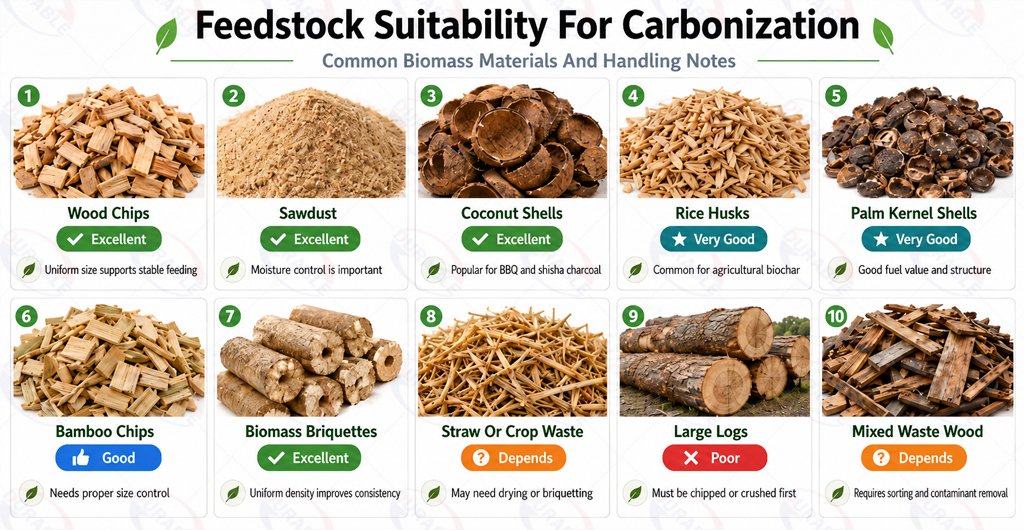
| Raw Material | Suitability | Preparation Notes |
|---|---|---|
| Wood Chips | Excellent | Uniform size supports stable feeding |
| Sawdust | Excellent | Moisture control is important |
| Coconut Shells | Excellent | Popular for BBQ and shisha charcoal |
| Rice Husks | Very Good | Common for agricultural biochar |
| Palm Kernel Shells | Very Good | Good fuel value and structure |
| Bamboo Chips | Good | Needs proper size control |
| Biomass Briquettes | Excellent | Uniform density improves consistency |
| Straw or Crop Waste | Depends | May need drying or briquetting |
| Large Logs | Poor | Must be chipped or crushed first |
| Mixed Waste Wood | Depends | Requires sorting and contaminant removal |
Large wood usually needs size reduction before carbonization. For this step, a Disc Wood Chipper can help prepare more uniform wood chips for feeding.
Loose materials such as sawdust, rice husks, and agricultural residues may need drying or briquetting depending on the final product.
In addition, contaminants such as stones, metal, plastic, or sand should be removed before feeding. These materials can affect charcoal quality and increase equipment wear.
Why Material Preparation Decides Real Output
Many buyers focus too much on the furnace and too little on the raw material.
This is a serious mistake.
Even a well-designed square continuous furnace cannot perform well if the material is too large, too wet, too dirty, or too inconsistent.
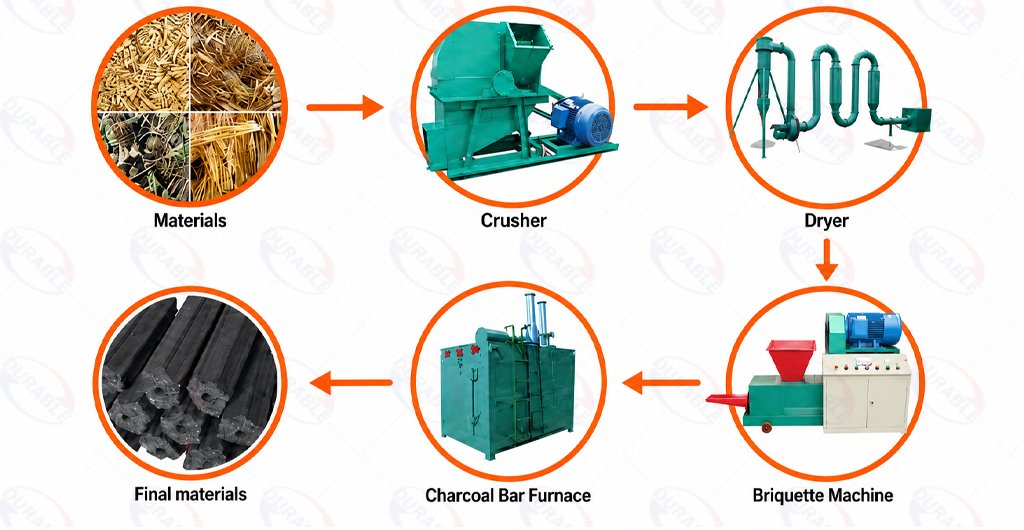
Material preparation affects:
- Feeding stability
- Carbonization temperature
- Residence time
- Gas generation
- Energy use
- Charcoal quality
- Discharge smoothness
- Maintenance frequency
For example, oversized wood may carbonize unevenly because heat cannot penetrate the material consistently.
Meanwhile, high-moisture biomass consumes more heat and may reduce carbonization efficiency.
Powdery or lightweight material may require a suitable feeding design to prevent blockage or unstable flow.
Depending on the raw material, preparation equipment may include chipping, crushing, drying, screening, briquetting, and conveying.
For some biomass materials, a Hammer Mill Crusher may be used before carbonization or downstream processing to improve size control.
The furnace is the core equipment, but the full line decides the final production result.
When Does This Furnace Deliver Better ROI?
A Square Continuous Biomass Carbonization Furnace does not deliver the same return for every factory.
ROI depends on production scale, working hours, labor cost, energy cost, raw material supply, and product market.
Generally, the more stable the production schedule, the stronger the advantage of continuous operation.
| Business Type | ROI Potential | Recommendation |
|---|---|---|
| Small startup | Moderate | Batch furnace may be enough at first |
| Seasonal producer | Moderate | Continuous equipment may be underused |
| Regional supplier | Good | Compare long-term operating cost |
| Export charcoal factory | High | Continuous production can support quality and supply |
| Industrial biomass fuel plant | High | Continuous output supports larger production |
Is Upgrading Always Worth It?
No. Upgrading is not automatically the best decision for every biomass producer.
A batch furnace may still be more practical when production is small, seasonal, or experimental.
It can also be suitable when raw material supply is unstable or the investment budget is limited.
However, a square continuous furnace becomes more attractive when the plant operates every day, customers require stable quality, and production capacity is expected to grow.
For export-oriented charcoal plants, the value of stable quality and predictable supply can be especially important.
The right question is not:
Which furnace is cheaper?
A better question is:
Which production model matches my business now and supports future growth?
That question usually leads to a better investment decision.
Common Investment Mistakes
Factories sometimes expect the furnace alone to solve every production problem.
In reality, a successful carbonization project depends on the complete production system.
Upgrading Only the Furnace
Installing a square continuous furnace without improving upstream feeding, drying, or material preparation may create a new bottleneck.
The furnace may be ready for continuous operation, but the rest of the line may not support it.
Ignoring Raw Material Moisture
High moisture reduces carbonization efficiency and increases energy demand.
Before choosing a system, buyers should test the average moisture of their raw material.
Comparing Only Theoretical Capacity
Theoretical capacity does not always equal real daily output.
Actual performance depends on material size, moisture, density, feeding stability, cooling, maintenance, and operator skill.
Forgetting Environmental and Safety Systems
Continuous carbonization involves high temperature and combustible gas.
Gas recovery, smoke treatment, dust collection, sealing, pressure control, and cooling systems should be considered from the beginning.
Underestimating Downstream Capacity
More carbonized material also requires enough cooling, crushing, storage, pressing, drying, and packaging capacity.
Otherwise, downstream bottlenecks may limit the value of the furnace.
How to Choose the Right System
The best system is not always the largest one.
It is the one that matches your raw material, target output, working hours, factory layout, and final charcoal product.
Before requesting a quotation, prepare these details:
- Raw material type
- Average moisture content
- Maximum material size
- Required hourly or daily output
- Final charcoal product
- Working hours per day
- Available factory space
- Fuel and electricity conditions
- Environmental requirements
- Downstream process
- Budget range
- Expansion plan
If you are still comparing different carbonization equipment types, DURABLE’s Charcoal Making Machine page can help you review broader carbonization solutions.
For projects using small loose biomass, a Rotary Drum Biomass Carbonization Furnace may also be compared with a square continuous furnace.
The final selection should be based on raw material behavior, production goal, site layout, and downstream processing needs.
How to Choose a Reliable Supplier
A Square Continuous Biomass Carbonization Furnace is not a simple standalone machine.
It is a thermal processing system involving feeding, heating, sealing, gas recovery, discharge, cooling, dust treatment, and safety control.
Before choosing a supplier, check these points:
| Supplier Factor | What You Should Check | Why It Matters |
|---|---|---|
| Manufacturing Ability | Workshop, welding, assembly quality | Affects durability and stable operation |
| Heat-Resistant Materials | Steel quality and insulation design | Helps protect the furnace under high temperature |
| Process Design | Feeding, carbonization, cooling, gas recycling | Ensures the full line works smoothly |
| Safety System | Sealing, pressure control, emergency design | Reduces operating risk |
| Environmental Support | Smoke, dust, and gas treatment options | Helps meet project requirements |
| Spare Parts Support | Seals, bearings, drives, control parts | Reduces downtime |
| Export Experience | Packing, documents, installation support | Reduces international purchase risk |
| Customization Ability | Layout, conveyors, feeding, discharge | Helps match your factory site |
A good supplier should first understand your project.
Then, they should recommend a suitable furnace configuration and complete production line layout.
For B2B buyers, engineering support often matters more than a small price difference.
Buyer Self-Check List
Before contacting a supplier, prepare your basic project information.
This helps engineers recommend the right system instead of guessing your needs.
- What biomass material will you process?
- Is the material chipped, powdered, shelled, briquetted, or mixed?
- What is the average moisture content?
- What is the maximum material size?
- Is the material clean or mixed with impurities?
- What hourly or daily charcoal output do you need?
- What final product will you make?
- Do you need chipping, crushing, drying, screening, or briquetting?
- Do you need downstream crushing, mixing, pressing, drying, or packaging?
- What fuel or energy source is available for startup?
- What environmental requirements must the project meet?
- How many hours per day will the plant operate?
- Which country will the equipment be installed in?
- What factory space is available?
- Do you have a future expansion plan?
Frequently Asked Questions
Does a Square Continuous Biomass Carbonization Furnace increase charcoal yield?
It does not change the theoretical carbon yield of biomass. However, it can improve usable charcoal yield by reducing uneven carbonization, handling loss, rejected products, and production interruptions.
Which raw materials are suitable for this furnace?
Prepared biomass materials such as wood chips, sawdust, coconut shells, rice husks, palm kernel shells, bamboo chips, agricultural residues, and biomass briquettes are commonly used. Large logs should be chipped or crushed first.
Can it reduce fuel cost?
Yes, it can reduce external fuel demand after stable operation if the gas recovery system is properly designed and the raw material is suitable. The actual saving depends on moisture, volatile content, furnace design, and operating conditions.
Is it suitable for small charcoal workshops?
Not always. Small or seasonal producers may still prefer a batch furnace because of lower investment and simpler operation. A square continuous furnace is usually better for daily commercial production.
What information should I provide for a quotation?
You should provide raw material type, moisture, feed size, required output, final charcoal product, working hours, project country, factory space, environmental requirements, and downstream equipment needs.
Final Thoughts
A Square Continuous Biomass Carbonization Furnace improves profit mainly by improving usable charcoal yield, production stability, energy use, labor efficiency, and finished product consistency.
It does not magically increase the theoretical yield of biomass.
Instead, it helps reduce real production losses and supports more predictable commercial output.
For small or seasonal producers, batch carbonization may still be practical.
For medium and large biomass plants with steady raw material supply, daily production needs, and quality-focused markets, a square continuous furnace can offer stronger long-term value.
Before buying, do not focus only on furnace price.
A successful project should match raw material preparation, carbonization, cooling, gas recovery, downstream processing, factory layout, safety design, and environmental requirements.
When the full system is properly designed, the Square Continuous Biomass Carbonization Furnace can become the core equipment for a more stable and profitable biomass charcoal production line.
About DURABLE
DURABLE supplies biomass carbonization equipment and complete biomass processing solutions for charcoal producers, biomass fuel manufacturers, agricultural processing companies, and industrial energy projects.
Our engineering team evaluates your raw materials, production target, factory layout, downstream process, environmental requirements, and investment budget before proposing a suitable solution.
Whether you are upgrading from batch carbonization or planning a new square continuous biomass carbonization line, DURABLE can help you design a practical system for stable production, lower operating cost, and long-term business growth.
To review more equipment categories, you can visit our Products page. To learn more about our manufacturing and project support, visit About DURABLE.
For a detailed quotation, please send your raw material type, average moisture, maximum feed size, required charcoal output, final product use, project country, and environmental requirements.
DURABLE will help you design a suitable Square Continuous Biomass Carbonization Furnace solution based on your real production needs.