 Durable Machinery
Get Price
Is a Concrete Block Business Still Profitable in 2026?
A concrete block business can still be profitable in 2026, but profit is not guaranteed by construction demand alone.
Successful factories usually combine affordable materials, realistic capacity, low rejection rates, short delivery distance, and products that match local building needs.
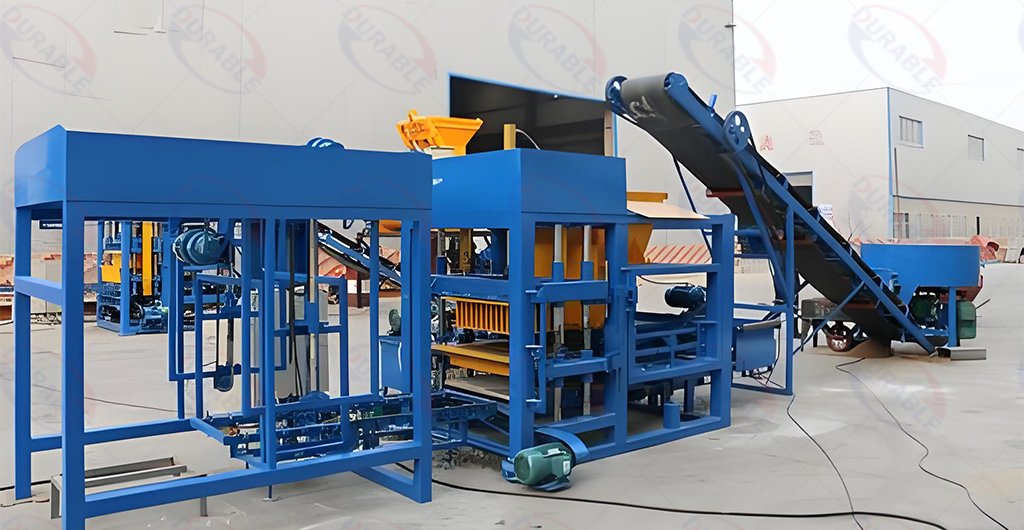
At the same time, competition is increasing. Cement, electricity, labor, pallets, transport, molds, maintenance, and curing space all affect the real cost of every saleable block.
This guide explains what determines concrete block business profit, where factories lose money, and how to judge whether a block factory is worth the investment in your market.
What Is the Profit Outlook for Concrete Blocks in 2026?
Concrete blocks remain important building materials for housing, commercial buildings, boundary walls, roads, landscaping, industrial sites, and infrastructure projects.
Their demand comes from several practical advantages.
- Raw materials are available in many markets.
- Production does not require kiln firing.
- Blocks can be made in many shapes and sizes.
- Hollow blocks reduce wall weight.
- Pavers and curbstones support municipal and landscaping projects.
- Production can start small and expand toward automation.
However, demand is not equal everywhere.
One city may have strong housing development and room for another reliable supplier. Another market may already have too many factories competing only on price.
The best opportunities usually appear where construction demand is stable, existing suppliers have delivery delays, product quality is inconsistent, or specialized blocks are difficult to source.
A factory also needs customers within a practical delivery radius. Concrete blocks are heavy, so transport cost can quickly remove profit from distant orders.
Before buying equipment, visit construction sites, building-material dealers, contractors, developers, and existing block factories.
Ask which block sizes sell fastest, which products have quality complaints, how customers pay, and what delivery problems currently exist.
The local market is more important than the global industry trend.
What Actually Determines Concrete Block Business Profit?
Concrete block business profit can be understood with a simple formula:
Saleable block output × average selling price − total production and delivery cost
The important word is saleable.
A machine may form thousands of blocks per shift, but not every block becomes revenue. Products can be rejected because of weak corners, uneven dimensions, low strength, poor curing, rough surfaces, handling damage, or customer complaints.
The main profit factors include:
| Profit Factor | Why It Matters |
|---|---|
| Local Selling Price | Determines revenue per block |
| Cement Cost | Usually one of the largest material expenses |
| Sand and Aggregate Cost | Affects material and transport cost |
| Saleable Output | Rejects consume resources but produce no revenue |
| Labor Efficiency | Influences production cost per block |
| Equipment Utilization | Low usage increases unit cost |
| Delivery Distance | Heavy products are expensive to transport |
| Product Mix | Pavers and curbstones may earn different margins |
| Payment Terms | Slow collection can damage cash flow |
| Maintenance | Downtime reduces production and delivery reliability |
A lower-capacity factory can outperform a larger plant if it produces fewer rejects, sells better-margin products, and serves nearby customers.
In contrast, an automatic factory can struggle if it operates far below capacity or depends on unstable orders.
Profit comes from balancing production with market demand, not from maximizing output at any cost.
How Much Does It Cost to Produce Concrete Blocks?
There is no reliable global cost per block.
Cement, sand, stone powder, fly ash, labor, electricity, transport, rent, taxes, pallets, and molds vary greatly between countries and cities.
A better method is to divide costs into clear categories.
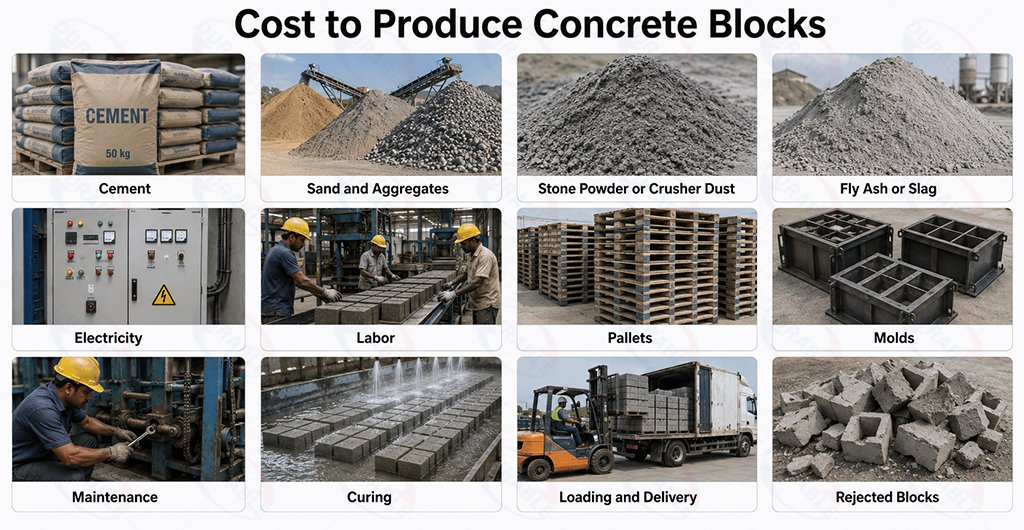
| Cost Category | Typical Impact |
|---|---|
| Cement | Often one of the largest variable costs |
| Sand and Aggregates | Strongly affected by local supply and transport |
| Stone Powder or Crusher Dust | Useful when quality and grading are suitable |
| Fly Ash or Slag | May reduce cost if available and properly tested |
| Electricity | Depends on machine size and operating hours |
| Labor | Strongly affected by automation level |
| Pallets | Frequently underestimated |
| Molds | Important for product flexibility and accuracy |
| Maintenance | Affects uptime and long-term cost |
| Curing | Requires space, water, time, and management |
| Loading and Delivery | Can become a major expense |
| Rejected Blocks | Directly reduce saleable output |
Cement
Cement is usually one of the largest variable costs.
Small changes in cement content can affect annual profit. However, reducing cement without proper testing may lower strength and increase rejection rates.
The goal is not to use the least cement possible. It is to develop a stable mix that meets the required strength at the lowest practical cost.
Sand and Aggregates
Local availability has a major influence on profitability.
When sand, stone powder, or aggregates must travel long distances, the factory may lose its raw-material advantage before production begins.
Labor
Manual factories require more workers for feeding, transferring, stacking, curing, and loading.
Automation can reduce labor per block, but it also increases equipment investment and maintenance requirements. The right level depends on local wages and real order volume.
Pallets and Molds
Pallets are easy to overlook during budgeting.
A factory may need hundreds or thousands, depending on machine type, production speed, and curing method.
Molds also affect long-term cost. Poor-quality molds wear quickly, change block dimensions, and increase rejection rates.
Which Concrete Block Products Generate Better Margins?
Producing more blocks does not always create more profit.
The product mix often matters more than total output. Ordinary hollow blocks may bring stable volume, while pavers, curbstones, interlocking blocks, and decorative products may offer better opportunities in some markets.
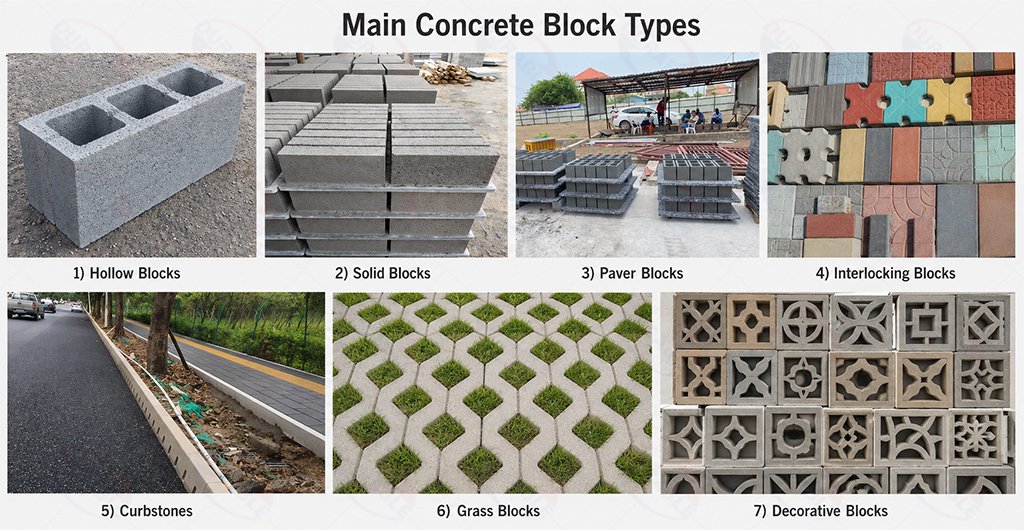
| Product | Market Opportunity | Main Challenge |
|---|---|---|
| Hollow Blocks | Strong wall-building demand | Intense price competition |
| Solid Blocks | Simple production and stable use | Higher material consumption |
| Paver Blocks | Landscaping, parking, and municipal projects | Surface quality and color control |
| Interlocking Blocks | Roads, yards, walkways, and public spaces | Accurate molds required |
| Curbstones | Infrastructure and landscaping | Heavy handling and larger molds |
| Grass Blocks | Specialized landscaping | Smaller market size |
| Decorative Blocks | Better price potential | Requires market development |
Hollow Blocks
Hollow blocks often provide stable volume because they are widely used for walls and partitions.
Even so, many factories compete in this category. Profit depends on raw-material control, fast delivery, consistent strength, and low production cost.
Paver Blocks
Pavers may offer better margins when landscaping, road, parking, residential, and municipal projects are active.
They also require better surface finish, color control, mold precision, and product consistency.
Interlocking Blocks
Interlocking blocks can serve roads, yards, walkways, and public projects.
Their value depends on dimensional accuracy. Poor mold precision can make installation difficult and lead to customer complaints.
A suitable Interlocking Brick Machine may help factories enter this segment, but local demand should be confirmed first.
Curbstones and Specialized Products
Curbstones, grass blocks, decorative blocks, and custom products may reduce dependence on ordinary hollow-block price competition.
However, specialized products also require molds, market education, storage space, and sometimes different handling systems.
Which Concrete Block Factories Are Most Likely to Be Profitable?
The most profitable factories usually have a strong match between materials, market, equipment, and logistics.
| Project Condition | Profit Potential |
|---|---|
| Nearby cement and aggregates | High |
| Stable housing and infrastructure demand | High |
| Automatic production with confirmed orders | High |
| Multiple product types | Medium to high |
| Long transport distance | Low to medium |
| High cement cost and price competition | Low |
| Oversized machine with weak sales | Low |
| Low reject rate and reliable curing | High |
Factories Close to Customers
Concrete blocks are heavy and expensive to move.
A factory with a short delivery radius may keep more profit than a distant competitor selling at the same price.
Factories With Stable Material Supply
Unexpected changes in cement, sand, aggregate grading, or moisture can affect strength and machine performance.
Reliable material sources improve both cost control and block consistency.
Factories With Balanced Production Lines
The forming machine is not the only capacity limit.
Mixing, feeding, pallets, transfer, curing, stacking, loading, and finished-product storage must all support the same daily output.
Factories With Product Flexibility
A machine that supports several profitable molds can help the business respond to different customers.
However, product expansion should follow real demand. Buying many molds without confirmed sales only increases investment.
Manual, Semi-Automatic, or Automatic: Which Setup Makes Sense?
Automation affects investment, labor cost, output stability, and factory management.
A fully automatic line is not automatically more profitable. It becomes valuable when market demand, factory organization, technical support, and curing capacity can use its output.
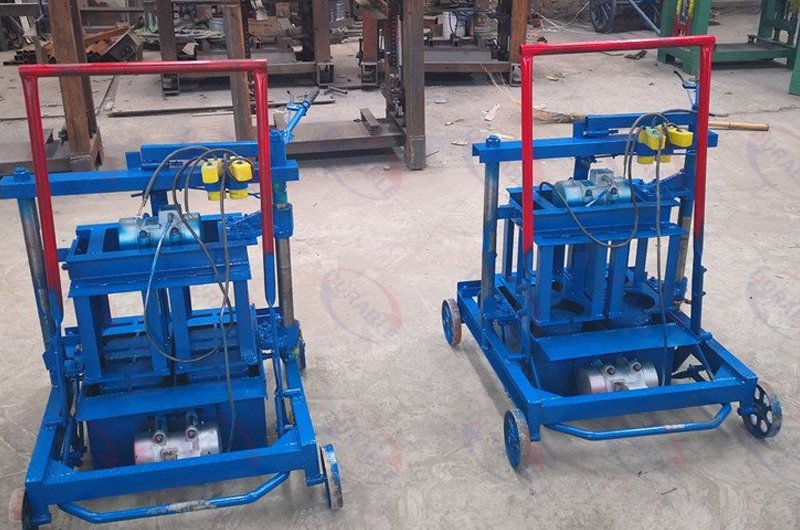
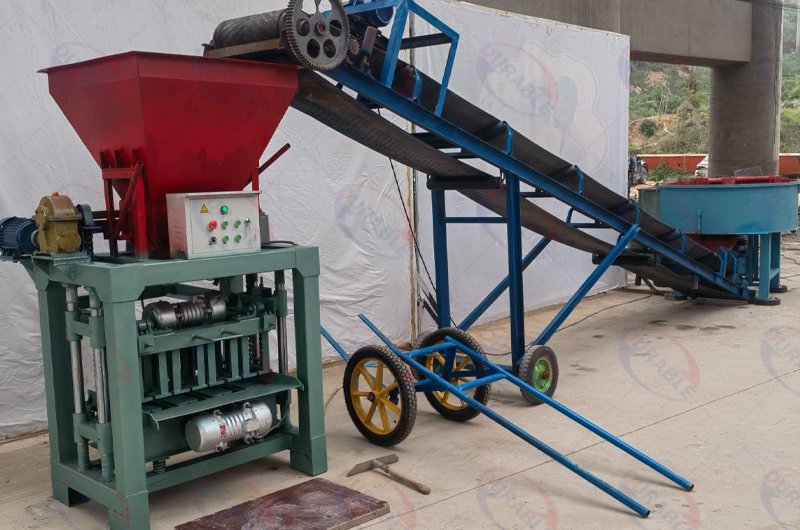
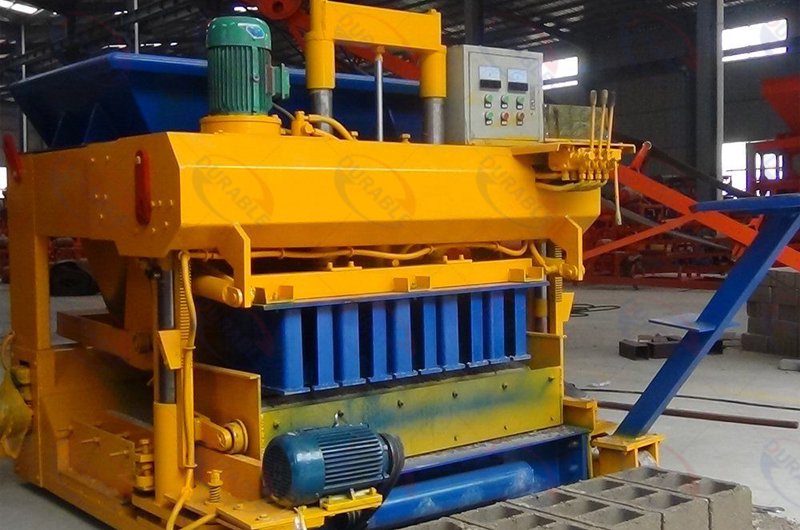
| Production Setup | Suitable Situation | Main Consideration |
|---|---|---|
| Manual or Compact Machine | Small market, startup, test production | Lower investment, higher labor dependence |
| Semi-Automatic Machine | Local supplier with moderate demand | Balanced cost and output |
| Automatic Hydraulic Machine | Commercial block factory | Better consistency and lower labor per block |
| Complete Automatic Line | Regional or project supplier | Requires strong demand and full layout planning |
A manual or compact setup may be practical for early market testing. It reduces initial investment but usually requires more labor and closer quality control.
For local suppliers with moderate demand, semi-automatic equipment can offer a practical balance between budget and production.
An automatic Concrete Block Machine can combine stable feeding, vibration, hydraulic pressure, demolding, and transfer. This setup becomes useful when daily orders are more consistent and product quality requirements are higher.
A complete automatic line may include aggregate bins, batching, mixing, conveyors, block forming, pallet transfer, stacking, curing, finished-product handling, and central control.
Larger lines should only be selected when demand, land, raw materials, power, labor, and maintenance can support them.
Where Do Concrete Block Businesses Lose Money?
Many block factories lose profit through operational problems rather than a lack of customers.
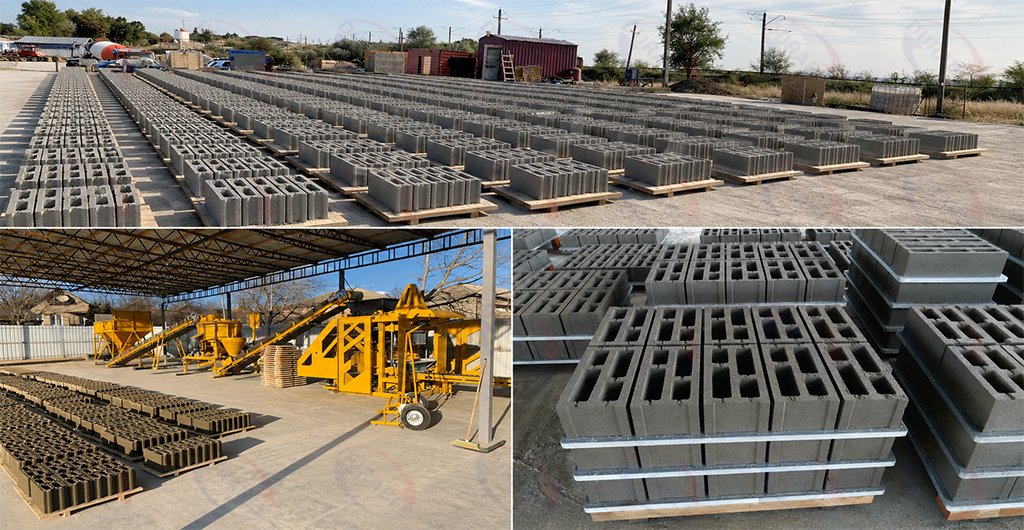
Buying an Oversized Machine
A machine that is much larger than local demand increases initial investment, electricity use, pallet requirements, mold cost, maintenance cost, curing-space demand, and working-capital pressure.
Unused capacity does not generate profit.
Ignoring Cement Consumption
A small increase in cement per block becomes a major annual expense at high production volume.
Factories should monitor cement use per thousand saleable blocks, not only per mixer batch.
Using Theoretical Production Capacity
Brochure output often assumes stable feeding, good materials, trained operators, enough pallets, smooth transfer, and no major interruptions.
Real production may be limited by mixer capacity, conveyor delays, mold changes, pallet shortages, curing space, maintenance, power interruptions, or slow loading.
Producing Too Many Rejects
Rejected blocks consume cement, aggregates, electricity, labor, pallets, curing space, and time.
Common causes include incorrect moisture, uneven feeding, poor vibration, unstable pressure, worn molds, early handling, weak curing, and inconsistent material proportions.
Failing to Plan Curing
A fast block machine can create problems if the factory does not have enough curing space.
Fresh blocks moved too early may crack, deform, or lose corners. Poor moisture control can also reduce final strength.
Delivering Too Far
A profitable factory price may become uncompetitive after freight is added.
Calculate delivery cost by route, vehicle capacity, road condition, and unloading method before accepting distant orders.
Competing Only on Price
Factories that sell only the cheapest ordinary block usually have little protection against new competitors.
Better dimensions, reliable strength, fast delivery, customized sizes, pavers, curbstones, or contract supply may create stronger differentiation.
Maintenance Points That Protect Daily Profit
A concrete block factory handles abrasive sand, aggregate dust, cement, vibration, wet concrete mix, pallets, molds, and hydraulic systems.
Without preventive maintenance, small problems can become expensive downtime.
Important maintenance points include:
- Clean wet concrete from mold cavities after production.
- Inspect tamper heads, mold liners, and wear surfaces regularly.
- Check hydraulic oil level, filtration, hoses, seals, and pressure stability.
- Lubricate guide columns, sliding parts, bearings, and moving joints.
- Inspect vibration motors, bolts, sensors, and electrical connections.
- Check pallets for bending, cracking, or uneven surfaces.
- Keep conveyors, mixers, and transfer points clean.
- Train operators to report abnormal noise, slow movement, oil leaks, or unstable block quality.
Maintenance should not be treated only as repair work.
It protects block consistency, reduces downtime, extends machine life, and helps the factory maintain delivery reliability.
How to Choose a Reliable Concrete Block Machine Supplier
Setting up a profitable block factory requires more than buying a single machine.
A reliable supplier should help match raw materials, product type, capacity, molds, automation, curing, layout, and budget.
| Supplier Factor | What You Should Check | Why It Matters |
|---|---|---|
| Machine Structure | Frame strength, welding, and vibration resistance | Supports long-term stability |
| Hydraulic System | Pumps, valves, seals, cylinders, and cooling | Affects pressure stability |
| Mold Capability | Mold material, accuracy, wear resistance, and product range | Affects product quality |
| Line Integration | Batching, mixing, conveying, forming, transfer, and stacking | Reduces bottlenecks |
| Control System | PLC functions, settings, alarms, and operator interface | Helps repeat production cycles |
| Spare Parts | Molds, seals, valves, sensors, bearings, and wear parts | Reduces downtime |
| Export Support | Packing, shipping, voltage, documentation, and installation guidance | Reduces international purchase risk |
| Project Experience | Real videos, layout examples, and technical communication | Improves selection accuracy |
A good supplier should ask about your target products, raw materials, daily output, local voltage, factory land, curing method, labor conditions, and budget before recommending a configuration.
For broader equipment comparison, DURABLE’s Brick Making Machine range can help buyers evaluate hydraulic, automatic, mobile, and product-specific equipment before choosing a final direction.
Is a Concrete Block Factory Worth It in Your Market?
A concrete block factory may be worth the investment when most of the following conditions are present:
- Local construction demand is stable.
- Existing suppliers have quality or delivery problems.
- Cement and aggregates are available at workable prices.
- Customers are located nearby.
- Contractors or dealers can provide repeat orders.
- The factory can produce several marketable block types.
- Enough land is available for production and curing.
- Local power can support the planned equipment.
- Environmental and business approvals are achievable.
- Working capital is sufficient for materials and credit sales.
The project requires more caution when the market already has too many suppliers, cement prices are unstable, customers require long credit terms, or delivery distances are large.
Risk also increases when production depends on one temporary project, available land is too small, spare parts are difficult to obtain, or the proposed machine is larger than realistic demand.
A useful feasibility study should test at least three scenarios:
- Expected production, cost, and sales
- Lower sales and more downtime
- Higher cement, labor, and delivery costs
A business that only makes money under the most optimistic assumptions is not ready for investment.
Buyer Project Self-Check List
Before investing, answer these questions honestly:
- How many blocks does the local market buy each month?
- Which products have the least competition?
- What is the delivered selling price?
- What are current cement and aggregate prices?
- How many saleable blocks can the factory realistically produce?
- What rejection rate should be included?
- How much curing space is available?
- How far are the main customers?
- How much credit will customers require?
- What happens if sales are lower than expected?
- Can the factory add pavers, curbstones, or other products later?
- Is technical support available locally or remotely?
- What voltage and power conditions are available?
- What budget is available for machine, molds, pallets, installation, and working capital?
If several answers remain unknown, complete the market study before purchasing equipment.
Frequently Asked Questions
Is a concrete block business profitable in 2026?
Yes, it can be profitable when local demand, material costs, product quality, delivery distance, equipment utilization, and payment collection are properly controlled.
What is the biggest cost in concrete block manufacturing?
Cement is often one of the largest material costs. Aggregates, labor, electricity, pallets, molds, maintenance, curing, and delivery also have a major impact.
Which concrete blocks are most profitable?
The answer depends on the local market. Pavers, curbstones, interlocking blocks, and decorative products may offer better margins than ordinary blocks, but they require suitable demand and molds.
How much production capacity should a new factory choose?
Choose capacity based on realistic daily sales, curing space, raw-material supply, working hours, available pallets, and future growth. Avoid buying a machine far larger than confirmed demand.
What information is needed before requesting a quotation?
Provide target block sizes, daily capacity, raw materials, voltage, automation level, factory space, curing method, mold requirements, project country, and budget.
Final Thoughts
A concrete block business can still be profitable in 2026, but success depends on local conditions.
Demand matters, but it is only one part of the calculation. Material costs, cement use, reject rate, delivery distance, curing space, product mix, equipment utilization, and cash flow all affect the final result.
Small factories should avoid oversized machines before sales are confirmed. A compact or semi-automatic setup may be safer during market testing.
Once daily demand becomes stable, automatic equipment can help improve labor efficiency and product consistency. Better feeding, vibration, hydraulic pressure, and mold accuracy can support stronger results when the whole process is well managed.
For larger projects, the complete production line matters more than the forming machine alone. Batching, mixing, pallet handling, curing, stacking, storage, maintenance, and delivery must all support the selected capacity.
The best concrete block factory is not always the biggest one. It is the factory that produces saleable blocks your market needs at a cost your business can sustain.
About DURABLE
DURABLE supplies concrete block machines, hydraulic brick machines, automatic production lines, and molds for hollow blocks, solid blocks, pavers, curbstones, interlocking bricks, and related building materials.
Our team evaluates local products, raw materials, realistic output, automation requirements, curing conditions, factory space, and investment budget before recommending equipment.
A profitable block factory is not built around machine capacity alone. Market demand, saleable output, material control, curing, delivery, maintenance, and cash flow must work together.
Please contact DURABLE with your target block samples, required output, raw materials, voltage, factory conditions, and project country to receive a practical concrete block production recommendation.