 Durable Machinery
Get Price
Can Crusher Dust Replace Sand? 7 Tests for Strong Blocks
In many markets, natural river sand costs are rising, and sand extraction is becoming more restricted. As a result, more concrete block producers are testing local crusher dust, quarry dust, and stone powder as alternative fine aggregates.
Crusher dust can replace part of the natural sand used in concrete blocks. In some carefully designed mixes, it may also replace all fine aggregate.
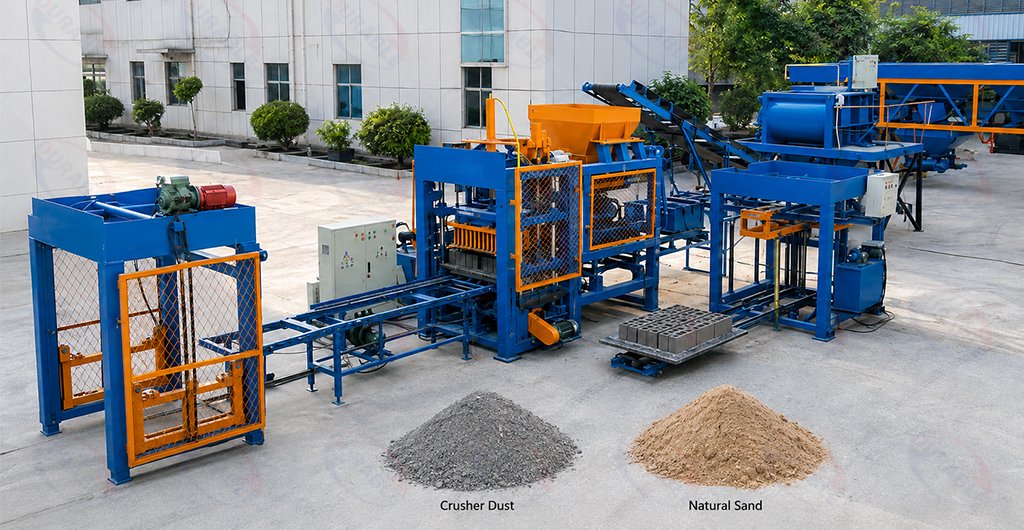
However, full replacement is not automatically safe, economical, or suitable for every block factory.
The result depends on the source rock, particle-size distribution, clay content, ultrafine content, moisture, particle shape, cement dosage, compaction, curing method, and required block performance.
A practical factory should first test the material, prepare trial mixes, produce sample blocks under real machine conditions, and compare strength, water absorption, appearance, production speed, reject rate, and cost.
This guide explains when crusher dust can replace sand, which 7 tests should be completed first, how it affects dry concrete block mixes, and what machine factors buyers should consider.
What Is Crusher Dust?
Crusher dust is the fine material produced during rock crushing and screening.
A typical aggregate process separates crushed rock into coarse aggregates, graded stone, manufactured sand, and finer particles.
Rock Crushing
↓
Screening and Classification
↓
Coarse Aggregate
+
Fine Crushed Material
+
Crusher Dust
The exact meaning of “crusher dust” varies between suppliers.
At one quarry, it may describe a graded 0–5 mm crushed product. At another, it may refer mainly to very fine material collected below the final screen.
Dust collected from a bag filter can be much finer than material taken from a crusher discharge pile.
This distinction matters because concrete blocks require balanced particle-size distribution.
Crusher dust performance can change according to source rock, crusher type, screen opening, clay contamination, washing, air classification, dust collection method, outdoor storage, and moisture variation.
Granite, basalt, limestone, and other rocks can produce fine materials with different density, absorption, mineral composition, and particle shape.
Crusher dust should also be distinguished from manufactured sand.
Manufactured sand is normally produced deliberately from suitable rock under controlled crushing and classification conditions. Untreated crusher dust may not have the same grading consistency.
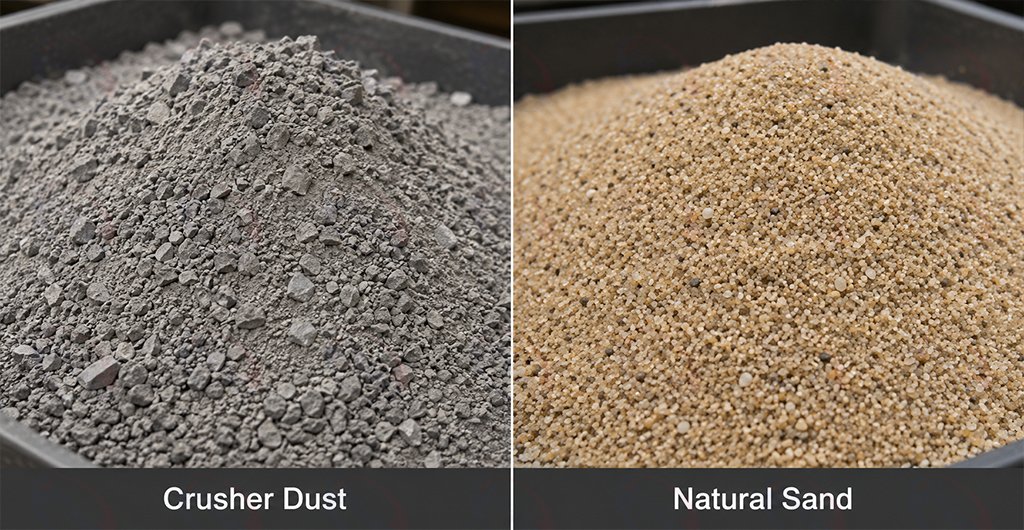
| Material | Practical Description |
|---|---|
| Crusher Dust | Fine by-product from crushing and screening |
| Quarry Dust | Fine material generated in quarry operations |
| Manufactured Sand | Purpose-produced and classified crushed fine aggregate |
| Stone Powder | Very fine mineral fraction, often with high content below 75 μm |
| Natural Sand | Naturally weathered fine aggregate from approved sources |
The material name alone does not determine whether it is suitable.
Test results are more important than the supplier’s description.
Can Crusher Dust Completely Replace Natural Sand?
Complete replacement is technically possible in some concrete block mixes, but it should not be treated as a universal recommendation.
Research and field results vary widely.
Some mixes perform well at high quarry-dust replacement levels. Other cases show reduced strength, higher water absorption, poor mold filling, or unstable block quality as the dust proportion increases.
This variation is not surprising.
Crusher dust is not one standardized material. Two samples from different quarries may have very different fineness, clay content, particle shape, water absorption, mineralogy, surface texture, and contaminants.
Full replacement is more likely to succeed when the material has:
- Stable grading
- Suitable coarse and fine particle balance
- Low clay contamination
- Consistent moisture
- Strong parent rock
- Controlled ultrafine content
- Reliable batching
It becomes more difficult when the dust is almost entirely powder.
Excessive fines increase surface area and water demand. The mix may become sticky, dry, difficult to feed, or hard to compact.
For this reason, the safest commercial answer is:
Crusher dust may partially or completely replace natural sand, but the replacement level must be proven for the actual material, machine, product, and local performance standard.
A mix that works for ordinary hollow blocks may not be suitable for high-strength pavers or architectural products.
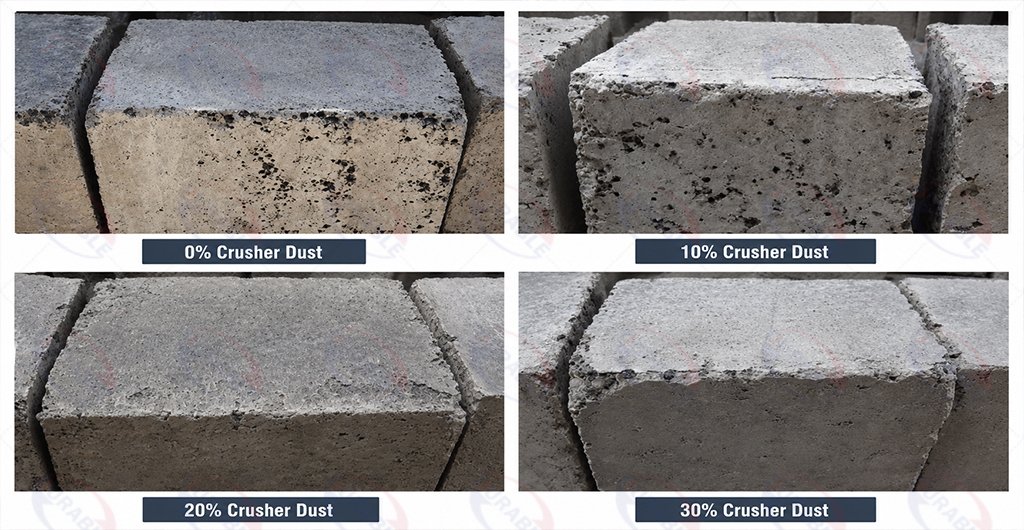
Recommended Replacement Ratios for Factory Trials
A factory using a new crusher-dust source should begin with controlled trial batches.
Do not replace all sand immediately without testing.
A practical test series may include:
| Trial Mix | Crusher Dust | Natural Sand |
|---|---|---|
| Control Mix | 0% | 100% |
| Trial 1 | 10% | 90% |
| Trial 2 | 20% | 80% |
| Trial 3 | 30% | 70% |
| Trial 4 | 40% | 60% |
| Extended Trial | 50% or more | Below 50% |
The percentages should refer to replacement of the fine-aggregate fraction by mass, unless the mix-design method uses another basis.
For an unknown material source, beginning around 10–30% is a conservative development approach.
This range is not a guaranteed optimum.
Some local materials may perform well at higher replacement levels. Others may show lower strength or poor workability even at moderate replacement.
The trial should continue only while the blocks meet important requirements:
- Compressive strength
- Water absorption
- Density
- Dimensions
- Edge quality
- Surface finish
- Demolding stability
- Production speed
- Reject rate
- Cost per saleable block
A higher replacement percentage is not automatically better just because it uses more waste material.
The correct ratio is the one that gives stable quality and the lowest reliable cost per saleable block.
How Does Crusher Dust Affect Strength, Water Demand, and Workability?
Crusher dust can either improve or reduce block strength.
The result depends mainly on particle packing, water demand, compaction, cement-paste distribution, and curing.
When It May Improve Strength
Well-graded crusher dust can fill spaces between larger aggregate particles.
This may create a denser structure with fewer internal voids, better particle contact, higher block density, and lower permeability.
Angular crushed particles may also interlock more strongly than very smooth natural sand when the mix is compacted correctly.
A stable Hydraulic Brick Making Machine can help compact angular fine particles into a dense block body, but the raw material still needs proper grading and moisture control.
When It May Reduce Strength
If the dust contains too many ultrafines, the total particle surface area increases.
The available cement paste must coat more material. Without proper adjustment, the block may have poor bonding, incomplete compaction, weak corners, higher porosity, variable density, and reduced strength.
High clay content is especially risky because clay can hold water and interfere with the bond between cement paste and aggregate.
Workability in Dry-Cast Block Mixes
Concrete blocks are usually made from a low-slump or dry-cast concrete mix.
The mix must be dry enough to hold its shape immediately after demolding, but moist enough to compact into a dense block.
Crusher dust can change this balance.
A mix that is too dry may show poor mold filling, loose surfaces, crumbling edges, low block weight, visible voids, and longer vibration time.
On the other hand, a mix that is too wet may cause block deformation, collapsed corners, mold sticking, delayed demolding, surface smearing, and higher drying shrinkage.
Water adjustment should be based on measured moisture, not only operator judgment.
Outdoor crusher dust can change significantly after rain, so moisture control is essential for repeatable production.
7 Tests to Complete Before Using Crusher Dust
Material testing should be completed before crusher dust is approved for regular production.
A simple visual check is not enough.
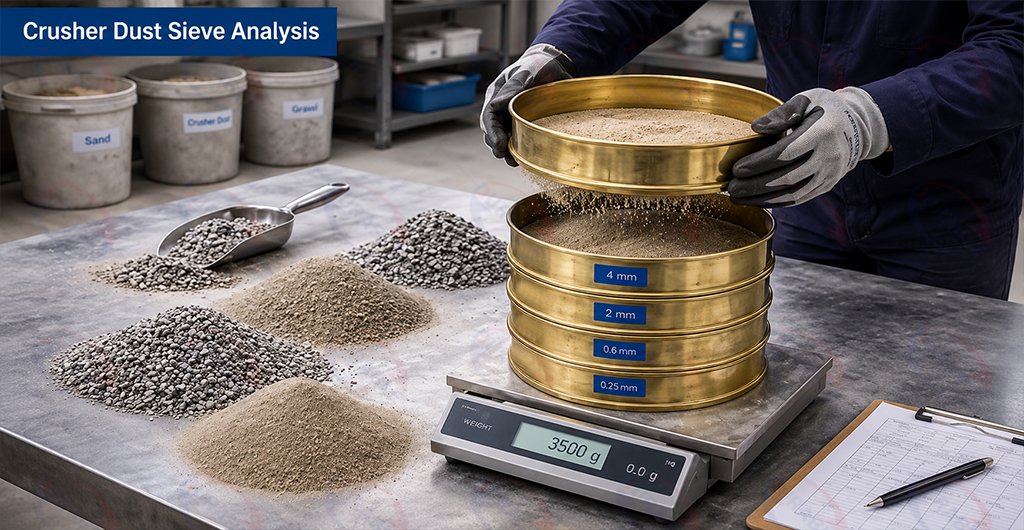
1. Sieve Analysis
Sieve analysis shows how the material is distributed across different particle sizes.
A typical test may include 4.75 mm, 2.36 mm, 1.18 mm, 600 μm, 300 μm, 150 μm, and 75 μm sieves.
The goal is not simply to reduce fine material.
A better objective is to create continuous grading that packs efficiently.
2. Material Finer Than 75 μm
This measurement helps identify the ultrafine fraction.
Particles below 75 μm are not automatically harmful. Clean rock powder may behave differently from clay or soil.
The factory should determine what the fine fraction contains.
3. Clay and Silt Content
High clay or silt content can increase water demand and reduce bond quality.
A crusher-dust pile placed directly on soil may become contaminated during loading and storage.
4. Moisture Content
Moisture should be measured regularly, especially when the material is stored outside.
Batching water must be adjusted to account for water already contained in the aggregate.
5. Specific Gravity and Absorption
These values help the mix designer calculate aggregate proportions and effective water content.
Highly absorptive dust may take water away from the cement paste during mixing.
6. Bulk Density and Batch Consistency
Bulk density is important when the factory uses volume-based loading or loader buckets instead of fully weighed batching.
If bulk density changes between deliveries, the same bucket volume may contain a different mass of crusher dust.
This can affect block weight, cement demand, moisture balance, and compaction stability.
7. Finished-Block Testing
The final decision should be based on manufactured blocks, not only raw-material tests.
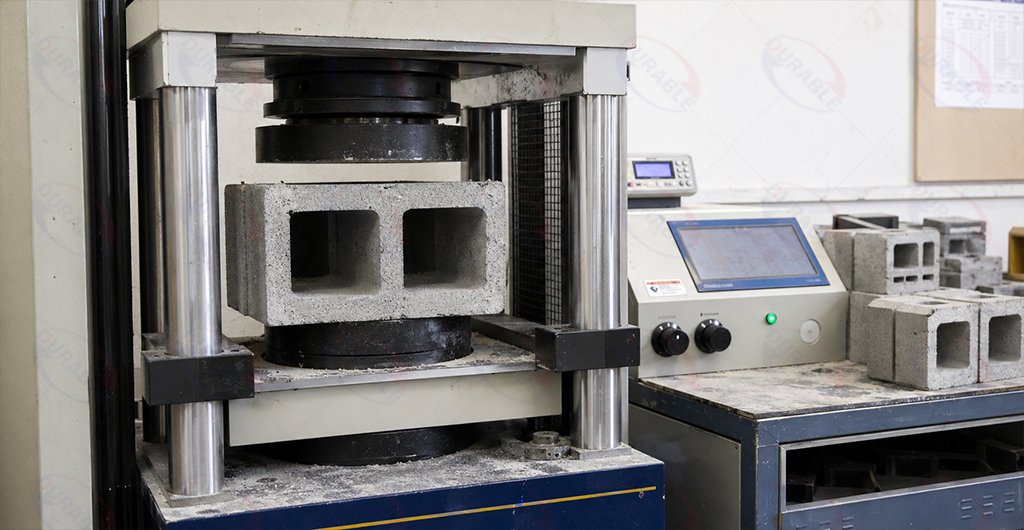
Important block tests include compressive strength, water absorption, density, dimensional tolerance, surface condition, drying shrinkage, and durability when required.
Applicable requirements should be confirmed against the standards and building regulations used in the project market.
How Should the Concrete Block Mix Be Adjusted?
Crusher dust should not normally be introduced through a simple one-to-one mass substitution while every other production parameter remains unchanged.
100 kg Natural Sand Removed
↓
100 kg Crusher Dust Added
↓
No Other Adjustment
This approach may fail because natural sand and crusher dust can have different moisture, bulk density, absorption, grading, surface area, and packing behavior.
The mix may require adjustments to:
- Natural sand content
- Coarse aggregate content
- Crusher-dust percentage
- Cement dosage
- Water dosage
- Admixture dosage
- Mixing time
- Feeding time
- Vibration duration
- Hydraulic pressure
- Curing conditions
The objective is not to maximize one fine material.
A better goal is to combine coarse particles, medium sand, and finer particles into a dense skeleton with enough cement paste to bind them.
If crusher dust lacks medium-sized particles, it may work better as part of a blend with natural sand or manufactured sand.
Moisture correction is also important.
The batching system should calculate total water from added mixing water, sand moisture, crusher-dust moisture, and other wet aggregates.
Without this correction, the water-to-cement ratio can change from one shift to the next.
The best laboratory mix may still require changes when used in a real block machine.
Operators may need to adjust mold filling time, vibration frequency, vibration duration, material distribution, pressing time, and demolding speed.
A suitable evaluation process is:
Material Testing
↓
Laboratory Trial Mixes
↓
Small Machine Trial
↓
Fresh Block Inspection
↓
7-Day Testing
↓
28-Day Strength and Absorption Testing
↓
Cost and Reject Analysis
↓
Controlled Full-Scale Production
At least one control mix using the existing sand should be tested at the same time.
That makes it possible to compare the new mix under identical cement, machine, curing, and testing conditions.
Can Crusher Dust Reduce Block Cost?
Crusher dust may cost less than natural sand, especially when the block factory is located near a quarry or operates its own crushing plant.
However, purchase price alone does not determine the real saving.
The correct calculation is:
Material Saving
− Additional Cement
− Additional Admixture
− Screening or Washing Cost
− Moisture-Control Cost
− Laboratory Testing
− Lower Production Speed
− Higher Reject Cost
= Real Economic Saving
A mix using more crusher dust may look cheaper per tonne but become more expensive per saleable block if it needs more cement, slows mold filling, increases reject rate, or causes inconsistent quality.
The factory should monitor:
| Cost Indicator | Why It Matters |
|---|---|
| Fine aggregate cost per batch | Direct raw-material saving |
| Cement use per 1,000 blocks | May increase with excessive fines |
| Cycle time | Affects daily output |
| Block weight variation | Shows batching or compaction instability |
| Reject rate | Converts low-cost material into waste |
| Mold wear | Angular particles may affect operating cost |
| Testing and processing | Must be included in the calculation |
| Saleable blocks per shift | Best measure of commercial performance |
The cheapest aggregate is not always the lowest-cost block material.
A suitable mix should deliver acceptable quality, repeatable production, and the lowest cost per saleable unit.
When Should a Factory Avoid Using Crusher Dust?
Crusher dust should not be approved for regular production when its quality cannot be controlled.
High-risk situations include:
- Material source changes frequently
- Dust is mixed with soil
- Clay content is high
- Grading is extremely fine
- Ultrafine content varies between deliveries
- Moisture cannot be measured
- Material contains oil or industrial contamination
- Parent rock is weak or weathered
- Block testing is unavailable
- Products require a very smooth architectural surface
- Customer specifications prohibit the material
Special caution is required with dust collected from bag filters.
This material may be much finer than screened crusher fines. It should not automatically be treated as 0–5 mm crushed sand.
Bag-filter dust may be usable in a controlled proportion, but it requires separate storage, accurate dosing, and independent testing.
A factory should stop or reduce crusher-dust use when it observes falling strength, rising water absorption, unstable block weight, more broken corners, mold-feeding problems, longer cycle times, higher rejection, or customer complaints.
Using a waste material is only sustainable when the resulting blocks remain reliable.
What Machine, Maintenance, and Supplier Factors Should Buyers Consider?
Crusher dust often contains sharp, angular particles and fine mineral powder.
For this reason, the machine setup must support uniform mixing, strong compaction, stable demolding, and reliable wear protection.
Machine Selection
Not all block machines handle fine quarry dust equally well.
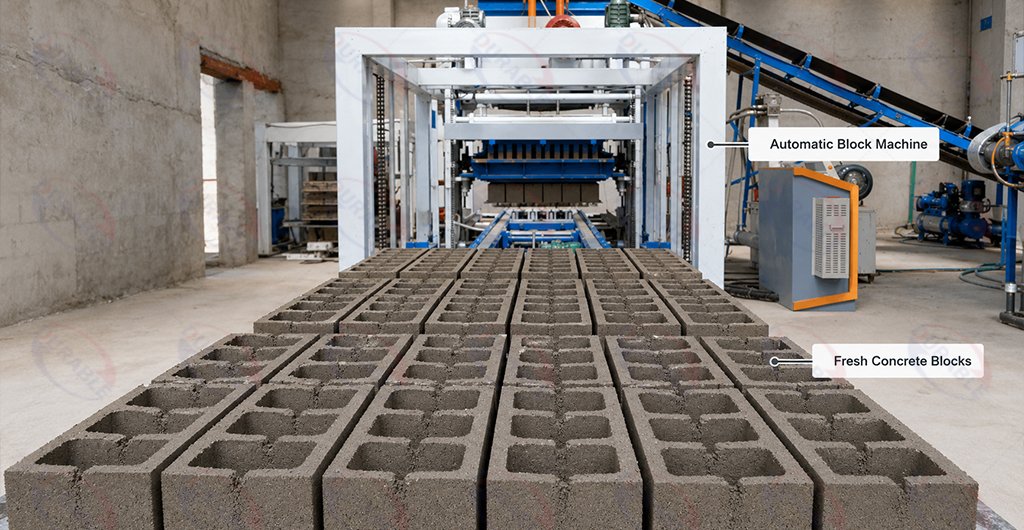
Simple gravity-drop units or low-energy vibration tables may struggle to compact non-plastic stone dust effectively.
For crusher-dust block production, a stable Concrete Block Machine with strong vibration, reliable feeding, and hydraulic compression can improve density consistency.
However, the machine cannot solve poor material quality by itself.
The raw material must still be tested, blended, and controlled.
Mixing System
Fine stone dust can clump during mixing.
A forced-action mixer, such as a twin-shaft or planetary mixer, can help disperse cement paste across fine particles more evenly than a basic gravity mixer.
Even with a good mixer, moisture and batching accuracy remain critical.
Maintenance Points
Crusher dust may increase abrasive wear on parts that contact the mix.
Daily maintenance should include:
- Cleaning wet concrete paste from molds and tamper heads.
- Inspecting guide pillars and applying clean grease.
- Monitoring hydraulic oil filters and fluid cleanliness.
- Checking mixer liners and paddle blades.
- Inspecting conveyor alignment and material spillage.
- Watching mold wear, edge quality, and demolding stability.
Supplier Evaluation
A suitable supplier should understand both block machines and raw material behavior.
| Supplier Factor | What to Check | Why It Matters |
|---|---|---|
| Mold Quality | Heat treatment, steel grade, wear resistance | Helps resist abrasive stone dust |
| Hydraulic System | Pressure stability, cylinders, seals, cooling | Supports compaction consistency |
| Mixing Knowledge | Experience with fine aggregate and dry-cast mixes | Helps improve mix uniformity |
| Layout Support | Batching, mixing, curing, storage, and traffic planning | Reduces production bottlenecks |
| Spare Parts | Molds, wear parts, seals, sensors, liners | Helps reduce downtime risk |
| Export Support | Packing, voltage, documents, installation guidance | Reduces project execution risk |
Before requesting a quotation, prepare:
- Crusher dust source and parent rock type.
- Particle size distribution and moisture condition.
- Clay, silt, and ultrafine content if available.
- Target block types, sizes, and strength requirements.
- Required daily or hourly production capacity.
- Preferred automation level.
- Local voltage and power supply.
- Planned curing method.
- Factory location and delivery country.
- Need for single machines or a complete production line.
Clear project information helps engineers recommend a practical machine and production process instead of guessing from the material name alone.
A broader Brick Making Machine comparison can also help buyers evaluate different production options before choosing a complete line.
Frequently Asked Questions
Can crusher dust completely replace river sand in concrete blocks?
It may be possible with a well-graded, clean, and consistent material. Complete replacement should only follow trial mixes and verification of strength, absorption, dimensions, and production stability.
What crusher-dust percentage should a factory test first?
For a new material source, controlled trials at approximately 10%, 20%, and 30% replacement provide a practical starting point. This is a testing sequence, not a universal optimum.
Does crusher dust make concrete blocks stronger?
It can improve particle packing and strength in some mixes. Excessive fines, clay, high water demand, or poor compaction can reduce strength in other cases.
Is crusher dust the same as manufactured sand?
Not necessarily. Manufactured sand is normally purpose-produced and classified to achieve controlled grading. Crusher dust may be an uncontrolled by-product with a much higher ultrafine content.
Does crusher dust wear block molds faster than natural sand?
It may increase mold wear because angular particles are more abrasive than rounded natural sand. Mold material, heat treatment, maintenance, and mix quality all affect the actual wear rate.
Final Thoughts
Crusher dust can be a useful alternative fine aggregate for concrete block production, but it should not be treated as a simple one-for-one sand substitute.
Partial replacement is often a safer starting point. Full replacement may be possible only when the material has stable grading, low clay content, controlled moisture, and proven block performance.
A successful change requires material testing, trial mixes, machine trials, finished-block testing, cost analysis, and controlled full-scale production.
The best mix is not the one that uses the most crusher dust. It is the mix that delivers stable quality, acceptable strength, repeatable production, and the lowest cost per saleable block.
About DURABLE
DURABLE supplies concrete block production equipment and complete factory solutions for customers using different local raw materials.
Our engineers can help evaluate natural sand, manufactured sand, crusher dust, stone powder, fly ash, slag, recycled aggregates, local cement, and alternative block materials.
A complete DURABLE block production solution can include aggregate batching systems, concrete mixers, belt conveyors, hydraulic block machines, mold systems, pallet handling, stacking equipment, and factory layout planning.
Before recommending a machine configuration or mix-development direction, we consider the target block type, local material grading, required capacity, automation level, curing method, and applicable product standard.
Contact DURABLE with your raw-material test report, target block dimensions, required daily output, and available factory conditions to receive a customized block production proposal.