 Durable Machinery
Get Price
Why Concrete Blocks Crack: Causes and Practical Fixes
A good concrete block machine can improve feeding, vibration, pressing, and demolding.
However, it cannot fully compensate for poor raw materials, incorrect moisture, weak pallets, rough handling, or inadequate curing.
In many factories, cracked concrete blocks are not caused by one machine fault. They often come from several small problems working together.
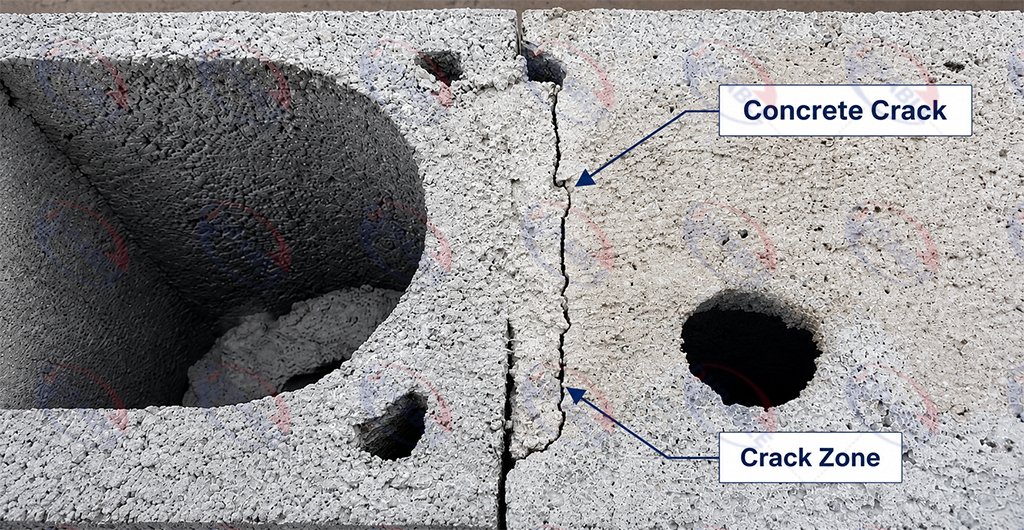
Before increasing pressure or adding more cement, the factory should first identify when the crack appears, where it appears, and whether it follows a repeatable pattern.
This guide explains the main causes of concrete block cracks and shows how to find whether the real problem comes from the mix, the machine, curing, handling, or storage.
First Identify When and Where the Cracks Appear
Not every crack has the same cause.
A crack that appears immediately after demolding usually has a different origin from one that becomes visible after several days of curing.
Cracks concentrated in one mold cavity also require a different investigation from random cracks across several production batches.
Before changing the mix formula or machine settings, record:
- First visible crack time
- Crack location on the block
- Affected quantity or percentage of blocks
- Repeated defects in one mold cavity
- Production shift, operator, and machine record
- Recent material delivery or batching change
- Weather influence, such as hot, dry, cold, windy, or rainy conditions
- Cracking stage, such as before stacking, during curing, after stacking, or during transport
A simple crack-pattern table can narrow the investigation.
| Crack Pattern | Main Areas to Check |
|---|---|
| Immediately after demolding | Moisture, mold filling, compaction, and demolding |
| Only one mold cavity | Mold wear, feeding distribution, pallet support, or local vibration |
| Fine surface lines after several hours | Rapid moisture loss or early drying |
| During curing | Temperature, humidity, shrinkage, or curing cycle |
| Broken corners during stacking | Low early strength or rough handling |
| After outdoor storage | Drying, temperature changes, or weak mix |
| Random defects between batches | Material, moisture, or batching inconsistency |
| During transportation | Packaging, stack stability, and impact |
This timing-based approach prevents factories from blaming the machine before checking the full production process.
For example, if all blocks leave the machine in good condition but crack after several hours in an exposed yard, the first investigation should focus on curing and moisture loss.
If blocks from one mold cavity repeatedly crack while blocks from other cavities remain normal, the factory should inspect that section of the mold, pallet, feeding system, and vibration distribution.
Is the Concrete Mix Too Wet or Too Dry?
Incorrect moisture is one of the most common reasons dry-cast concrete blocks crack.
A concrete block machine normally uses a low-slump or near-zero-slump mix. The material must contain enough moisture to compact and bind together, but it must remain dry enough to retain its shape after demolding.
Even a small moisture change can affect production quality.
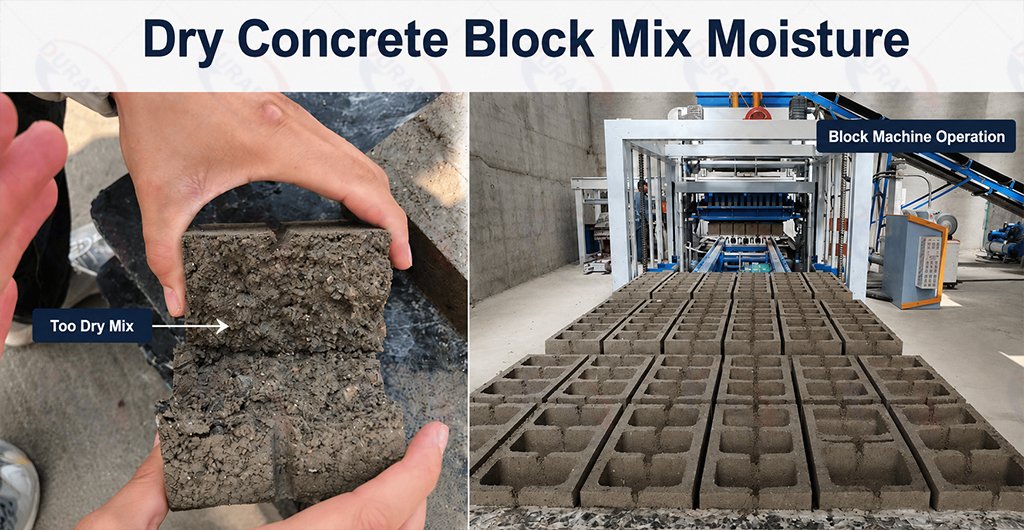
What Happens When the Mix Is Too Dry?
A mix that is too dry may not compact into a dense and continuous structure.
Common symptoms include:
- Loose surfaces
- Crumbling corners
- Vertical cracks after demolding
- Visible internal voids
- Low block weight
- Poor mold filling
- Long vibration time
- Weak early strength
The machine may still produce a block-shaped unit, but the particles may not be bonded or compacted sufficiently.
Adding more vibration does not always solve the problem. If the material lacks enough moisture or fine particles, longer vibration may only increase cycle time and equipment wear.
What Happens When the Mix Is Too Wet?
A mix that is too wet may look easier to feed, but it can create another group of defects.
Common symptoms include:
- Deformed blocks
- Collapsed edges
- Material sticking to the mold
- Surface smearing
- Uneven dimensions
- Higher drying shrinkage
- Cracks appearing during curing
- Slow early-strength development
Too much water increases the amount of moisture that must later leave the block.
As a result, drying shrinkage may increase, and visible cracks may appear during curing or storage.
Can operators judge moisture by hand?
Experienced operators can make a quick field check by compressing the mix in one hand.
The material should hold together as a compact lump without releasing visible free water. It should not behave like wet mortar, but it should also not fall apart immediately like dry loose aggregate.
However, this is only a quick operating check.
It cannot replace:
- Aggregate moisture measurement
- Controlled water dosing
- Batch records
- Trial-mix testing
- Block weight monitoring
Outdoor sand and crusher dust may change moisture after rain, overnight storage, or strong sunlight.
For this reason, the same water setting cannot be used reliably when aggregate moisture keeps changing.
Can Poor Aggregate Grading Cause Block Cracks?
A stable concrete block mix needs a balanced distribution of coarse, medium, fine, and very fine particles.
Smaller particles should fill the spaces between larger particles. This creates a dense aggregate skeleton that can be bound together with a reasonable amount of cement paste.
Poor grading creates excessive voids or excessive surface area.
Too Much Coarse Aggregate
A mix with insufficient fine material may produce:
- Large internal voids
- Rough surfaces
- Weak corners
- Low density
- Poor mold filling
- Cracking during handling
- High water absorption
The block may look open and porous because there are not enough smaller particles to fill the spaces between coarse aggregate grains.
Too Much Fine Material
Excessive fine sand, stone powder, or crusher dust may create:
- Higher water demand
- Greater cement-paste demand
- Sticky or slow feeding
- Increased shrinkage
- Poor compaction
- Strength variation
- Surface cracking
Fine particles are not automatically harmful. A controlled amount may improve packing and surface finish.
The problem begins when the fine fraction becomes excessive, unstable, or contaminated with clay.
Why material variation matters
Even a proven mix can begin cracking when raw materials change.
Common changes include:
- Sand becoming finer
- Crusher dust containing more powder
- Aggregate moisture increasing
- Source rock or quarry supply changing
- Different materials mixed in one storage bay
- Soil contamination from the yard floor
- Loader operators taking material from different parts of the pile
Factories using crusher dust should treat it as an engineered aggregate component, not only as a low-cost replacement for sand.
The factory should regularly monitor:
- Sieve grading
- Material below 75 μm
- Clay and silt contamination
- Moisture
- Bulk density
- Water absorption
When cracks appear soon after changing a sand or crusher-dust supplier, the raw material should be checked before the block-machine settings are changed.
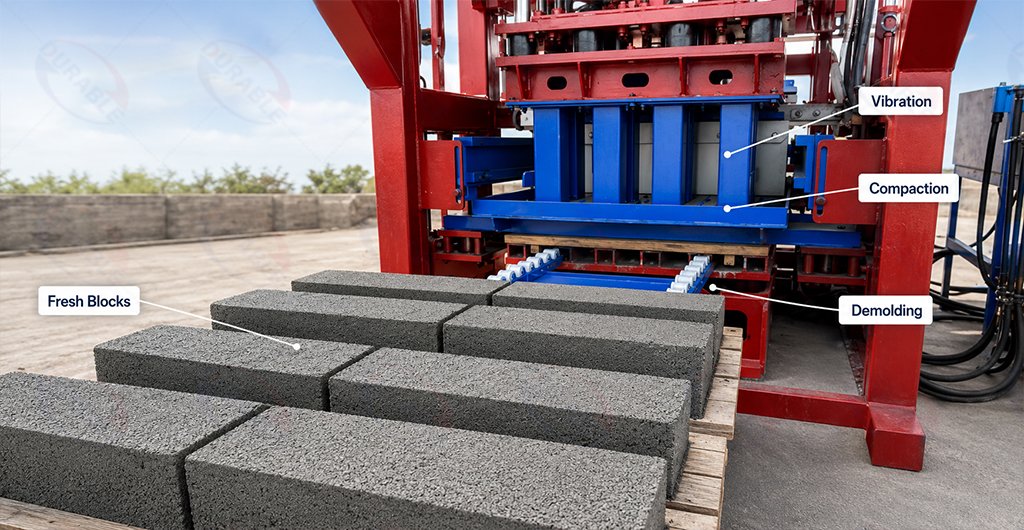
Are Vibration, Compaction, and Handling Settings Incorrect?
A good block machine can still produce defective blocks when its operating settings do not match the actual mix.
Dry-cast block production depends on the relationship between mold filling, material distribution, vibration, pressing, pallet support, demolding, and early handling.
These settings should be adjusted as a system.
Insufficient Compaction
If vibration or pressure is too low, the block may retain excessive internal voids.
Possible results include:
- Low density
- Weak internal webs
- Broken corners
- High water absorption
- Poor compressive strength
- Cracking during stacking
Insufficient compaction may also come from poor mold filling rather than low machine power.
For example, one side of the mold may receive less material because the feeding box is not level, the mix does not flow consistently, or material sticks inside the feed drawer.
Increasing hydraulic pressure will not correct an empty or poorly filled area.
This is especially important when using a hydraulic brick making machine for dense blocks, hollow blocks, or high-pressure products.
Excessive Vibration
Longer vibration is not always better.
Excessive vibration may lead to:
- Aggregate segregation
- Fine particles moving downward
- Uneven top and bottom density
- Longer cycle time
- Increased mold wear
- Faster bearing and vibration-system wear
The ideal setting is the shortest stable cycle that produces uniform mold filling, consistent block weight, good surface quality, and sufficient strength.
Uneven Vibration or Pressing
When cracks repeatedly appear in the same mold cavity, investigate:
- Mold alignment
- Tamper-head alignment
- Vibration-motor synchronization
- Loose fasteners
- Worn guide components
- Uneven pallet support
- Bent pallets
- Material distribution
A local machine problem usually creates a repeatable defect pattern.
In contrast, a mix problem is more likely to affect several cavities or complete batches. Both problems can also occur at the same time.
The factory should monitor unit weight by mold cavity. A repeated weight difference can reveal a feeding or compaction problem before visible cracking becomes severe.
Early demolding and rough movement
A fresh concrete block may look complete after demolding, but it has very limited green strength.
At this stage, it is vulnerable to bending, vibration, impact, sudden acceleration, rough stacking, and uneven pallet support.
Many blocks blamed on the machine are actually damaged after leaving the mold.
Check whether fresh blocks are exposed to:
- Weak or bent production pallets
- Misaligned chains or rollers
- Gaps between conveyors
- Sudden stops
- Fast turns
- Premature stacking
- Rough manual handling
- Uneven transfer points
At the same time, automation speed should not be increased only to raise nominal output.
If more blocks crack during handling, the saleable output may become lower even when the machine cycle looks faster.
For an automatic brick making machine, smooth pallet transfer and stable curing flow are just as important as machine cycle speed.
Is Poor Curing Causing Shrinkage Cracks?
Curing is one of the most underestimated causes of concrete block cracking.
Concrete needs suitable moisture and temperature conditions for cement hydration and strength development.
A strong block machine cannot correct poor curing after the block leaves the production line.
Rapid moisture loss
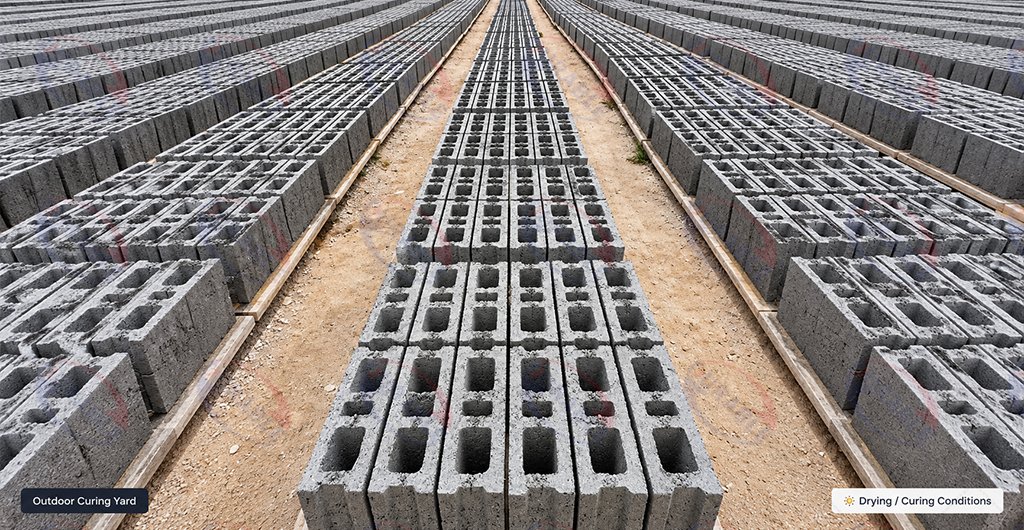
Fresh blocks placed in direct sunlight, dry wind, or low humidity may lose surface moisture too quickly.
The surface begins shrinking while the interior remains wetter. This difference can create fine surface cracks.
High-risk conditions include:
- Hot weather
- Strong wind
- Low humidity
- Direct sunlight
- Dry curing rooms
- Delayed covering
- Inconsistent water spraying
Good curing procedures are intended to prevent rapid early moisture loss.
Uneven curing
Blocks on the outside of a stack may dry faster than blocks in the center.
Similarly, one side of a curing chamber may receive more heat, steam, or airflow than another.
Uneven conditions can create differences in early strength, moisture, shrinkage, color, and surface quality.
Therefore, factories should monitor conditions at several positions instead of checking only one temperature or humidity point.
Too much water followed by rapid drying
Repeatedly soaking blocks and then allowing them to dry rapidly is not the same as controlled curing.
The goal is stable moisture and temperature, not alternating wet and dry cycles.
Poorly controlled spraying may also wash cement paste from fresh surfaces or create color variation.
Incorrect steam-curing cycle
Steam curing can shorten production cycles, but an aggressive cycle may cause defects.
Potential problems include:
- Heating too early
- Temperature rising too quickly
- Excessive peak temperature
- Uneven steam distribution
- Cooling too quickly
- Moving products immediately after curing
The curing cycle should match the cement, block size, mix, chamber design, and required strength.
Can Storage and Transportation Crack Good Blocks?
Some concrete blocks leave curing without visible defects but crack during storage, loading, or delivery.
This does not always mean the forming process was correct. Low strength, high absorption, or excessive shrinkage may make the units more vulnerable to handling damage.
Common storage and transport problems include:
- Uneven storage ground
- Incorrect pallet support
- Excessive stack height
- Mixed product sizes in one stack
- Forklift impact
- Incorrect fork position
- Excessive packaging pressure
- Loose truck loading
- Repeated handling
- Delivery before sufficient strength develops
Uneven storage surfaces
A block stack should be supported on a stable, level base.
If one side settles or a pallet is supported only at several points, the stack can bend and transfer uneven stress into the lower blocks.
Excessive stack height
Higher stacks save yard space, but they also increase the load on lower products.
The acceptable height depends on block shape, early strength, pallet system, stack alignment, ground condition, and handling method.
Hollow blocks with thin internal webs may require more careful stacking than dense solid products.
Forklift and packaging damage
Forklift drivers may crack blocks by entering the pallet at an angle, hitting lower units, lifting too quickly, turning sharply, dropping the load, or moving across rough roads.
Tight straps can stabilize a load, but excessive pressure may damage corners or thin-walled blocks.
Protective corner pieces and correct strap positioning can reduce concentrated loads.
A factory should separate impact damage from material cracking. Chipped corners often indicate rough handling, while fine internal or continuous cracks may point more strongly toward shrinkage, compaction, or strength problems.
How Can a Block Factory Find the Real Cause?
Crack diagnosis should follow a controlled process.
The worst approach is changing water, cement, vibration, pressure, and curing at the same time. Even if the problem disappears, the factory will not know which adjustment solved it.
Use this sequence:
Record the crack time and pattern → Separate affected batches → Check raw material and moisture records → Measure block weight and density → Inspect mold, pallet, and vibration → Review demolding and handling → Check curing temperature and humidity → Test strength, absorption, and shrinkage → Change one variable at a time
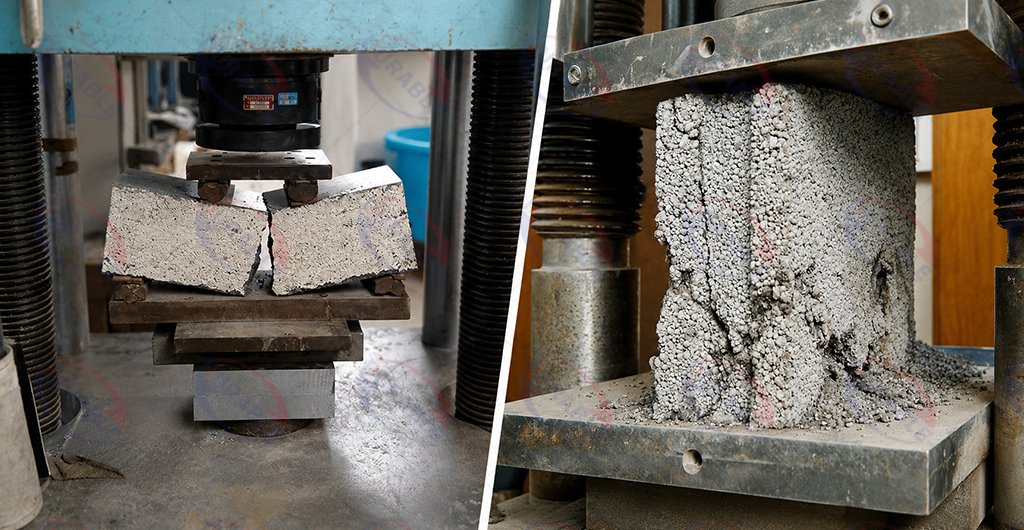
Step 1: Isolate affected production
Mark the batch, production time, operator, mold, material source, and curing location.
Do not mix affected units with acceptable stock.
Step 2: Compare block weights
Unit weight is one of the fastest factory indicators.
A low or highly variable weight may indicate poor mold filling, moisture variation, inconsistent compaction, batching errors, or material segregation.
Measure blocks from each mold cavity separately.
Step 3: Review raw-material records
Check whether the cracks followed a new sand delivery, a different crusher-dust source, rain, a cement change, a new admixture, or changes in aggregate grading.
Step 4: Inspect the forming system
Inspect mold wear, tamper-head alignment, feeding distribution, vibration motors, hydraulic pressure, pallets, and conveyor transfer points.
Step 5: Review curing data
Record temperature, relative humidity, curing duration, water spraying, steam cycle, and stack location.
Step 6: Test finished blocks
Depending on the product and market, useful tests may include:
- Compressive strength
- Water absorption
- Density
- Dimensions
- Moisture content
- Drying shrinkage
- Surface and visual inspection
Applicable national or project standards should control final acceptance.
Step 7: Change one factor
Change one variable while keeping the others stable.
For example, adjust moisture without changing cement and machine settings. Repair one pallet group without changing the mix. Improve curing protection without increasing cement.
This method takes more discipline, but it creates a repeatable production solution instead of a temporary correction.
How Should Buyers Prevent Concrete Block Cracking?
Crack prevention should start before production begins.
A buyer should not only ask whether the machine has enough pressure or vibration force. The better question is whether the full production system can keep raw materials, mixing, forming, handling, curing, and storage stable.
Before choosing a brick making machine, buyers should confirm raw materials, block type, curing area, automation level, and factory layout.
Before ordering a machine or upgrading a line, prepare:
- Local raw material information
- Sand and aggregate grading
- Moisture variation conditions
- Target block dimensions
- Hollow or solid block design
- Required daily capacity
- Cement type and dosage range
- Available curing area
- Preferred automation level
- Pallet handling method
- Factory layout size
- Local climate conditions
This information helps engineers recommend a complete block production line rather than only selecting a forming machine.
For example, a factory using unstable outdoor sand may need better batching and moisture control.
A factory with many handling cracks may need smoother pallet transfer and more disciplined stacking.
A producer making high-value hollow blocks may need better molds, stronger pallet support, and a more controlled curing area.
How Do Machine Maintenance and Supplier Support Help?
Machine quality matters, but long-term alignment, maintenance, and supplier support also affect product quality.
A reliable block production line should keep mold filling, vibration, pressing, and demolding stable over time.
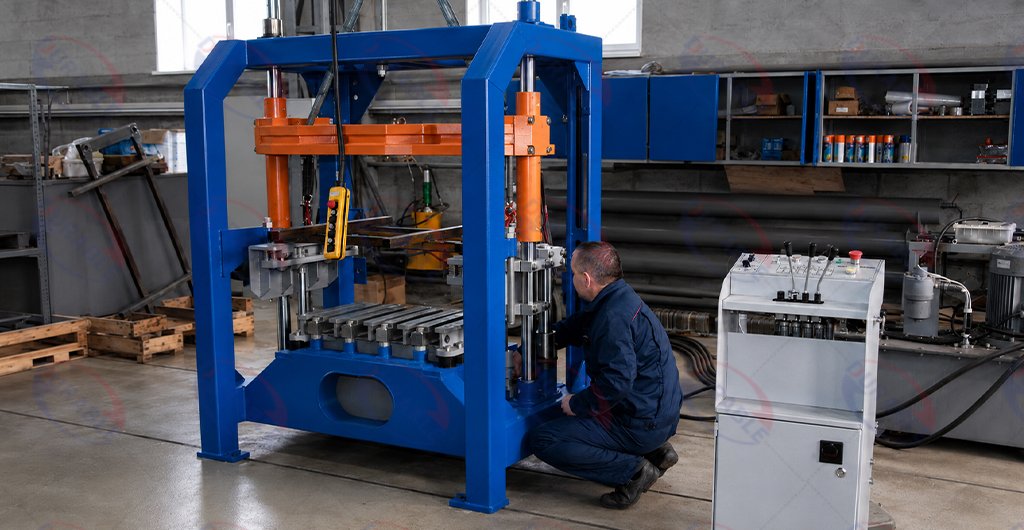
Maintenance items to check
Factory operators should regularly inspect:
- Mold wear
- Tamper-head alignment
- Guide columns
- Hydraulic pressure stability
- Vibration motor synchronization
- Pallet flatness
- Feeding-box movement
- Conveyor transfer points
- Fasteners and frame condition
- Control-system settings
Regular preventive maintenance helps reduce repeatable defects from one cavity, one pallet group, or one transfer section.
Supplier factors to evaluate
When choosing a supplier, buyers should check:
| Supplier Factor | What to Check | Why It Matters |
|---|---|---|
| Machine structure | Frame strength, welding quality, and machine weight | Helps reduce deformation during long-term production |
| Hydraulic system | Pressure stability and smooth movement | Helps maintain consistent pressing and demolding |
| Vibration system | Motor synchronization and adjustment range | Helps match different block types and mixes |
| Mold quality | Mold material, machining accuracy, and replacement support | Affects block dimensions and edge quality |
| Layout support | Mixing, conveying, curing, and pallet handling design | Reduces defects outside the forming machine |
| After-sales support | Installation, training, spare parts, and troubleshooting | Helps factories solve production problems faster |
A good supplier should not only sell a machine.
It should help the buyer understand raw materials, mix preparation, moisture control, production flow, and curing requirements.
Frequently Asked Questions
Why do blocks crack immediately after demolding?
Immediate cracks are commonly related to incorrect moisture, poor mold filling, insufficient compaction, uneven pressure, pallet bending, or rough demolding. The crack pattern and affected mold cavity should be recorded before adjustments are made.
Can too much cement make concrete blocks crack?
Yes, an unnecessarily high cement-paste content can increase cost and shrinkage risk. More cement does not automatically correct poor grading, excessive water, inadequate compaction, or poor curing.
Can excessive vibration damage concrete blocks?
Yes. Excessive vibration can cause segregation, uneven density, longer cycles, and faster equipment wear. Vibration should be long enough to achieve uniform compaction but not longer than necessary.
How long should blocks cure before stacking or delivery?
There is no single curing time suitable for every factory. It depends on cement, mix design, product size, climate, curing method, required strength, and local standards.
How can I tell whether cracks come from the machine or the mix?
A machine or mold problem often creates a repeatable defect in the same cavity or position. A material problem is more likely to affect several cavities or complete batches.
Final Thoughts
Concrete block cracking is rarely caused by a single mechanical fault.
In many factories, defects result from unstable raw materials, incorrect moisture, poor aggregate grading, insufficient compaction, rough handling, poor curing, or weak storage practices.
A good block machine is important, but it cannot replace process control.
Factories should first identify when and where cracks appear. Then they should investigate raw materials, moisture, compaction, pallets, handling, curing, storage, and testing records.
The best solution is not always more cement, higher pressure, or longer vibration.
A stable block production system depends on balanced mix design, suitable equipment settings, smooth material handling, controlled curing, and disciplined quality checks.
About DURABLE
DURABLE supplies concrete block machines and complete production solutions for small, medium, and industrial block factories.
Our solutions can include aggregate batching systems, concrete mixers, belt conveyors, hydraulic block machines, automatic block machines, mold systems, pallet feeders, fresh-block conveyors, stacking systems, pallet-return systems, curing-area planning, and factory layout design.
A reliable machine is only one part of a stable block production system.
Before recommending a production line, DURABLE engineers evaluate raw materials, block dimensions, required capacity, mix preparation, moisture control, automation level, curing method, pallet handling, factory layout, and product quality requirements.
DURABLE can also help buyers compare different block and brick production equipment based on capacity, automation level, material type, and finished product requirements.
Contact DURABLE with photos of the cracks, the time when they appear, raw-material information, block dimensions, machine configuration, and curing method. This information can help identify whether the problem is related to the mix, compaction, handling, curing, or another part of the production process.