 Durable Machinery
Get Price
What Determines Charcoal Quality Beyond Temperature?
Many charcoal producers believe that carbonization temperature is the main factor that determines charcoal quality.
Temperature is important, but it is only one part of the full production process. Two factories can use similar raw materials and similar furnace temperatures but produce very different charcoal.
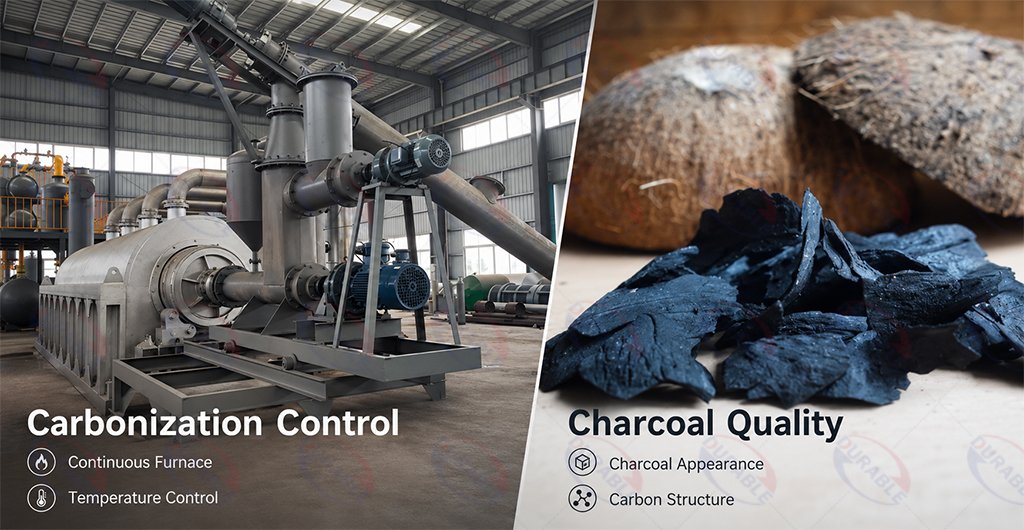
The difference usually comes from raw material quality, moisture control, heating speed, oxygen management, cooling, post-processing, and final inspection.
For commercial charcoal manufacturers, stable quality requires controlling the whole production chain, not only adjusting furnace temperature.
Why Temperature Alone Does Not Define Charcoal Quality
Carbonization temperature affects how biomass becomes carbon-rich charcoal.
However, higher temperature does not always mean better charcoal.
If the temperature is too high or the heating process is poorly controlled, the final product may suffer from:
- Lower charcoal yield
- More cracking
- Carbon loss
- Uneven carbonization
- Higher breakage during handling
A stable carbonization process must balance several factors:
- Temperature
- Heating speed
- Residence time
- Oxygen control
- Raw material type
- Particle size
- Cooling method
Different markets also require different charcoal properties.
For example, shisha charcoal usually needs high density, low ash, low odor, strong shape, and stable burning time.
BBQ charcoal may focus more on heat output, ignition behavior, lump strength, and user experience.
Industrial charcoal may pay more attention to supply stability, fuel value, and production cost.
Therefore, the first step is not simply raising the furnace temperature. The producer should define the target product and then adjust the production process around that market.
How Raw Materials Affect Final Charcoal Performance
Raw materials are one of the most important factors affecting charcoal quality.
Different biomass materials have different carbon content, ash content, density, fiber structure, moisture behavior, and burning performance.
The same carbonization process cannot produce the same result from every raw material.
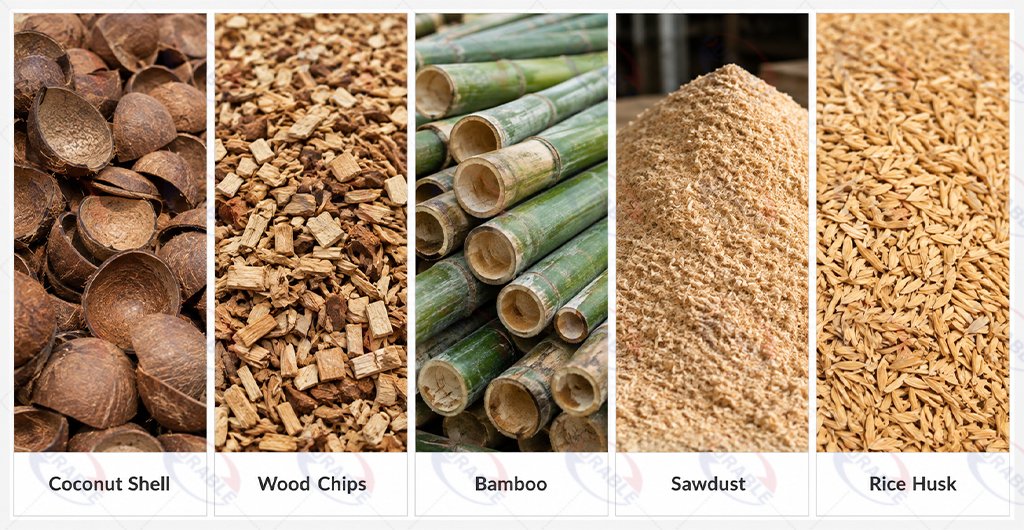
| Raw Material | Main Characteristics | Common Application |
|---|---|---|
| Coconut shell | Dense structure, low ash, stable burning | Shisha charcoal |
| Hardwood | Strong structure and good heat output | BBQ charcoal |
| Bamboo | Renewable and fast-growing biomass | Biomass charcoal |
| Sawdust | Easy to process into briquettes | Shisha, BBQ, or fuel briquettes |
| Agricultural waste | Low-cost biomass source | Industrial fuel or biomass charcoal |
Coconut shell charcoal
Coconut shell is often used for premium charcoal products because it naturally provides dense structure, stable burning, and lower ash potential.
This is why coconut shell charcoal is commonly selected for shisha and hookah charcoal production.
However, good raw material still needs proper drying, stable carbonization, and controlled cooling.
Hardwood charcoal
Hardwood usually provides strong structure, good heat retention, and stable combustion.
It is widely used for BBQ charcoal and lump charcoal markets.
Even so, quality still depends on wood species, moisture content, carbonization conditions, and post-processing.
Agricultural biomass
Sawdust, bamboo waste, rice husk, crop residues, and other biomass materials can also be converted into charcoal products.
However, these materials often need stricter process control because ash level, fiber structure, and natural density may vary.
Before choosing a charcoal making machine, manufacturers should test the raw material and define the target product.
Related guide:
How to Choose the Right Charcoal Making Machine Based on Your Raw Materials
Why Moisture Control Matters Before Carbonization
Many charcoal quality problems begin before carbonization.
Raw material moisture affects heating efficiency, carbonization time, fuel consumption, product strength, and final consistency.
When biomass contains too much moisture, more heat is used for drying instead of carbonization.
As a result, the process may become slower, less stable, and less efficient.
Excess moisture can cause:
- Longer production cycles
- Higher energy consumption
- Uneven carbonization
- Internal cracking
- Lower production consistency
At the same time, raw material should not simply be dried without control.
Very dry or unevenly dried biomass may heat too quickly in some areas. This can lead to surface cracking, unstable internal structure, or reduced charcoal strength.
A practical preparation process usually includes:
- Raw material sorting
- Size adjustment
- Moisture control
- Carbonization
- Cooling
- Crushing, screening, or briquetting
- Final drying and packaging when needed
Professional charcoal plants adjust moisture preparation according to biomass type, particle size, furnace design, and target product requirements.
How Carbonization and Cooling Affect Charcoal Quality
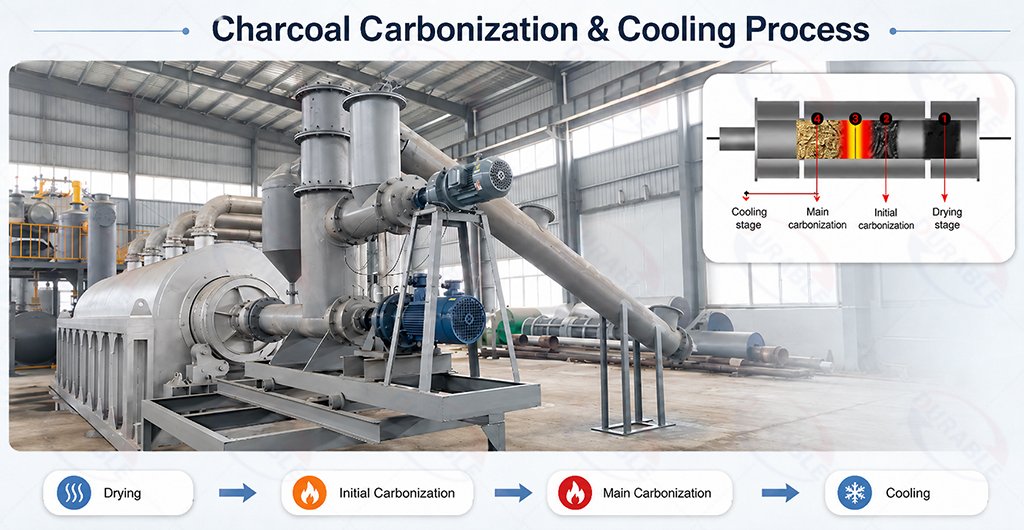
A stable carbonization process depends on more than final temperature.
Heating speed, residence time, oxygen control, and cooling all influence the finished product.
Heating rate
Heating rate affects the internal structure of charcoal.
If biomass heats too quickly, the outside may carbonize faster than the inside. This can create cracks, uneven carbonization, and lower mechanical strength.
A controlled heating process allows heat to penetrate more evenly.
Residence time
Residence time means how long the material stays under carbonization conditions.
If the time is too short, carbonization may be incomplete and the charcoal may burn unevenly.
If the time is too long, energy consumption increases and production efficiency may decrease.
Oxygen control
Carbonization requires a controlled low-oxygen environment.
Too much oxygen may cause partial combustion, which can reduce yield, increase ash, and lower fixed carbon.
This is why furnace sealing, air control, and stable feeding are important for continuous operation.
More information:
Why More Biomass Plants Are Switching to Continuous Carbonization
Cooling process
Cooling is often overlooked, but it is very important.
Fresh charcoal can still react with oxygen if it is exposed too quickly after carbonization. Poor cooling may cause burning loss, lower yield, and unstable final quality.
Controlled cooling helps preserve fixed carbon, reduce product loss, and improve handling safety.
Why Fixed Carbon, Ash, Density, and Volatile Matter Matter
Professional charcoal buyers evaluate more than appearance.
A product may look black, but that does not mean it has good burning performance or stable market quality.
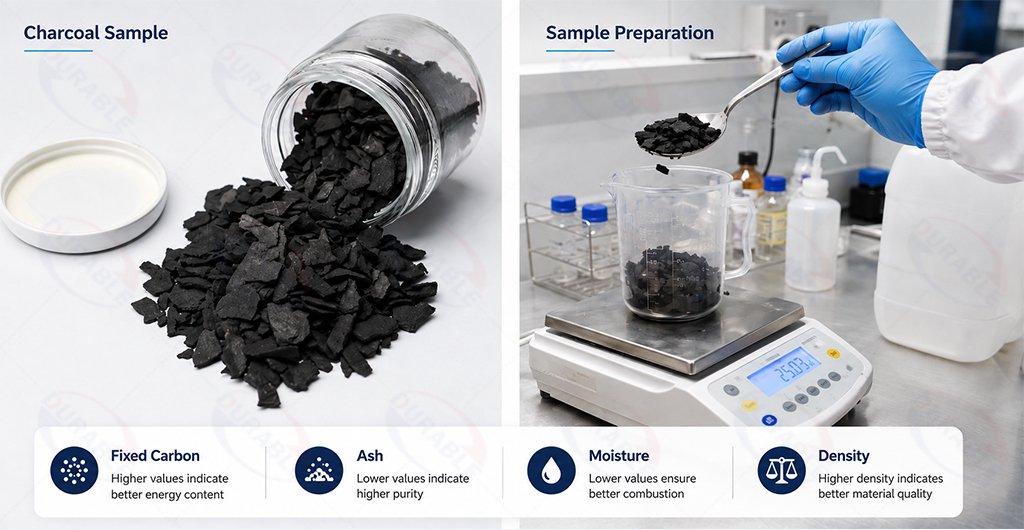
Important charcoal quality indicators include:
- Fixed carbon
- Ash content
- Volatile matter
- Moisture
- Density
- Burning time
- Odor
- Mechanical strength
| Quality Parameter | Why It Matters |
|---|---|
| Fixed carbon | Affects heat output and burning time |
| Ash content | Affects residue, cleanliness, and buyer acceptance |
| Volatile matter | Influences ignition, smoke, odor, and burning behavior |
| Moisture | Affects storage stability and product value |
| Density | Influences strength, burning time, and transport resistance |
Fixed carbon
Higher fixed carbon usually supports longer burning time and more stable heat release.
However, fixed carbon should not be considered alone. A good charcoal product also needs suitable density, low ash, proper moisture, and stable combustion behavior.
Ash content
Ash mainly comes from mineral components inside the raw material.
High ash content may create more residue, reduce customer satisfaction, and weaken combustion performance.
Raw material selection, contamination control, and process stability all affect ash level.
Volatile matter
Volatile matter influences ignition, smoke, odor, and burning characteristics.
Different markets require different performance. For example, shisha charcoal usually needs controlled burning and low odor rather than extremely fast ignition.
Density
Density is especially important for shisha charcoal and BBQ briquettes.
A dense charcoal product usually has better shape strength, longer burning duration, and stronger transport resistance.
How Post-Processing Affects Shisha, BBQ, and Biomass Charcoal
Carbonization creates charcoal, but the final product quality is often shaped by post-processing.
Many manufacturers focus heavily on furnace performance while ignoring crushing, screening, mixing, briquetting, drying, and packaging.
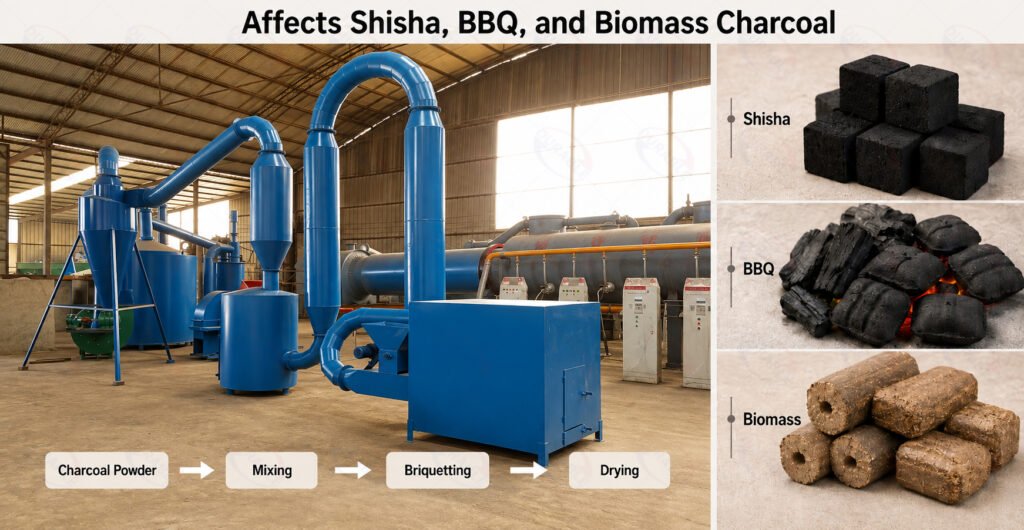
These steps directly affect:
- Particle distribution
- Briquette strength
- Density
- Burning time
- Product appearance
- Customer satisfaction
Shisha charcoal
Shisha charcoal customers usually expect strong cubes or tablets, low breakage, low ash, low odor, and stable burning.
For this product, the pressing process is very important.
Key factors include particle size, binder selection, moisture level, pressing pressure, drying conditions, and mold accuracy.
A suitable shisha hookah press machine should match the raw material, target size, and required output.
BBQ charcoal
BBQ charcoal needs good ignition, stable heat, acceptable smoke level, and enough strength during packing and transportation.
For lump charcoal, raw material quality and carbonization control are critical.
For BBQ briquettes, crushing, mixing, pressing, and drying also affect final quality.
Biomass briquettes
Some manufacturers produce biomass briquettes for industrial fuel, heating, or renewable energy projects.
These products may require different density, moisture resistance, and burning behavior compared with shisha or BBQ charcoal.
For fuel briquette projects, equipment selection should match the material type and expected product shape.
Related equipment:
How to Build Stable Charcoal Quality Control
High-quality charcoal production requires systematic quality management.
Testing only the final product is not enough. Professional producers control quality from raw material preparation to finished product storage.
Raw material inspection
Before production begins, factories should evaluate:
- Biomass type
- Moisture content
- Particle size
- Ash characteristics
- Material consistency
- Contamination risk
Stable raw materials help create stable production results.
Carbonization monitoring
During carbonization, operators should monitor temperature changes, heating speed, processing time, oxygen conditions, and production yield.
Recording production data helps factories identify repeated problems and improve consistency.
Finished product testing
Finished charcoal should be tested according to market requirements.
Common quality checks include:
- Fixed carbon analysis
- Ash content testing
- Moisture testing
- Density measurement
- Burning performance evaluation
- Drop strength or breakage testing when needed
For export markets, quality documentation can also improve buyer confidence.
Production data management
Factories should record raw material source, production parameters, equipment settings, test results, and customer feedback.
These records help manufacturers trace quality changes and make better process decisions.
How to Choose Equipment and Suppliers for Stable Quality
Charcoal quality depends on both process control and equipment design.
A reliable supplier should not only provide a furnace. It should help the buyer evaluate raw materials, capacity needs, site layout, fuel supply, post-processing requirements, and target product specifications.
Equipment selection should consider:
- Raw material type
- Raw material moisture
- Particle size
- Target product
- Required capacity
- Drying requirement
- Cooling method
- Briquetting requirement
- Automation level
- Local installation conditions
A complete production system may include crushers, dryers, carbonization furnaces, cooling systems, conveyors, screening equipment, briquetting machines, and packing systems.
Supplier evaluation
| Supplier Factor | What to Check | Why It Matters |
|---|---|---|
| Process experience | Biomass and charcoal project cases | Helps reduce trial-and-error |
| Equipment matching | Crusher, dryer, furnace, press, and cooling layout | Avoids process bottlenecks |
| Furnace sealing | Feeding, discharge, and oxygen control design | Protects yield and quality |
| Material support | Raw material analysis and process suggestion | Improves product stability |
| After-sales support | Installation, training, spare parts, and troubleshooting | Supports long-term operation |
Before buying equipment, prepare the following information:
- Raw material type
- Average moisture level
- Particle size
- Target product
- Required hourly or daily output
- Fuel source
- Available workshop space
- Local power condition
- Destination country
- Quality requirement from buyers
This information helps engineers design a more suitable production solution.
Common Mistakes That Reduce Charcoal Quality
Many charcoal quality problems come from repeated production mistakes.
Focusing only on furnace temperature
Temperature is important, but it cannot solve problems caused by poor raw materials, excess moisture, weak cooling, or unstable post-processing.
A better approach is improving the complete production system.
Using unstable raw materials
Frequent changes in biomass sources can create inconsistent charcoal quality.
Factories should establish reliable suppliers, raw material inspection procedures, and standard preparation methods.
Ignoring moisture preparation
Poor moisture control increases the risk of uneven carbonization, cracking, longer cycles, and unstable product quality.
Before carbonization, moisture should be managed according to material type and furnace requirements.
Skipping cooling management
Fresh charcoal requires controlled cooling.
Poor cooling may reduce yield, fixed carbon, and burning performance.
Not testing finished products
Without regular testing, manufacturers cannot clearly understand why batches differ or why customers complain.
Quality data helps factories improve production step by step.
Frequently Asked Questions
Does higher carbonization temperature always produce better charcoal?
No. Higher temperature may increase carbonization degree, but excessive or poorly controlled heating can reduce yield, increase cracking, and damage product strength. Raw materials, heating speed, residence time, oxygen control, and cooling must work together.
What is the most important factor affecting charcoal quality?
There is no single factor. Raw materials, moisture control, carbonization conditions, cooling, density, ash content, and post-processing all influence final charcoal performance.
Why does the same raw material produce different charcoal quality?
Different moisture levels, heating rates, residence times, oxygen control, cooling methods, and post-processing steps can create different charcoal characteristics from the same raw material.
How can manufacturers reduce charcoal ash content?
Manufacturers can reduce ash problems by selecting suitable raw materials, preventing contamination, improving process control, and regularly testing finished products.
What tests should charcoal factories perform before export?
Common tests include fixed carbon, ash content, moisture, density, burning performance, odor, and breakage resistance. Specific requirements depend on the target market and customer standards.
About DURABLE
DURABLE provides biomass and charcoal production solutions for customers worldwide.
Our solutions include charcoal making machines, continuous carbonization systems, biomass processing equipment, crushing and screening equipment, briquetting systems, drying systems, and complete production line solutions.
A successful charcoal project requires more than carbonization equipment.
It requires the right combination of suitable raw materials, stable production process, proper equipment selection, and quality control management.
DURABLE helps customers evaluate biomass characteristics, production requirements, site conditions, and market goals to develop suitable charcoal production solutions.