 Durable Machinery
Get Price
Why Concrete Blocks Fail Quality Tests: Causes and Fixes
Concrete blocks fail quality tests for many reasons, including poor raw materials, incorrect moisture, weak compaction, and improper curing.
Producing concrete blocks is not only about making products with the correct shape.
A successful block factory must consistently manufacture blocks that meet strength, durability, dimensional accuracy, appearance, and project acceptance requirements.
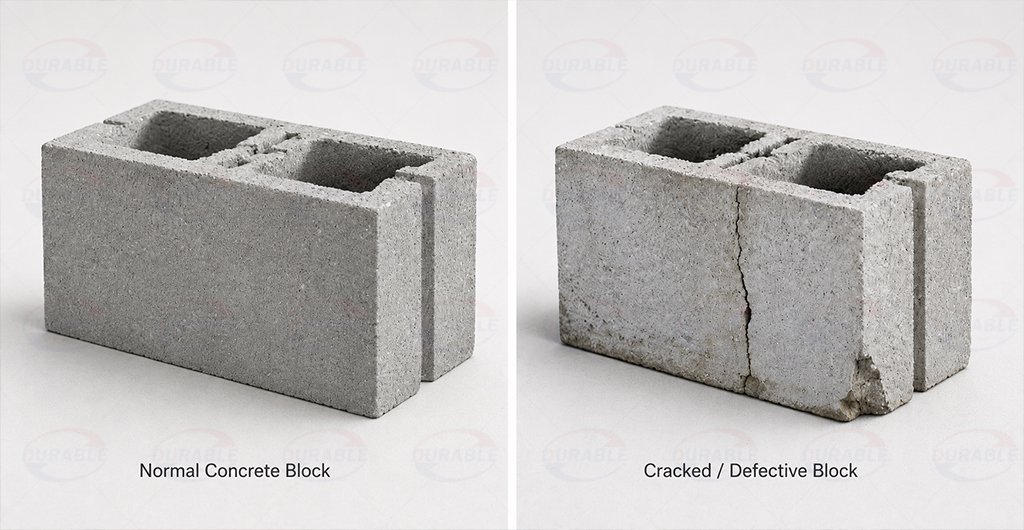
Many factories face the same problem: the production line runs normally, the blocks look acceptable after demolding, but samples fail customer inspection or laboratory testing.
A failed quality test does not always mean the concrete block machine is the only problem.
In most cases, quality failures come from several connected factors:
- Unstable raw materials
- Incorrect mix design
- Poor moisture control
- Insufficient compaction
- Incomplete mixing
- Improper curing
- Early handling damage
- Weak production monitoring
A reliable machine provides stable forming conditions, but final block quality depends on the complete production process.
This guide explains why concrete blocks fail quality tests and how factories can reduce rejected products through better raw material control, mixing, forming, curing, maintenance, and quality management.
What Quality Tests Do Concrete Blocks Need to Pass?
Before solving block quality problems, factories need to understand what is being tested.
Different countries and projects may use different standards. However, most concrete block inspections focus on several key performance areas.
| Test Item | What It Evaluates | Common Failure Signal |
|---|---|---|
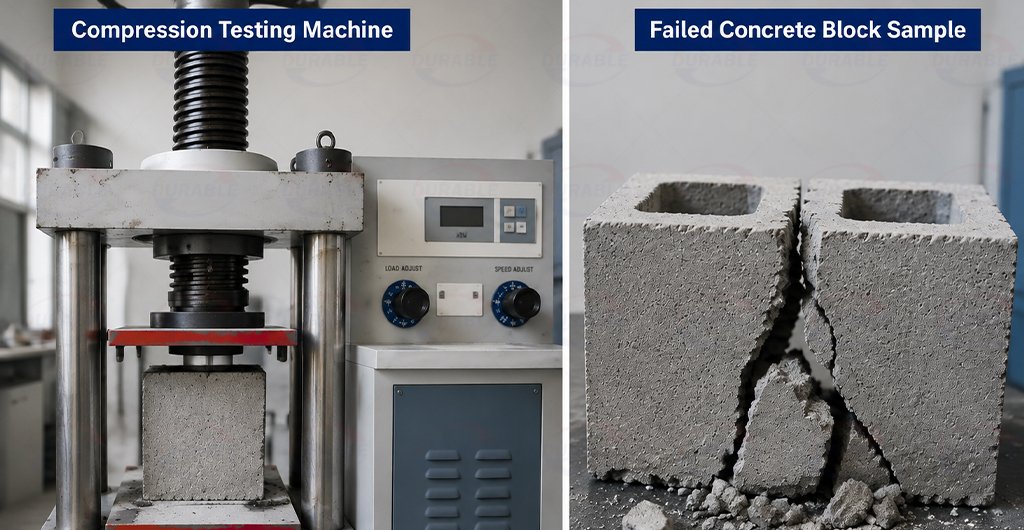
| Compressive strength | Load-bearing capacity | Blocks crush below the required strength |
| Water absorption | Density, porosity, and durability | Blocks absorb too much water |
| Dimensions | Length, width, height, and wall thickness | Blocks vary too much in size |
| Density | Compaction and internal structure | Blocks are too light or inconsistent |
| Appearance | Surface, corners, cracks, and edges | Blocks show cracks, chips, or deformation |
| Drying shrinkage | Long-term dimensional stability | Blocks shrink or crack after curing |
| Freeze-thaw resistance | Durability in cold climates | Blocks deteriorate after moisture and freezing cycles |
A block can pass one test and fail another.
For example, a block may look good but fail compressive strength testing. Another block may have acceptable strength but fail water absorption requirements.
For this reason, professional factories cannot rely only on visual inspection.
Before mass production, manufacturers should confirm:
- Required strength grade
- Maximum water absorption
- Dimensional tolerance
- Appearance requirements
- Testing frequency
- Customer or project standard
- Local construction regulations
Quality control should start before the first batch enters the production line.
Why Concrete Blocks Fail Quality Tests for Strength and Absorption?
Strength and water absorption are closely related.
A block with poor compaction, unstable moisture, or excessive internal voids may fail strength testing and also absorb too much water.
Incorrect water content
Water has a major influence on dry-cast concrete blocks.
Too much water may make the mix easier to feed, but excess moisture can leave internal pores after curing.
This may cause:
- Lower density
- Reduced strength
- Higher shrinkage
- More internal voids
- Higher water absorption
A mix that is too dry can also fail.
If there is not enough moisture for proper compaction and cement hydration, the block may have:
- Weak corners
- Loose surfaces
- Poor bonding
- Uneven density
- Low early strength
The correct moisture level depends on aggregate grading, cement content, fine material percentage, block size, machine vibration, and local climate.
Poor aggregate grading
Concrete blocks need a balanced particle structure.
Large particles provide the main skeleton. Smaller particles fill the spaces between larger particles.
When grading is poor, blocks may contain excessive voids and weak zones.
Common problems include:
- Too much coarse aggregate
- Excessive fine powder
- Unstable sand quality
- Changing material sources
- Poor particle packing
Many factories underestimate raw material variation.
A small change in sand, stone powder, or crusher dust can affect water demand, compaction, surface quality, and strength development.
Related reading:
Can Crusher Dust Replace River Sand in Concrete Blocks?
Insufficient compaction
Even with a good mix, insufficient compaction can reduce strength.
Possible causes include:
- Short vibration time
- Incorrect vibration frequency
- Poor mold filling
- Uneven material distribution
- Incorrect hydraulic pressure
- Worn molds
- Weak pallet support
The goal is not maximum vibration or maximum pressure.
The goal is uniform density throughout the complete block.
A hydraulic brick making machine can help improve compaction stability, but machine settings must still match the actual mix condition.
Poor curing
Concrete blocks continue gaining strength after forming.
If curing conditions are poor, cement hydration slows down and the blocks may not reach the expected performance.
Common curing problems include:
- Direct sunlight exposure
- Strong wind
- Low humidity
- Short curing time
- Uneven curing conditions
- Moving blocks too early
A strong machine cannot compensate for poor curing after production.
Why Do Blocks Fail Dimension and Appearance Checks?
Not all quality failures are related to strength.
Many construction projects reject blocks because of size variation, uneven surfaces, poor edges, cracks, color differences, or deformation.
These problems are usually connected to production consistency.
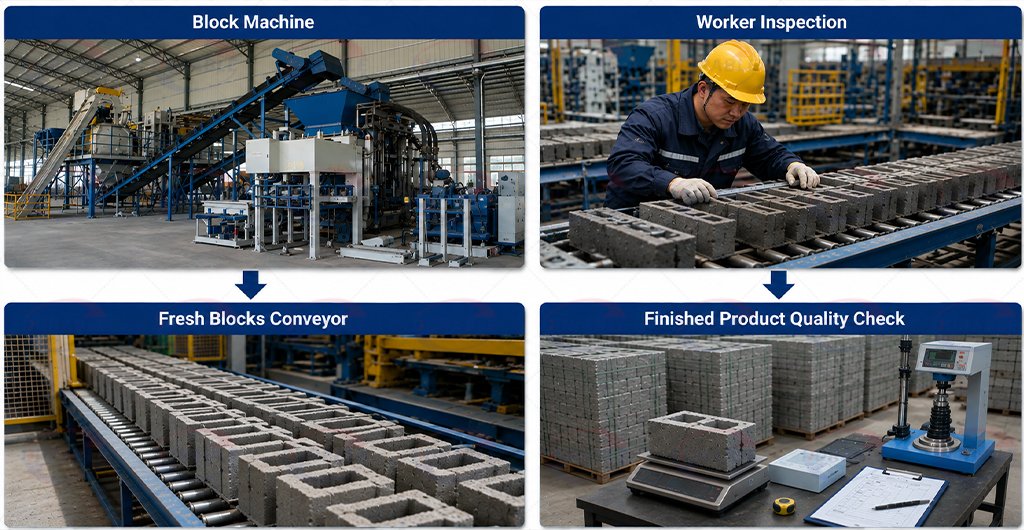
Uneven mold filling
A block mold must receive a uniform amount of concrete mix.
If filling is uneven, the finished product may have different heights, weak corners, uneven density, or poor surface finish.
Possible causes include:
- Incorrect feeding time
- Material segregation
- Poor moisture condition
- Feeding system problems
- Unstable batch volume
An automatic brick making machine can improve feeding consistency, but it still needs correct mix design, stable moisture, and regular maintenance.
Mold wear
The mold directly controls final block dimensions.
After long-term operation, mold wear can affect block length, width, height, edge accuracy, and surface quality.
Using worn molds for too long can increase reject rate, customer complaints, and adjustment time.
Poor demolding
Fresh blocks have limited early strength immediately after forming.
Incorrect demolding can create cracks, broken corners, surface damage, or shape deformation.
Common causes include:
- Incorrect vibration settings
- Excessive production speed
- Poor pallet condition
- Insufficient early strength
- Sticky or wet mix
The solution is not always reducing machine speed.
The factory should first identify whether the problem comes from the mix, machine settings, handling system, or curing process.
Damaged pallets
Production pallets support the block during forming, transfer, and early curing.
Bent, dirty, or damaged pallets can create uneven support and cause deformation, edge cracking, or dimensional variation.
Many factories focus on the machine itself but ignore pallet quality.
However, pallets are one of the most important components affecting production consistency.
How Do Raw Materials, Mixing, and Compaction Affect Quality?
A stable concrete block factory begins with stable raw materials.
Even a modern automatic production line cannot produce consistent products if the incoming materials change every day.
Common materials include:
- Cement
- River sand
- Crusher dust
- Stone powder
- Gravel
- Water
- Additives
Cement quality
Cement affects strength development, bonding, early hardness, and long-term durability.
Factories should control cement type, storage conditions, moisture exposure, and supply consistency.
Cement stored in humid conditions may lose performance before it enters production.
Sand and aggregate quality
Aggregate is the main structural component of concrete blocks.
Important factors include:
- Particle size distribution
- Cleanliness
- Moisture variation
- Hardness
- Absorption
- Clay or organic contamination
A sudden change in aggregate source can affect water requirement, mixing time, compaction behavior, and final strength.
Mixing quality
Poor mixing can result in uneven moisture distribution, cement concentration differences, and weak areas inside blocks.
Important factors include:
- Mixer type
- Mixing time
- Material loading sequence
- Water dosing
- Moisture control
- Batch size
For high-output block factories, the mixer should match both the forming machine capacity and the concrete requirements.
Choosing the wrong mixer can create inconsistent batches even when the forming machine is working correctly.
Related guide:
How to Choose the Right Concrete Mixer for Different Projects
Compaction control
The forming stage determines the initial density and shape of the block.
Possible problems include:
- Incorrect vibration
- Uneven feeding
- Incorrect hydraulic pressure
- Mold wear
- Poor pallet support
Machine settings should always be adjusted according to concrete mix, block size, material characteristics, and production target.
How Do Curing, Handling, and Storage Cause Failures?
Blocks that leave the machine correctly can still fail later.
Curing, early handling, and storage have a strong influence on final quality.
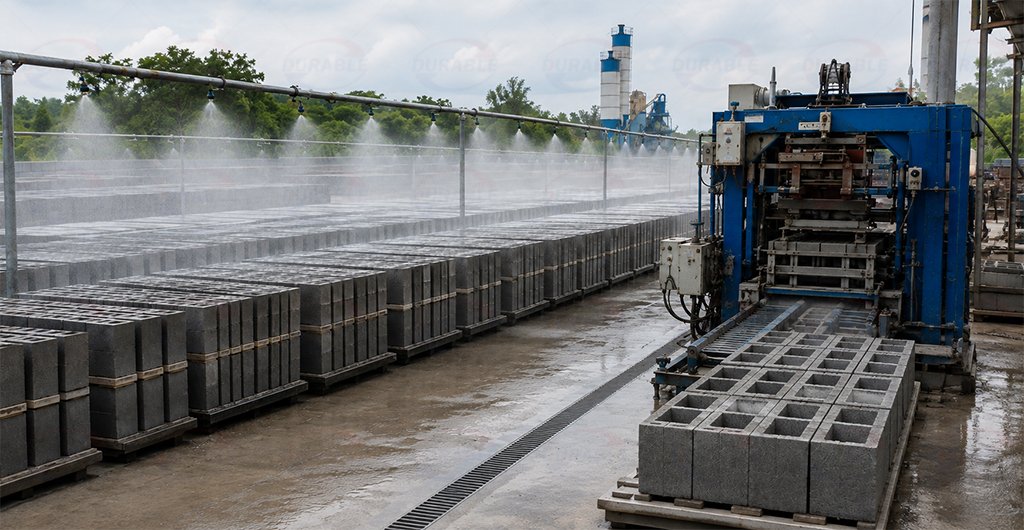
Curing problems
Curing is not simply waiting.
It is an active quality-control process.
Factories should control:
- Temperature
- Humidity
- Curing time
- Airflow
- Handling time
- Stack arrangement
Poor curing may result in lower strength, higher absorption, surface cracks, weak corners, or unstable color.
Early handling damage
Fresh blocks are easy to damage before they gain enough strength.
Rough transfer, unstable conveyors, manual impact, or early stacking can create cracks that may only become visible later.
Factories should check:
- Conveyor alignment
- Pallet movement
- Transfer points
- Stacking speed
- Forklift handling
- Yard road condition
Storage problems
Storage also affects final quality.
Uneven ground, excessive stack height, poor protection from rain or sun, and mixed product stacking can all create quality problems.
Good storage management helps reduce cracks, edge damage, moisture variation, and customer complaints.
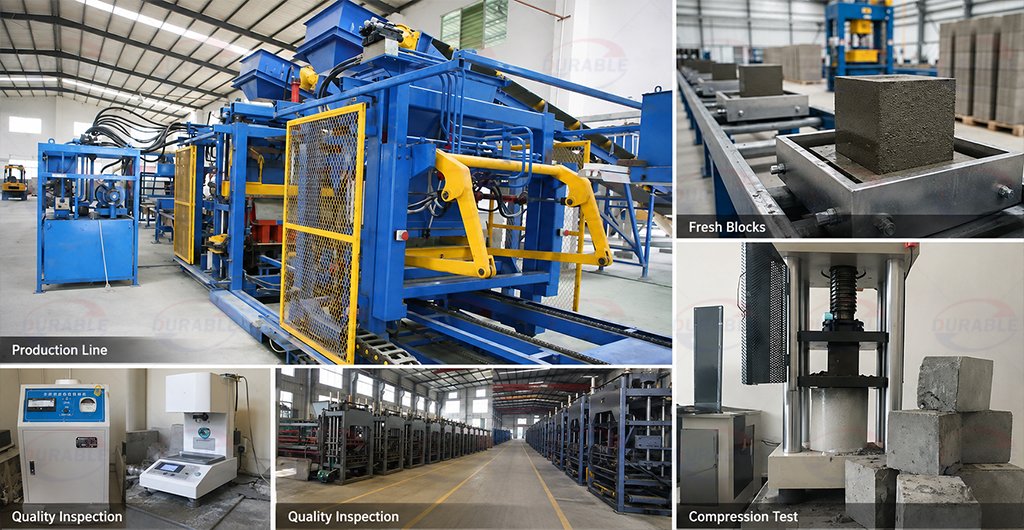
How to Prevent Concrete Blocks From Failing Quality Tests?
Professional block factories do not rely only on final inspection.
They control every stage of production.
Incoming material control
Record:
- Supplier information
- Material source
- Moisture content
- Grading results
- Cement batch
- Test records
Stable raw materials are the foundation of stable production.
Production monitoring
Track:
- Mix ratio
- Water quantity
- Cement quantity
- Mixing time
- Machine settings
- Pallet condition
- Production date
- Operator information
Production records help identify repeated problems quickly.
Finished product testing
Regular checks should include:
- Visual inspection
- Block weight
- Dimensions
- Strength testing
- Water absorption testing
Testing frequency depends on production volume, local standards, and customer requirements.
Failure analysis
Rejected blocks should not be ignored.
They provide valuable information about the production process.
When blocks fail, record:
- Defect type
- Time of production
- Raw material batch
- Machine settings
- Curing condition
- Operator shift
- Test result
This helps the factory find patterns instead of guessing.
Common mistakes to avoid
Many quality problems repeat because factories change too many variables at the same time.
For example, changing water, cement, vibration, pressure, and curing time together may improve the result, but the factory will not know which factor solved the problem.
A better method is to change one variable at a time.
Other common mistakes include:
- Copying another factory’s formula
- Testing only one sample
- Ignoring rejected products
- Replacing machines before checking materials
- Adding more cement before solving moisture or compaction problems
Use this table as a quick troubleshooting guide.
| Failure Problem | First Area to Check | Practical Direction |
|---|---|---|
| Low strength | Moisture, grading, compaction, curing | Optimize mix and forming conditions |
| High water absorption | Internal voids and poor packing | Improve compaction, grading, and curing |
| Height variation | Pallets, mold filling, guide alignment | Check pallets, mold, and feeding system |
| Edge chipping | Green strength and handling | Improve demolding and transfer process |
| Surface cracks | Moisture loss and fine material | Improve curing and material balance |
| Repeated defects in one cavity | Mold or local machine condition | Inspect mold, tamper head, and pallet support |
How Do Maintenance, Supplier Support, and Buyer Preparation Help?
Quality control also depends on maintenance and supplier support.
A machine that is not maintained can slowly lose alignment, pressure stability, vibration performance, and mold accuracy.
Maintenance checklist
Factory operators should regularly check:
- Mold cavities and tamper shoes
- Guide pillars and lubrication
- Hydraulic pressure stability
- Vibration system condition
- Pallet flatness
- Feeding drawer movement
- Conveyor transfer points
- Mixer blades and liners
- Electrical sensors and PLC records
Preventive maintenance helps reduce repeat quality failures.
Supplier evaluation
A reliable supplier should not only sell a machine.
It should help the buyer evaluate raw materials, mix preparation, forming technology, curing method, factory layout, automation level, and long-term maintenance.
| Supplier Factor | What to Check | Why It Matters |
|---|---|---|
| Machine structure | Frame strength, mold accuracy, and forming stability | Helps maintain consistent compression |
| Hydraulic system | Pressure control and smooth movement | Reduces density and size variation |
| Mixing support | Mixer selection and batching design | Improves batch consistency |
| Layout design | Material flow, curing area, and pallet handling | Reduces handling and storage defects |
| Spare parts | Molds, pallets, seals, blades, and sensors | Reduces downtime |
| After-sales support | Installation, training, and troubleshooting | Helps factories stabilize production faster |
Buyer self-check list
Before requesting technical support or submitting blocks for testing, prepare:
- Raw material information
- Sand and aggregate grading
- Moisture condition
- Cement type
- Block size and shape
- Required capacity
- Machine model
- Mixer type
- Curing method
- Defect photos
- Test report
- Project country or standard
This information helps engineers identify whether the problem comes from materials, mixing, forming, curing, handling, or equipment condition.
Frequently Asked Questions
What is the most common reason concrete blocks fail strength tests?
Common causes include unstable raw materials, incorrect moisture, poor compaction, and insufficient curing. The machine itself is only one part of the complete production system.
Can a good block machine guarantee high-quality blocks?
No. A reliable block machine provides stable forming conditions, but final quality also depends on material quality, mix design, mixing, curing, handling, and production management.
Does adding more cement always improve block quality?
No. More cement cannot correct poor grading, excessive water, weak compaction, or poor curing. The complete production process should be optimized first.
How often should concrete blocks be tested?
Testing frequency depends on local standards, production volume, and customer requirements. Regular checks of strength, dimensions, weight, and absorption help identify problems early.
How can a factory reduce rejected concrete blocks?
Factories can reduce rejects by controlling raw materials, improving mix consistency, maintaining equipment, optimizing curing, recording production data, and analyzing every failed batch.
About DURABLE
DURABLE provides complete concrete block production solutions for small, medium, and industrial block factories.
Our solutions can include concrete block machines, hydraulic brick making machines, automatic block production lines, concrete mixers, batching systems, conveyors, pallet handling systems, molds, and factory layout planning.
A successful block factory requires more than reliable equipment.
It requires the correct combination of raw materials, mixing system, forming technology, curing process, handling method, and quality control management.
DURABLE engineers help customers evaluate materials, production requirements, factory conditions, automation level, and future expansion plans to develop suitable block manufacturing solutions.
You can also review DURABLE’s full block and brick production equipment to compare suitable machines and supporting systems for your project.