 Durable Machinery
Get Price
Why Concrete Quality Problems Start Before Mixing
Concrete quality problems do not always begin inside the mixer.
When strength, consistency, surface finish, or block quality becomes unstable, operators often check the mixer first. This is understandable because the mixer is the most visible machine in the production process.
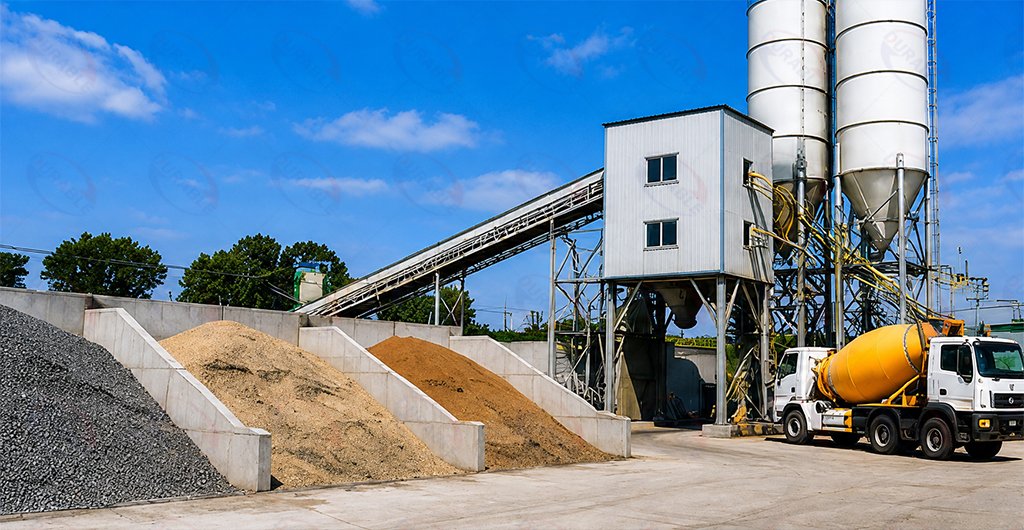
However, many problems have already developed before mixing starts.
Changing aggregate grading, wet sand, contaminated stockpiles, inaccurate weighing, or poor cement storage can change a concrete batch before the mixer has any chance to correct it.
A mixer can distribute materials more evenly. It cannot turn unstable inputs into consistently good concrete.
For concrete plants, precast factories, and block manufacturers, stable quality starts with one principle:
Make the materials entering the mixer predictable before asking the mixer to make the concrete consistent.
Why a Better Mixer Cannot Fix Every Concrete Quality Problem
A good concrete mixer can improve material distribution and help create a more uniform batch.
Still, mixer performance depends heavily on what enters the mixing chamber.
Two batches can use the same mixer, same mixing time, and same settings. If one batch receives correctly graded aggregate and controlled moisture, while another receives wetter sand and inaccurate dosing, the finished concrete may behave differently.
Factories sometimes try to correct upstream problems by changing:
- Mixing time
- Mixer speed
- Water addition
- Discharge time
- Production cycle
These adjustments may change the result temporarily, but they do not always solve the root cause.
A properly selected mixer can help distribute cement, spread water and admixtures, and improve batch uniformity.
For commercial concrete plants, a twin shaft concrete mixer is often used when fast, high-output mixing is required.
For dry-cast concrete, precast products, and some block production lines, a planetary concrete mixer may provide strong mixing coverage for low-slump materials.
Even so, an advanced mixer cannot reliably correct incorrect material proportions, excessive sand moisture, missing aggregate sizes, clay-contaminated aggregate, deteriorated cement, or major weighing errors.
Therefore, mixer selection should be considered together with raw material preparation, batching accuracy, and production quality control.
How Aggregate Grading Changes Concrete Before Mixing
Aggregate usually makes up a large proportion of a concrete mixture.
As a result, changes in aggregate grading can quickly affect workability, density, strength, surface quality, and compaction behavior.
Good grading provides a balanced combination of different particle sizes. Smaller particles fill spaces between larger particles, helping create a denser structure.
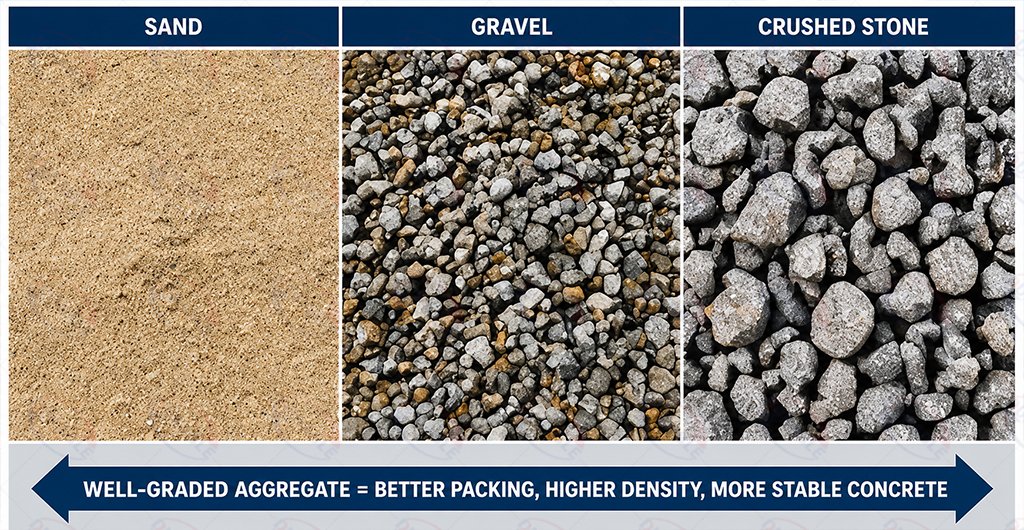
Poor grading creates the opposite problem.
Too many fine particles increase total particle surface area. Consequently, the mix may require more water or cement paste to reach the expected consistency.
This can cause higher water demand, shrinkage risk, difficult compaction, variable surface finish, and higher cement demand.
The issue is especially important when factories use manufactured sand, crusher dust, or quarry fines.
These materials can be useful, but they should not be treated as direct replacements for natural sand without testing.
For block producers, this guide explains key checks when using crusher dust in concrete products:
Can Crusher Dust Replace Sand? 7 Tests for Strong Blocks
Too much coarse aggregate may create more internal voids and poor paste distribution. For dry-cast blocks and pavers, this can contribute to weak edges, uneven density, poor mold filling, and rough surfaces.
Missing intermediate sizes can reduce packing efficiency. In that case, more paste may be needed to fill the remaining voids.
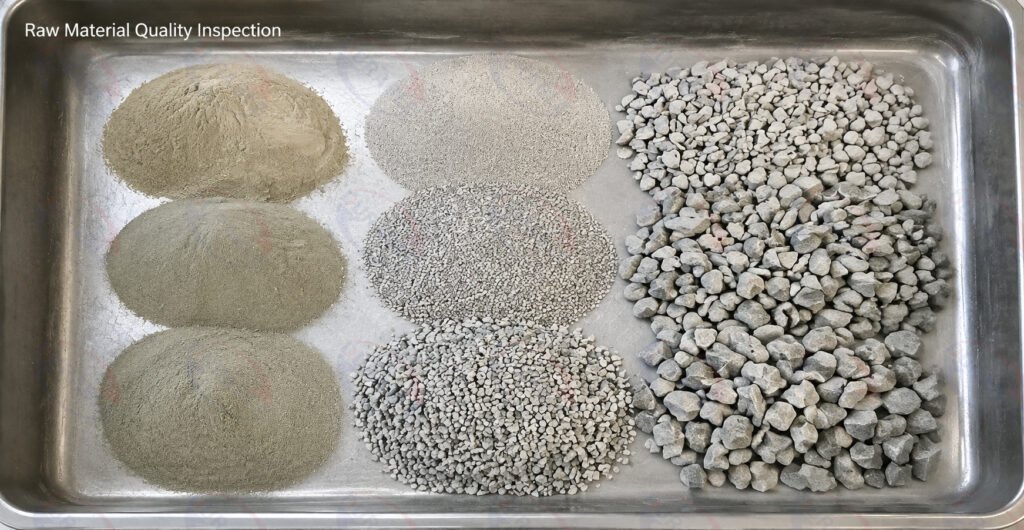
A visual check of a sand pile is not enough. A simple sieve analysis often gives a clearer picture of whether the material is suitable for stable production.
When a factory changes aggregate suppliers, the new material may look similar but have different particle distribution, shape, surface texture, water absorption, or fine content.
Therefore, a supplier change should trigger material verification instead of automatic continuation of the old recipe.
Why Aggregate Moisture Causes Hidden Mix Variations
Moisture is one of the easiest variables to overlook.
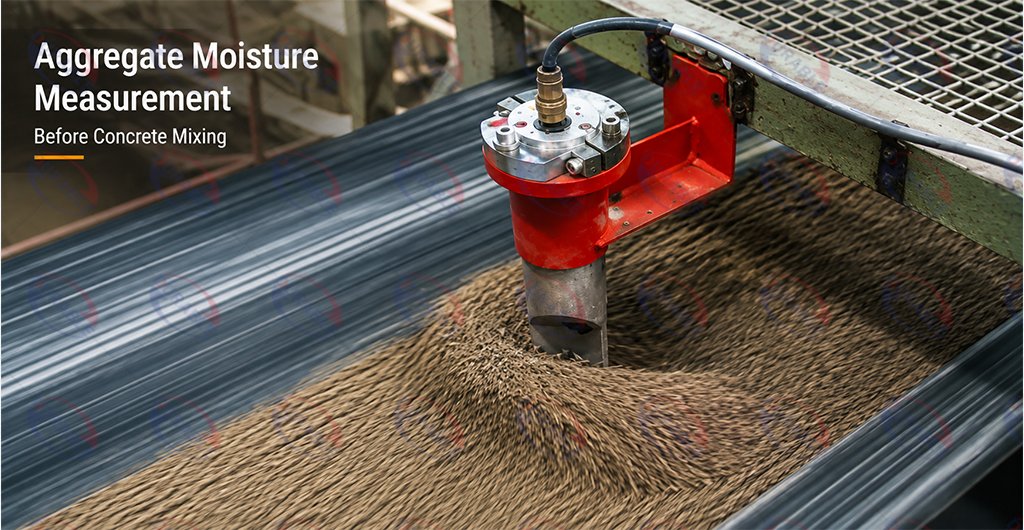
Operators usually know how much water the batching system adds. However, sand and aggregate may already contain moisture before they enter the mixer.
This means the displayed water dosage is not always the total water entering the batch.
A recipe may be developed using relatively dry sand. After rain, the same stockpile becomes much wetter. If the factory continues to add the same amount of mixing water, the actual water content increases.
The result may include:
- Higher effective water-cement ratio
- Softer concrete
- Lower final strength
- Greater shrinkage
- Different forming behavior
For dry-cast blocks, excess moisture may also make demolding more difficult.
Very dry aggregate can create the opposite problem. It may absorb part of the available water, making the batch too stiff, difficult to compact, poorly distributed, or inconsistent in appearance.
The solution is not simply adding water by feeling.
A better approach is to check aggregate condition and adjust added water according to actual material moisture.
Outdoor stockpiles can also change during the same day. Sand may be wet in the morning and drier in the afternoon. Rain can change the condition again within a short period.
For consistent output, aggregate moisture should be treated as a production variable, not as a fixed material property.
How Poor Storage and Batching Create Inconsistent Concrete
Material quality can change between delivery and production.
For this reason, storage design is part of concrete quality control.
Unprotected sand and aggregate stockpiles can absorb water during rain. The surface and lower sections of the same pile may also contain different moisture levels.
Improper handling can separate coarse and fine particles. Once a stockpile becomes uneven, material taken from different positions can behave differently during batching.
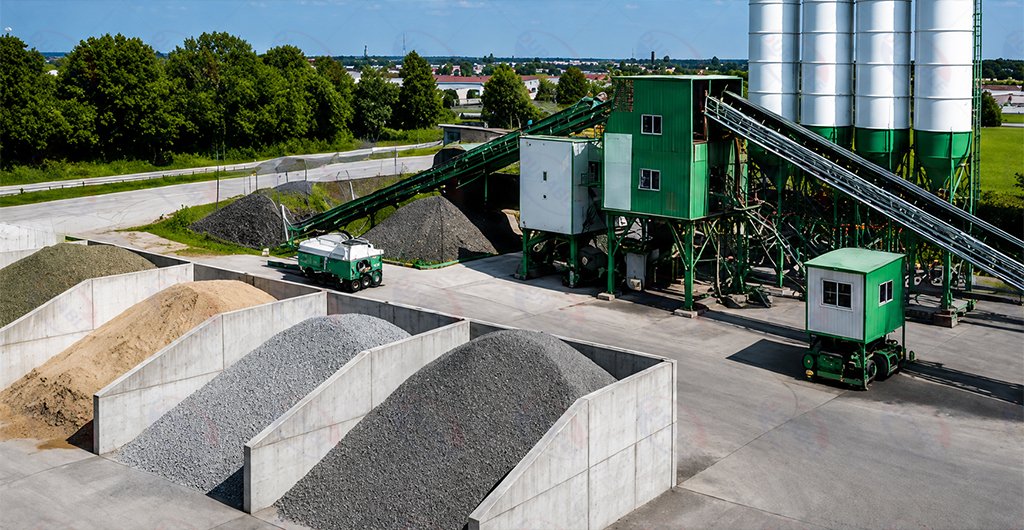
Poorly separated storage areas may also allow:
- Sand to mix with coarse aggregate
- Soil to enter stockpiles
- Different aggregate grades to mix together
- Foreign material to contaminate production
Once contamination occurs, accurate weighing alone cannot restore the intended recipe.
Cement also needs dry storage. Moisture exposure can cause lumping, reduced flow, feeding problems, and unstable batching.
A well-designed plant should therefore consider not only machine positions but also storage separation, drainage, material flow, and feeding stability.
For block factories, this is closely related to production layout:
How to Design an Efficient Concrete Block Factory Layout
Batching accuracy is the next key point.
Even when materials are suitable and properly stored, they still need to enter each batch in the correct proportions.
Small dosing errors can become repeated quality problems when production runs continuously.
Incorrect aggregate quantity changes the balance between coarse particles, fine particles, cement paste, and water.
Cement dosage must also remain consistent. Adding extra cement to compensate for poor control increases cost and may not solve the real problem.
Water accuracy is especially important because the system must account for moisture already present in the aggregates.
The target should be controlling total effective water, not simply repeating the same added-water quantity.
An automated batching system is only as accurate as its calibration and material data. Load cells, flow meters, moisture sensors, and dosing equipment require regular inspection.
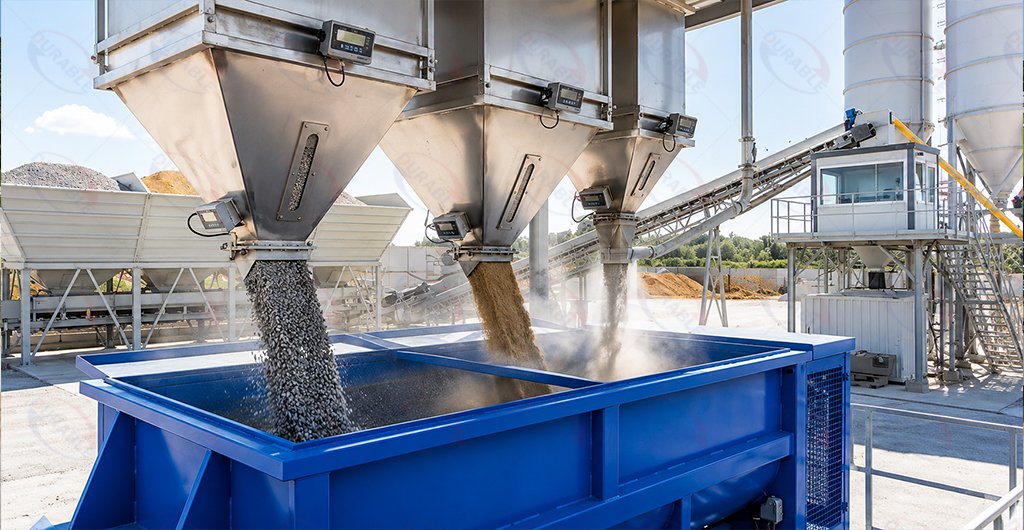
For larger projects, a stationary concrete batching plant can integrate aggregate batching, weighing, mixing, storage, and automated control.
For smaller or movable projects, a mobile concrete batching plant may provide more flexible site arrangement.
Even so, calibration and material management remain essential in both plant types.
What Should Be Checked Before Materials Enter the Mixer?
A simple pre-mixing inspection can prevent many downstream problems.
Instead of waiting until concrete fails a strength test or finished products show defects, factories should control the inputs first.
| Check | Why It Matters | Warning Sign |
|---|---|---|
| Aggregate grading | Controls packing and consistency | Sudden particle distribution change |
| Sand moisture | Changes actual water input | Mix becomes wetter or drier without recipe change |
| Aggregate cleanliness | Prevents clay and contamination | Mud, soil, or foreign material |
| Cement condition | Affects hydration and feeding | Lumps or moisture exposure |
| Batch weights | Maintains recipe consistency | Repeated weighing deviations |
| Water dosage | Influences strength and workability | Unexplained consistency change |
| Admixture dosage | Affects setting and performance | Irregular dosing or calibration errors |
The exact testing frequency depends on the plant, materials, weather, and product requirements.
However, checks should become more frequent whenever conditions change.
Examples include a new material supplier, heavy rain, very hot or dry weather, a new concrete formula, unexplained strength variation, or increased product rejection.
This approach is more effective than waiting for a finished product to reveal that something went wrong hours or days earlier.
How to Build a Stable Pre-Mixing Quality Control Process
Reliable concrete production does not require operators to test everything continuously.
Instead, factories need a practical system that detects meaningful changes before those changes become expensive defects.
Standardize material sources. Use consistent suppliers where possible and define acceptable material characteristics. When a source changes, verify the new material before using the old settings.
Separate and protect materials. Use clearly divided storage areas and reduce contamination between different aggregates. At the same time, manage rainwater, drainage, and stockpile handling.
Monitor aggregate grading. Periodic sieve analysis helps identify changes that cannot be judged reliably by appearance alone.
Check moisture and adjust water. Measure moisture when conditions change and adjust the added water accordingly. The objective is consistent concrete, not a permanently fixed water setting.
Calibrate batching equipment. Regularly verify aggregate weighing, cement weighing, water measurement, and admixture dosing.
Record production changes. Useful records include material supplier, moisture readings, batch proportions, water adjustments, test results, and unusual weather conditions.
Trace problems upstream. When concrete quality changes, do not immediately adjust the mixer. First check whether the aggregate source, moisture, grading, weighing system, cement condition, or actual water input has changed.
For factories comparing plant types, this guide may help:
Mobile vs Stationary Concrete Batching Plant: Which Is Better?
How to Choose Equipment and Suppliers for Stable Concrete Quality
Stable concrete quality depends on both equipment and process control.
A supplier should not only recommend a mixer. It should help the buyer evaluate materials, plant layout, batching accuracy, storage design, automation level, and target products.
Equipment selection should consider concrete type, required output, aggregate size, moisture variation, mixer type, batching accuracy, storage method, automation level, and future expansion.
A concrete block machine line, for example, may require a different concrete consistency from a ready-mix plant.
This means the mixer, batching system, material preparation, and curing process should be planned together.
| Supplier Factor | What to Check | Why It Matters |
|---|---|---|
| Process understanding | Concrete type, raw materials, and finished products | Helps avoid wrong machine selection |
| Mixer matching | Twin shaft, planetary, or other suitable mixer | Supports stable mixing performance |
| Batching design | Aggregate bins, weighing system, water control | Reduces repeated dosing errors |
| Layout planning | Storage, feeding, mixing, and discharge flow | Improves production stability |
| After-sales support | Installation, training, spare parts, and troubleshooting | Supports long-term operation |
Before requesting a quotation, prepare your raw material type, aggregate size, sand moisture condition, cement type, required capacity, target product, project country, power supply, automation requirement, and site layout.
This information helps engineers recommend a more suitable concrete production solution.
Frequently Asked Questions
Can a better concrete mixer solve poor concrete quality?
Not by itself. A better mixer can improve material distribution and mixing consistency, but it cannot fully correct incorrect batching, contaminated aggregate, excessive moisture, poor grading, or poor cement storage.
How does aggregate moisture affect concrete quality?
Moisture inside sand and aggregate contributes to the total water in the batch. If it is not considered when dosing water, the actual water-cement ratio and concrete consistency may change.
Why does the same concrete mix design produce different results?
The written recipe may remain unchanged while aggregate moisture, grading, material source, weighing accuracy, or weather conditions change. As a result, the actual batch can be different.
How often should aggregate moisture be checked?
The frequency should match production conditions. Checks are especially important after rain, during major weather changes, when material sources change, or whenever concrete consistency becomes unstable.
What should be inspected before concrete materials enter the mixer?
Factories should check aggregate grading and cleanliness, moisture condition, cement storage, batch weights, water dosage, admixture dosing, and batching equipment calibration.
About DURABLE
DURABLE provides concrete production equipment and complete solutions for construction projects, batching plants, precast operations, and block factories.
Our equipment range includes concrete mixers, mobile concrete batching plants, stationary concrete batching plants, concrete block machines, material batching and conveying systems, and supporting production equipment.
A stable concrete production system requires more than selecting a mixer.
Raw material storage, batching accuracy, moisture management, material flow, mixing equipment, and downstream production must work together.
DURABLE helps customers evaluate materials, required capacity, production process, site conditions, and automation needs before configuring a suitable concrete production solution.