 Durable Machinery
Get Price
Why Biomass Briquettes Crack and Break: Causes and Fixes
A biomass briquette can look strong when it leaves the machine and still crack during cooling, conveying, storage, or transportation.
When this happens, increasing machine pressure is not always the right solution.
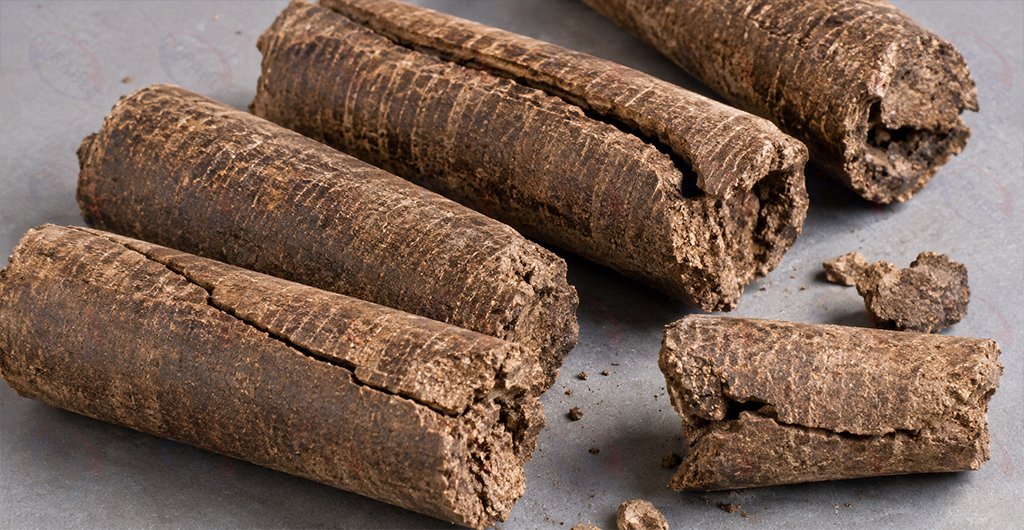
Weak briquettes often result from several connected factors, including raw material condition, particle size, moisture, feeding stability, forming conditions, cooling, and post-production handling.
The timing and appearance of the damage provide useful clues. A briquette that cracks immediately after forming may have a different problem from one that breaks several hours later.
For commercial biomass fuel producers, the best troubleshooting method is simple:
Identify when and how the briquette fails before changing machine settings.
Why Briquettes Can Look Good at the Machine but Break Later
A briquette leaving the forming die has completed only one stage of the production process.
Its final strength continues to depend on cooling, moisture stabilization, conveying, storage, and handling.
This explains why some briquettes initially have:
- Smooth surface
- Correct shape
- Acceptable density
- No obvious cracks
but later develop:
- Longitudinal cracks
- Broken ends
- Surface splitting
- Crumbling
- Complete breakage
Immediate cracking and delayed cracking should be treated differently.
If briquettes crack immediately after leaving the machine, first check raw material moisture, particle size, feeding consistency, forming conditions, and die or screw condition.
However, if they look acceptable at discharge but crack later, the problem may be related to rapid cooling, uneven moisture loss, internal stress, excessive conveying impact, or poor storage conditions.
A better production check should examine briquettes at several stages:
- Immediately after forming
- After initial cooling
- After conveying
- Before packaging
- After storage
Comparing these stages makes it easier to identify where strength is being lost.
DURABLE’s guide to how a biomass briquette machine works explains the relationship between material preparation, feeding, forming, cooling, and final briquette performance.
How Raw Material and Particle Size Affect Briquette Strength
Biomass is not a uniform industrial powder.
Sawdust, rice husk, straw, bagasse, bamboo waste, wood shavings, and other agricultural materials have different fiber structures, natural binding behavior, bulk densities, moisture characteristics, ash content, and impurity levels.
As a result, two materials processed with identical machine settings may form very differently.
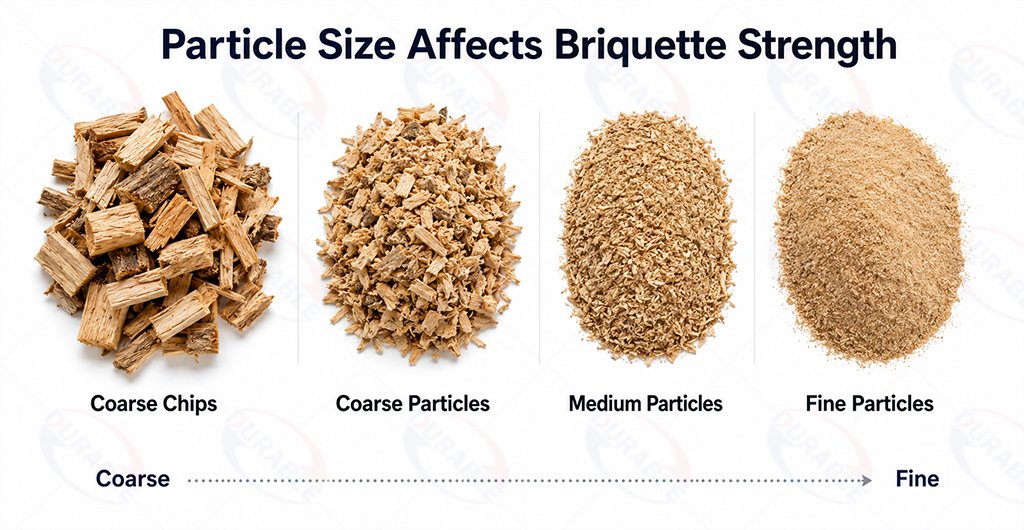
Large particles can create weak zones.
Oversized particles may not pack uniformly inside the forming zone. They can disturb feeding and create local differences in density.
Common symptoms include rough surfaces, weak sections, irregular shape, cracks around larger fibers, and unstable extrusion.
Large wood chips, bark pieces, or long straw fibers usually require size reduction before briquetting.
Very fine material is not always better.
Reducing everything to extremely fine powder does not automatically produce stronger briquettes.
Excessive fines may change material flow, friction, moisture behavior, and compaction characteristics. They can also increase dust during handling.
The objective should be a stable particle-size distribution that matches the forming system, not simply making the biomass as fine as possible.
Mixed particle sizes can cause inconsistent feeding.
If one batch contains mostly fine sawdust while another contains larger fibers, the bulk density entering the machine can change.
Even when the feeder runs at the same speed, the actual mass entering the forming chamber may differ.
Consequently, briquette density and strength can fluctuate.
Before changing pressure or temperature, check whether the raw material itself has changed.
Why Moisture Is One of the Biggest Causes of Briquette Cracking
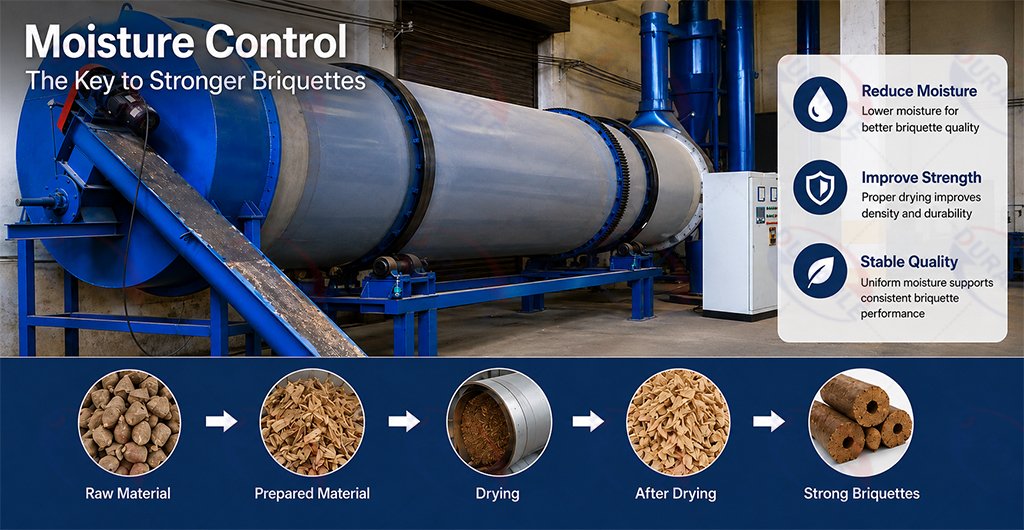
Moisture is one of the first variables to check when briquettes begin cracking.
For biomass briquetting, moisture affects material flow, compression behavior, heating response, and the way biomass binds under pressure.
However, one point is important:
Too wet and too dry can both cause problems.
When biomass is too wet, excess moisture can interfere with stable densification.
In heated forming conditions, water may turn into vapor. If that vapor cannot escape smoothly, internal pressure can contribute to surface cracks, internal splitting, irregular extrusion, and poor shape stability.
Wet material may also make feeding less predictable.
For this reason, material preparation is just as important as the biomass briquette machine itself.
Very dry biomass can also form poorly.
Depending on the material and briquetting system, insufficient moisture may reduce binding behavior and contribute to brittle briquettes, surface cracking, high forming resistance, and weak edges.
Therefore, operators should avoid responding to every cracking problem by drying the material further.
A common production mistake is judging moisture only by touch.
That may be useful for a quick check, but it is not enough for consistent commercial production.
Moisture can change because of:
- Rain
- Seasonal humidity
- Dryer settings
- Raw material supplier
- Storage time
- Different biomass types
If briquette quality suddenly changes, measure the actual material condition before adjusting several machine parameters.
How Compression, Feeding, and Machine Wear Cause Weak Briquettes
Once raw material size and moisture are stable, the forming process becomes the next area to investigate.
A briquette needs sufficient and consistent densification to maintain its shape.
However, the answer is not simply “use more pressure.”
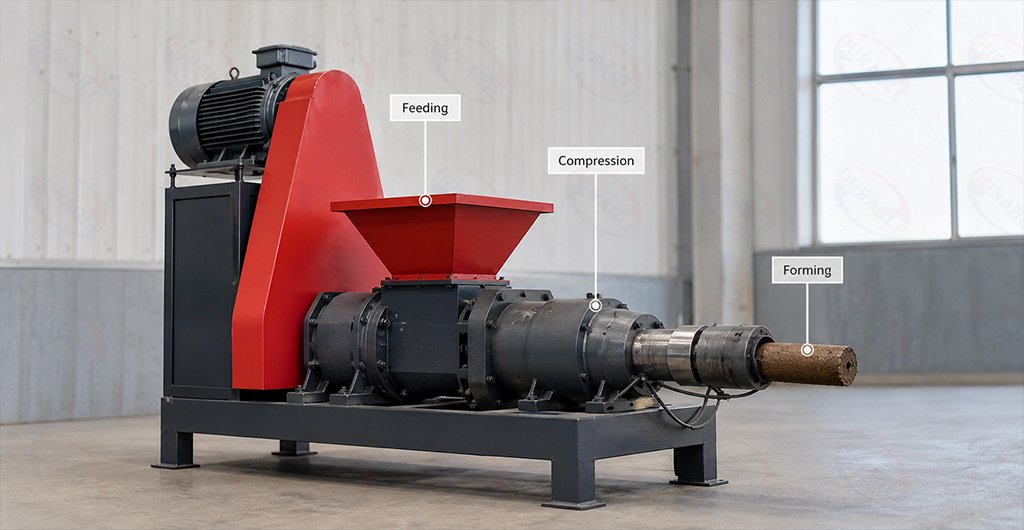
Unstable feeding creates density variation.
A briquette machine performs best when material enters the forming section continuously.
If feeding repeatedly changes between too much and too little material, the briquette may develop sections with different densities.
Those transitions can later become weak points.
Common causes include:
- Bridging inside the hopper
- Uneven raw material size
- Variable bulk density
- Interrupted feeding
- Poor upstream conveying
If the finished briquette repeatedly breaks at similar intervals, feeding consistency deserves attention.
Forming conditions must match the material.
The correct forming conditions depend on biomass type, moisture, particle distribution, machine design, and required briquette shape.
A setting that works well for sawdust may not be ideal for rice husk, straw, bark, or fibrous agricultural waste.
For heated screw briquetting systems, heat and mechanical compression work together with the natural binding characteristics of biomass.
Stable production requires balance, not one maximum setting.
Wear can gradually change briquette quality.
If production was previously stable but quality slowly deteriorates, inspect wear components.
Depending on the machine design, wear around the screw, forming die, or other high-friction components may affect compression, material flow, briquette dimensions, and surface finish.
This is especially important with abrasive biomass containing sand, grit, or other impurities.
DURABLE’s briquette machine troubleshooting guide covers broader machine faults, output problems, and maintenance issues. This article focuses specifically on cracking and breakage in finished briquettes.
Why Cooling, Conveying, and Storage Can Break Good Briquettes
Not every broken briquette was formed incorrectly.
Sometimes the product leaves the machine in acceptable condition but becomes damaged afterward.
This is one of the most overlooked causes of briquette breakage.
Freshly formed briquettes may leave the forming area at an elevated temperature.
Their outer surface and internal section do not always cool at exactly the same rate.
If cooling is too abrupt, differences in temperature and moisture can contribute to internal stress. Cracks may then appear during cooling rather than at the machine outlet.
Handling also matters.
Newly formed briquettes may not yet have reached their final handling strength.
Large drops between conveyors can cause broken ends, surface chips, complete fracture, and excessive fines.
If damage appears mainly after one transfer point, inspect the conveying system before changing the briquette machine.
Storage conditions can also affect final strength.
Biomass briquettes may interact with environmental moisture during storage. Poor protection from rain, ground moisture, high humidity, or condensation can weaken stability.
Packaging should therefore begin only after the briquettes have reached suitable cooling and storage conditions.
How to Diagnose Briquette Cracks by Failure Pattern
Instead of changing several parameters at once, examine the defect first.
The location, timing, and appearance of the crack can narrow the troubleshooting range.
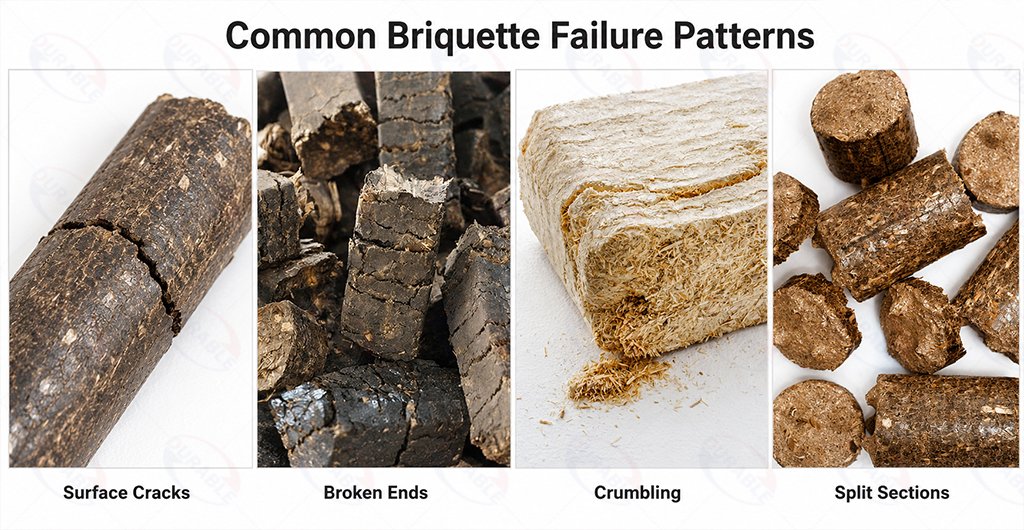
| Failure Pattern | Likely Area to Check First | What to Inspect |
|---|---|---|
| Cracks immediately after forming | Raw material and forming | Moisture, particle size, compression |
| Long surface cracks | Moisture or forming stability | Material condition, extrusion consistency |
| Briquette splits into sections | Feeding consistency | Hopper flow, feed stability, density variation |
| Ends crumble easily | Compaction or particle structure | Material size, forming condition |
| Good at discharge but cracks while cooling | Cooling process | Cooling rate and moisture loss |
| Breakage at conveyor transfers | Handling | Drop height and impact |
| Excessive breakage during storage | Final strength and storage | Cooling, humidity, stacking |
This table should be used as a diagnostic starting point rather than a universal formula.
The same visible crack may have more than one contributing cause.
Change one variable at a time.
Suppose a factory simultaneously adds water, changes particle size, adjusts heating, and increases feed rate.
If the briquettes improve, the operator still does not know which adjustment solved the problem.
More importantly, reproducing the result later becomes difficult.
A better troubleshooting method is:
- Record the current production condition.
- Identify the most likely cause.
- Change one important variable.
- Observe the result.
- Record the new condition.
- Continue only after the effect is clear.
This approach takes more discipline, but it produces much more useful production knowledge.
How to Produce Stronger and More Consistent Biomass Briquettes
Reliable briquette quality comes from controlling the complete process rather than repeatedly compensating for unstable inputs.
The following sequence provides a practical starting point.
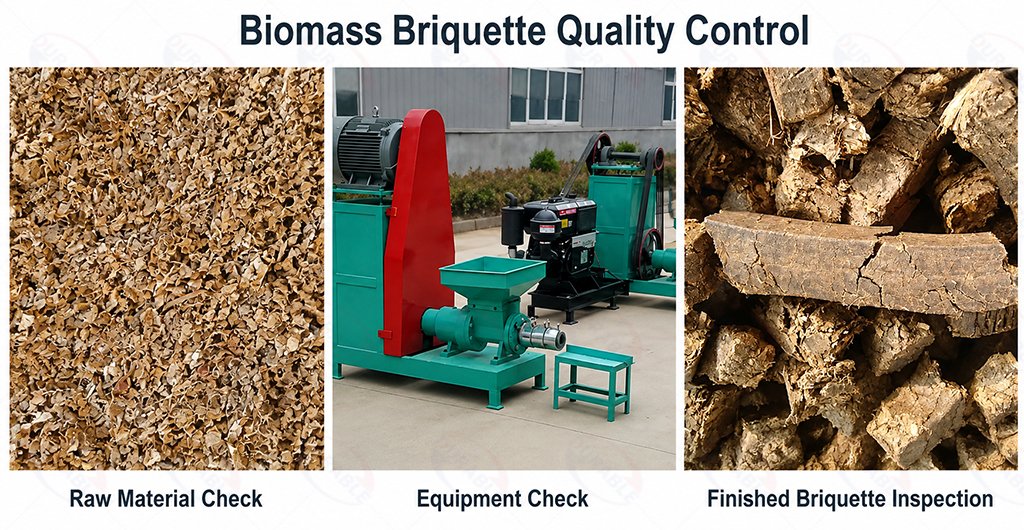
Stabilize the raw material.
Track biomass source, material type, impurities, and bulk density. If the raw material changes, do not assume the existing settings will remain optimal.
Control particle size.
Use appropriate crushing or size reduction when incoming biomass is too large or inconsistent. At the same time, avoid assuming that maximum fineness automatically improves strength.
Measure moisture.
Check actual moisture instead of relying only on appearance or operator experience. Pay particular attention after rain, dryer adjustments, supplier changes, and seasonal weather changes.
Stabilize feeding.
Watch for interruptions, bridging, and large changes in feed density. Consistent forming begins with consistent material delivery.
Check forming conditions.
Once the raw material is stable, inspect machine settings, forming temperature where applicable, compression behavior, wear components, and briquette shape at discharge.
Observe cooling.
Do not evaluate the briquette only when it exits the machine. Check whether cracks develop after several minutes or during further cooling.
Reduce handling impact.
Inspect conveyor transfers, collection points, and packaging operations. A good briquette should not be damaged by an unnecessarily aggressive material-handling system.
Keep production records.
Record raw material, moisture, particle size, machine settings, defect pattern, and final result.
Over time, these records become a practical production database for the factory.
The main lesson is simple:
Do not change moisture, particle size, feed rate, and machine settings at the same time. Find the failure stage first, then adjust the most likely cause.
How to Choose Equipment and Suppliers for Stable Briquette Quality
Stable briquette quality depends on the complete production line, not only the forming machine.
A supplier should help evaluate raw material type, moisture control, size reduction, feeding method, forming system, cooling, conveying, and packing.
Equipment selection should consider:
- Biomass type
- Raw material size
- Moisture condition
- Required capacity
- Briquette shape
- Heating and forming method
- Cooling method
- Automation level
- Site layout
- Future expansion
A suitable line may include raw material crushing, drying, feeding, briquetting, cooling, conveying, and packing, depending on the project.
| Supplier Factor | What to Check | Why It Matters |
|---|---|---|
| Raw material understanding | Biomass type, size, moisture, impurities | Helps avoid wrong machine selection |
| Complete line design | Crusher, dryer, feeder, briquette machine, cooling and conveying | Reduces bottlenecks and unstable feeding |
| Wear-part support | Screw, die, sleeve, and high-friction parts | Supports long-term forming stability |
| Testing and adjustment | Ability to evaluate real material samples | Helps match settings to actual feedstock |
| After-sales support | Installation, training, spare parts, troubleshooting | Supports stable operation after delivery |
Before requesting a quotation, prepare:
- Raw material type
- Current particle size
- Moisture condition
- Required capacity
- Target briquette shape
- Available power supply
- Project country
- Site layout
- Automation requirement
- Whether drying or crushing is needed
This information helps engineers recommend a more suitable biomass briquetting solution.
Frequently Asked Questions
Why do biomass briquettes crack after coming out of the machine?
Common causes include unsuitable moisture, inconsistent particle size, unstable feeding, forming conditions, or rapid cooling. First determine whether the crack appears immediately or develops later, because the timing helps identify the likely production stage.
Can too much moisture make biomass briquettes break?
Yes. Excess moisture can interfere with densification and may create vapor pressure under heated forming conditions. However, overly dry material can also produce brittle or poorly bonded briquettes, so moisture should be measured rather than reduced blindly.
Does finer sawdust always make stronger briquettes?
No. Uniform and suitable particle size is more important than maximum fineness. Excessive fines can change material flow and forming behavior, while oversized particles can create weak zones or unstable feeding.
Why are briquettes strong after pressing but weak after cooling?
The problem may be related to rapid cooling, uneven moisture loss, internal stress, or handling before the briquettes develop sufficient strength. Inspect the product at several points after forming instead of judging it only at the machine outlet.
How can I improve biomass briquette strength without simply increasing pressure?
Start by stabilizing raw materials, checking particle size and moisture, maintaining consistent feeding, inspecting forming conditions, and improving cooling and handling. Change one variable at a time so you can identify what actually improves the product.
About DURABLE
DURABLE provides biomass processing equipment and production solutions for wood processors, agricultural waste projects, biomass fuel producers, and charcoal manufacturers.
Our biomass equipment range includes biomass briquette machines, crushers, hammer mills, wood chippers, biomass dryers, pellet making machines, carbonization equipment, and supporting conveying systems.
Briquette quality depends on more than the forming machine.
Raw material preparation, moisture, particle size, feeding, forming, cooling, and handling must work together.
DURABLE helps buyers evaluate raw materials, required capacity, final product, factory conditions, and supporting equipment before configuring a suitable biomass briquetting solution.