 Durable Machinery
Get Price
Why Wood Chip Size Matters More Than Chipper Capacity
When buyers compare wood chippers, production capacity is often the first number they check.
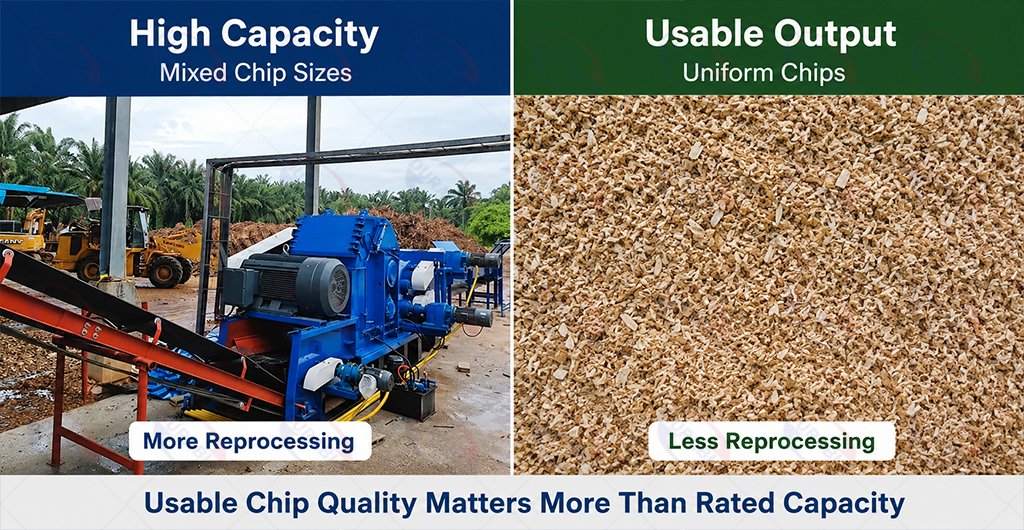
A machine rated for more tons per hour may appear to be the better investment. However, that number does not tell you whether the chips leaving the machine are suitable for drying, grinding, pelletizing, carbonization, or boiler feeding.
A plant can process a large volume of wood and still create downstream problems if the chips are too large, too thin, highly irregular, or mixed with excessive fines.
Therefore, the more useful question is not simply:
“How many tons per hour can the chipper process?”
It is:
“How many tons of usable chips can the plant consistently produce for the next process?”
For biomass fuel plants, pellet factories, briquette projects, and wood-processing operations, chip quality can be more important than brochure capacity.
Why Rated Chipper Capacity Does Not Tell the Whole Story
Rated chipper capacity measures how much raw material a machine can process under specified conditions.
It does not automatically measure usable final output.
Actual chipper performance depends on:
- Wood species
- Log diameter
- Moisture condition
- Material shape
- Feeding consistency
- Knife condition
- Required chip size
- Downstream process requirements
For example, straight logs can usually move through a chipper more predictably than tangled branches, slabs, or irregular forestry residues.
Likewise, producing coarse biomass fuel chips may allow higher throughput than producing tightly controlled chips for a more demanding downstream process.
Rated output and usable output are not the same.
Suppose two chippers process the same raw material.
Machine A has a higher nominal capacity but produces more oversized pieces and fines. Some material must be screened out, returned, or reprocessed.
Machine B processes less raw material per hour but produces a more consistent chip size.
Depending on the downstream process, Machine B may provide more usable material per shift, even though its brochure capacity is lower.
This is why buyers should distinguish between:
- Raw throughput
- Acceptable chip output
- Material requiring reprocessing
- Fines and handling losses
- Stable output delivered to the next machine
Capacity still matters. But it should always be evaluated together with chip quality.
What Makes a Good Wood Chip for Biomass Production?
There is no single ideal wood chip size for every application.
A good chip is one that matches the next processing stage.
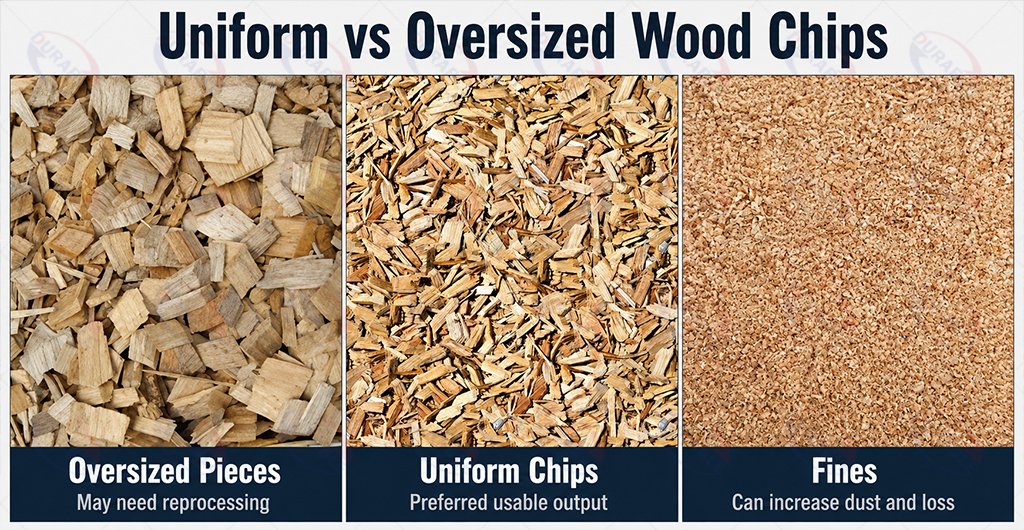
Important characteristics include:
- Length
- Thickness
- Width
- Size distribution
- Oversize content
- Fines content
- Moisture consistency
- Feeding behavior
Uniformity is often more important than one exact dimension.
Wood chips for pellet production
Wood chips normally require additional preparation before entering a pellet mill.
Typical downstream steps may include drying, fine grinding, screening, and pelletizing.
A Pellet Making Machine works with much smaller prepared particles than the chips produced directly by a primary wood chipper.
Therefore, the purpose of the chipping stage is not to produce the final pellet feed size.
Instead, it should create material that can be dried and ground efficiently.
Wood chips for biomass fuel
Boiler and biomass fuel applications may accept larger chips than pellet production.
However, excessively irregular chips can still create feeding problems, bridging, uneven combustion, and inconsistent fuel flow.
The fuel-handling system should determine the acceptable size distribution.
Wood chips for carbonization
If wood chips enter a carbonization process, size consistency also matters.
Very different chip sizes may heat at different rates. Larger pieces can require more time, while small fragments heat much faster.
Stable raw material preparation can support more consistent carbonization.
Uniformity matters more than appearance
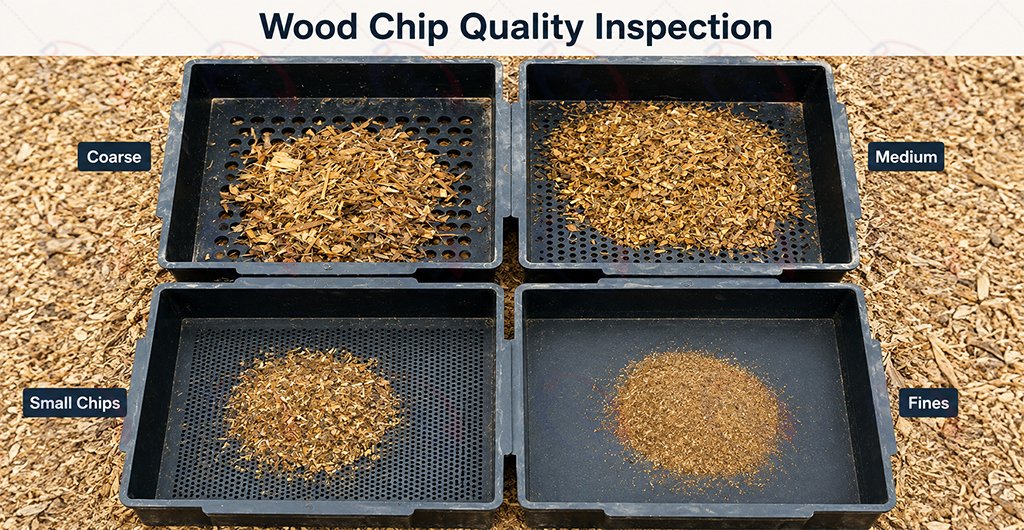
A pile of chips can look acceptable while still containing a wide particle-size distribution.
For commercial production, useful questions include:
- What percentage of chips falls within the target range?
- How much oversize material is present?
- How much fine material is generated?
- Does the distribution remain stable throughout the shift?
- Can the next process handle the chip size consistently?
These questions provide more useful information than judging chip quality by appearance alone.
How Chip Size Affects Drying, Grinding, and Pelletizing
The real importance of wood chip size becomes clear after the chipper.
Poor chip consistency can create problems throughout the rest of a biomass line.
Drying
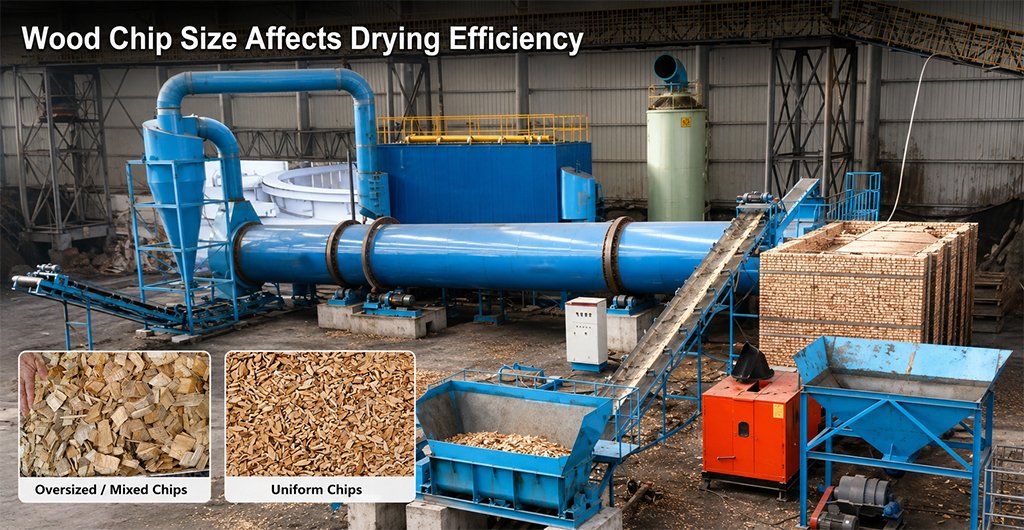
Larger wood pieces generally require more time for moisture to move from the center to the surface.
Small particles lose moisture faster.
When a dryer receives a mixture of very large chips and very small fragments, the material may not dry uniformly.
Possible results include:
- Wet oversized chips
- Over-dried fines
- Unstable dryer discharge moisture
- More difficult process control
- Higher risk of inconsistent downstream feeding
Uniform chips make the drying load more predictable.
Fine grinding
Pellet and briquette production often require further size reduction after chipping.
A Hammer Mill Crusher can reduce prepared wood into smaller particles for downstream processing.
However, the hammer mill works more consistently when incoming chips are reasonably controlled.
Oversized pieces can increase grinding load, cause unstable feeding, and reduce practical throughput.
At the same time, excessive fines do not need the same grinding work and may increase dust handling.
Pelletizing and briquetting
A pellet mill or briquette machine requires prepared material with suitable particle size and moisture.
Therefore, primary chipping quality indirectly affects the whole production line.
If drying and grinding receive stable chips, they can usually provide more consistent material to the pellet mill or Biomass Briquette Machine.
This means the chipper should be selected as part of the complete process rather than as an isolated machine.
Why Oversized Chips and Excess Fines Reduce Real Output
A chipper can show strong hourly throughput while still creating hidden production losses.
Two common problems are oversized chips and excessive fines.
Oversized chips
Oversized material may need:
- Screening
- Manual removal
- Re-chipping
- Additional grinding
- Extra conveying
- Extra machine time
Each extra step uses electricity, labor, conveying capacity, and production time.
Therefore, reprocessing reduces the value of high primary throughput.
Excessive fines
Fines can also create problems.
Depending on the application, excessive fine material may increase:
- Dust
- Handling loss
- Uneven drying
- Storage contamination
- Housekeeping burden
- Fire and safety concerns
Some fines may still be usable in downstream grinding or fuel production.
The key question is whether the downstream process can handle them efficiently.
A better capacity question
Instead of asking only:
“What is the chipper capacity?”
buyers should ask:
“What is the usable output at my required chip specification?”
That question forces the comparison to include both volume and quality.
| Buyer Focus | What It Really Tells You |
|---|---|
| Rated capacity | Potential processing rate under stated conditions |
| Target chip size | Whether downstream equipment can accept the material |
| Size uniformity | How stable drying, feeding, and grinding may be |
| Oversize material | How much may require screening or reprocessing |
| Fines generation | Potential dust and material handling load |
| Raw material range | Whether test conditions match your feedstock |
| Knife system | How chip quality can be maintained over time |
| Screening option | Whether tight size control is required after chipping |
A higher-capacity machine can still be the correct choice.
Nevertheless, its value depends on the quality of the output that reaches the next process.
Drum Chipper vs. Disc Chipper: Which Gives Better Chip Control?
Both drum chippers and disc chippers can produce useful wood chips, but they are designed around different priorities.
A disc chipper uses knives mounted on a rotating disc. When clean logs or straight wood enter under controlled conditions, this cutting action can produce highly uniform chips.
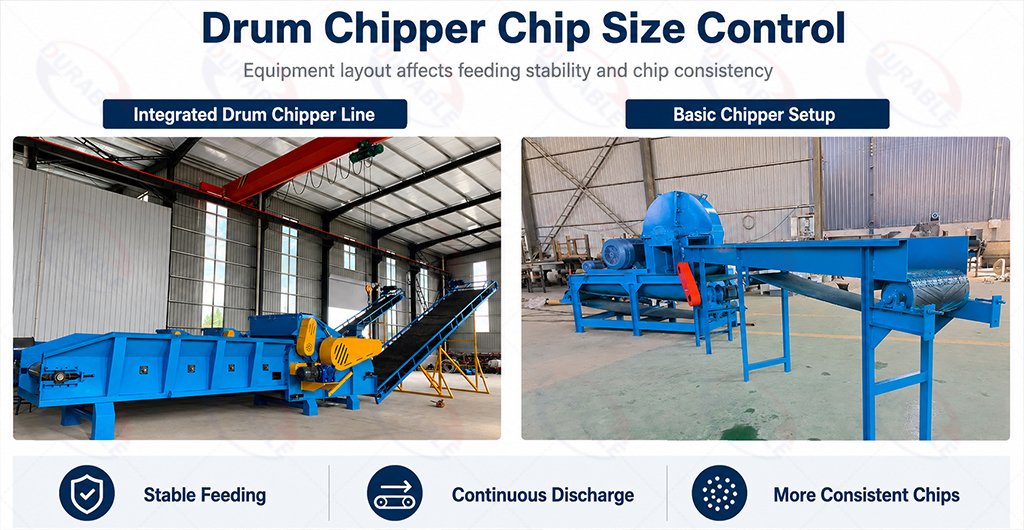
A drum chipper uses knives mounted on a rotating cylindrical drum. This design is commonly selected where continuous feeding, higher throughput, and irregular wood materials are important.
DURABLE’s comparison of Disc Chippers and Drum Chippers explains these differences in greater detail.
When disc chipping makes sense
A Disc Wood Chipper is often suitable when the raw material consists of clean logs, straight branches, or regular wood sections.
Its main advantage is controlled cutting and consistent chip geometry.
This can be useful for pellet raw material preparation, boiler fuel, pulp-related applications, and clean wood chip production.
When drum chipping makes sense
Drum chippers are often preferred when the plant handles sawmill slabs, forestry residues, irregular branches, wood offcuts, or larger biomass volumes.
In these projects, stable feeding and raw material tolerance may matter more than very precise chip geometry.
The article Why More Biomass Plants Are Switching to Drum Chippers explains why larger biomass operations increasingly consider this configuration.
Neither design is automatically better
The correct choice depends on what the downstream plant needs.
If uniform chip geometry is the priority, disc chipping may offer an advantage.
If high-volume continuous processing of irregular material is the priority, a drum chipper may be more practical.
What Actually Controls Wood Chip Size and Uniformity?
Machine type matters, but it is not the only factor controlling chip quality.
Several operating variables can change the product even when the same chipper is used.
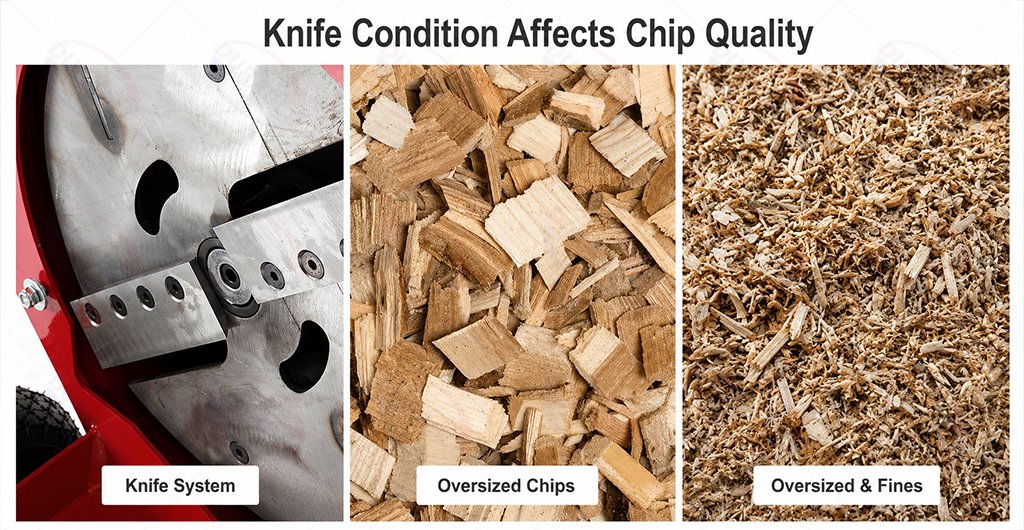
Knife condition
Sharp knives cut wood more cleanly.
As knives wear, operators may notice:
- More irregular chips
- Increased tearing
- More fines
- Higher power demand
- Reduced cutting efficiency
A worn knife can reduce chip quality before the machine shows a major loss in total capacity.
This is why knife inspection should be based on chip quality as well as operating hours.
Knife adjustment
Knife position and cutting geometry influence chip dimensions.
If the machine allows adjustment, the correct setting should match the raw material, target chip size, knife design, and machine instructions.
Adjustment should follow the equipment manufacturer’s operating requirements rather than trial-and-error changes during full production.
Feed speed
Feeding affects how the wood contacts the cutting system.
Unstable feeding can produce inconsistent cuts, especially when raw material dimensions vary significantly.
A continuous industrial line therefore needs a feeding system that matches chipper capacity.
Raw material diameter and shape
A chipper processing straight logs under stable conditions may produce different results from the same machine handling twisted branches or irregular residues.
Before selecting a chipper, buyers should provide:
- Maximum feed diameter
- Typical feed diameter
- Material length
- Wood species
- Material shape
- Moisture condition
- Contamination risk
Without this information, a capacity number has limited value.
Moisture condition
Fresh wood and dry wood can cut differently.
Moisture affects cutting resistance, chip breakage, and material behavior during discharge.
Therefore, chip quality testing should use raw material that represents the buyer’s actual production conditions.
Screening
When tight product control is required, screening may be used after chipping.
Screening can separate target chips, oversize pieces, and fine material.
This does not improve the cutting action itself, but it can improve the consistency of material delivered downstream.
How Buyers Should Compare Wood Chippers Before Purchasing
A useful wood chipper comparison should begin with the complete biomass process.
Do not select a machine only because the quotation shows the highest capacity number.
Start with the raw material.
Record:
- Wood type
- Average diameter
- Maximum diameter
- Moisture condition
- Material shape
- Contamination level
- Whether the material is clean logs, slabs, branches, or mixed residues
Next, define what the chipper must produce.
Specify:
- Target chip size
- Acceptable size range
- Maximum oversize material
- Acceptable fines level
- Downstream process
- Whether screening is required
Then consider the required production volume.
Ask what raw material was used for the capacity test
Rated capacity is meaningful only when the test conditions are understood.
Ask the supplier:
- What wood species was processed?
- What diameter was used?
- What moisture condition was used?
- What chip size was targeted?
- Was feeding continuous?
- Was screening included?
- Was the material similar to my actual feedstock?
A capacity test using clean straight logs should not automatically be applied to irregular forestry waste.
Ask for actual chip samples or production evidence
Where available, buyers should review:
- Real machine videos
- Chip samples
- Chip-size measurements
- Similar raw material projects
- Downstream operation feedback
This provides better evidence than a single capacity number.
Compare maintenance requirements
Chip quality depends on maintaining the cutting system.
Therefore, ask about:
- Knife inspection
- Knife replacement
- Adjustment procedure
- Bed knife or counter-knife maintenance
- Access to wear parts
- Time required for routine maintenance
A machine that produces good chips only when the knives are new is not enough.
The plant needs a practical way to maintain chip quality over time.
Consider the next machine
Finally, ask what happens to the chips after they leave the chipper.
If the next stage is fine grinding, the primary objective may be creating stable feed for the hammer mill.
If the chips go directly to a biomass burner, size distribution may influence fuel feeding.
For pellet production, chipping should support consistent drying and grinding before the material reaches the pellet mill.
The purchasing principle is simple:
Buy the chipper for the downstream process, not for the largest capacity number on the quotation.
How to Choose Equipment and Suppliers for Stable Chip Quality
Stable chip quality depends on both machine design and process planning.
A supplier should help buyers evaluate raw material type, feed method, target chip size, downstream equipment, maintenance access, screening requirement, and site layout.
The best machine is not always the machine with the largest rated output.
It is the machine that can provide stable usable chips for the buyer’s next production stage.
| Supplier Factor | What to Check | Why It Matters |
|---|---|---|
| Raw material understanding | Wood type, shape, diameter, moisture, contamination | Helps avoid wrong machine selection |
| Process design ability | Chipping, drying, grinding, pelletizing, briquetting, or carbonization | Ensures the chipper matches the whole line |
| Chip-size control | Knife system, feed system, adjustment, screening | Supports more stable downstream processing |
| Wear-part support | Knives, counter-knives, screens, bearings, belts | Helps maintain chip quality over time |
| Evidence and testing | Videos, samples, similar projects, real material tests | Reduces risk before purchase |
| After-sales support | Installation guidance, training, spare parts, troubleshooting | Supports long-term operation |
Before requesting a quotation, prepare:
- Raw material type
- Typical and maximum feed size
- Target chip size
- Required capacity
- Downstream process
- Project country
- Power supply
- Site layout
- Whether screening, drying, or grinding is needed
This information helps engineers recommend a more suitable wood-processing solution.
Frequently Asked Questions
What is the best wood chip size for biomass production?
There is no universal best size. The correct chip dimensions depend on whether the material will be dried, ground, pelletized, carbonized, burned directly, or used for another process. Define the downstream requirement first.
Does a larger wood chipper always produce more usable output?
No. A larger chipper may process more raw material, but oversized chips, excessive fines, or poor size consistency can reduce usable downstream output. Compare acceptable chip production as well as raw throughput.
Why does a wood chipper produce too many fines?
Possible causes include worn knives, unsuitable cutting settings, dry or brittle material, inconsistent feeding, and raw material characteristics. The cutting system and feedstock should be inspected together.
Can wood chip size be adjusted on a chipper?
Depending on the machine design, chip size may be influenced by knife settings, feed conditions, cutting geometry, and downstream screening. Available adjustments should be confirmed for the specific model.
Should I choose a drum chipper or disc chipper for uniform chips?
For clean logs and straight wood, a disc chipper often provides strong chip-size uniformity. A drum chipper is generally more suitable when high throughput and tolerance for irregular biomass are more important.
About DURABLE
DURABLE provides wood and biomass processing equipment for pellet plants, briquette projects, charcoal production, biomass fuel preparation, and wood recycling applications.
Our equipment range includes disc wood chippers, wood chipping systems, hammer mill crushers, comprehensive crushers, pellet making machines, biomass briquette machines, carbonization equipment, and supporting conveying systems.
A successful biomass line should not be designed around one machine’s maximum capacity.
Raw material characteristics, chip quality, drying, grinding, feeding, and downstream equipment must work together.
DURABLE helps buyers evaluate raw material type, target chip size, required capacity, downstream process, and project conditions before configuring a suitable wood-processing solution.