 Durable Machinery
Get Price
Why Some Block Factories Produce More With the Same Equipment
Two block factories can use similar machines, similar molds, and similar working hours, but still finish the day with very different numbers of saleable blocks.
The difference is not always the block machine itself.
One factory may keep the machine supplied with consistent concrete, clean pallets, stable feeding, and smooth product handling. Another factory may stop repeatedly to adjust the mix, wait for pallets, clear minor faults, or remove defective blocks.
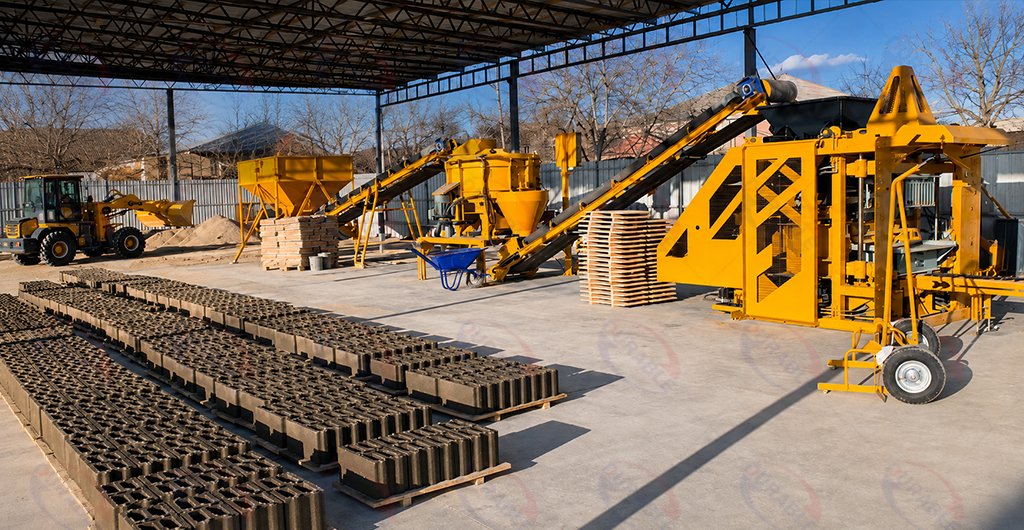
On paper, both factories may have similar equipment capacity.
In real production, their saleable output per shift can be very different.
That is why productive block factories do not focus only on making the forming machine cycle faster. They reduce waiting time, rejects, small interruptions, and bottlenecks across the whole production line.
Why Machine Capacity Is Not the Same as Factory Output
Block machine specifications commonly include blocks per mold, forming cycle, pieces per hour, and pieces per shift.
These figures are useful when comparing equipment, but they do not automatically tell you how many acceptable blocks a factory will produce during a real shift.
Production is lost whenever the machine waits because of:
- Concrete not being ready
- Aggregate or cement shortages
- Empty pallet supply
- Finished pallets not being removed
- Mix adjustments
- Material blockages
- Mold cleaning
- Minor maintenance
- Product congestion near the curing area
A machine may have a fast rated cycle, but if the mixer cannot supply concrete in time, the forming machine waits. If pallets are not ready, the machine waits. If finished blocks cannot leave the forming area, the machine waits again.
This is why buyers should not evaluate a Concrete Block Machine only by theoretical output.
Machine capacity must be matched with the complete production system.
Why Saleable Output Matters More Than Gross Output
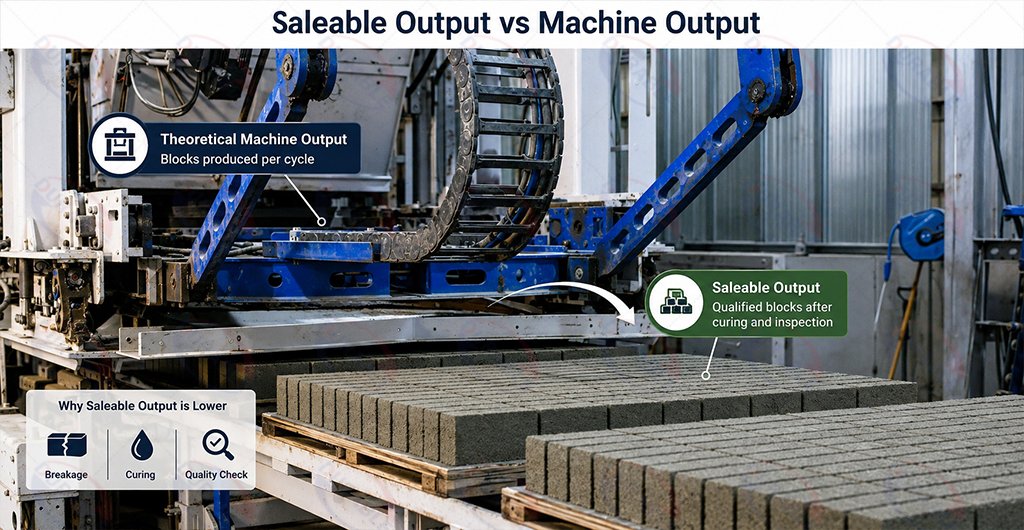
Factories should distinguish between three output numbers.
| Output Type | Meaning | Why It Matters |
|---|---|---|
| Machine output | Blocks leaving the forming machine | Shows forming activity |
| Finished output | Blocks completing production and curing | Shows production completion |
| Saleable output | Blocks meeting quality requirements and ready for delivery | Shows commercial value |
For a commercial block factory, saleable output matters most.
Rejected blocks still consume cement, aggregate, water, electricity, labor, pallets, curing space, and handling time.
A factory that produces more blocks but also produces more rejects may not improve its real production efficiency.
A better question is not:
How fast can the machine cycle?
A better question is:
How many acceptable blocks can the whole factory produce and deliver per shift?
That question shifts the focus from machine speed to factory efficiency.
How Consistent Concrete Keeps the Block Machine Running
A block machine cannot run consistently if the concrete feeding it changes from batch to batch.
For dry-cast concrete blocks, small changes in moisture, aggregate grading, and batching accuracy can quickly affect forming behavior.
A mix that is too wet may cause difficult demolding, deformation, material sticking, weak green blocks, and more cleaning.
A mix that is too dry may cause poor compaction, weak edges, incomplete mold filling, rough surfaces, and more adjustment.
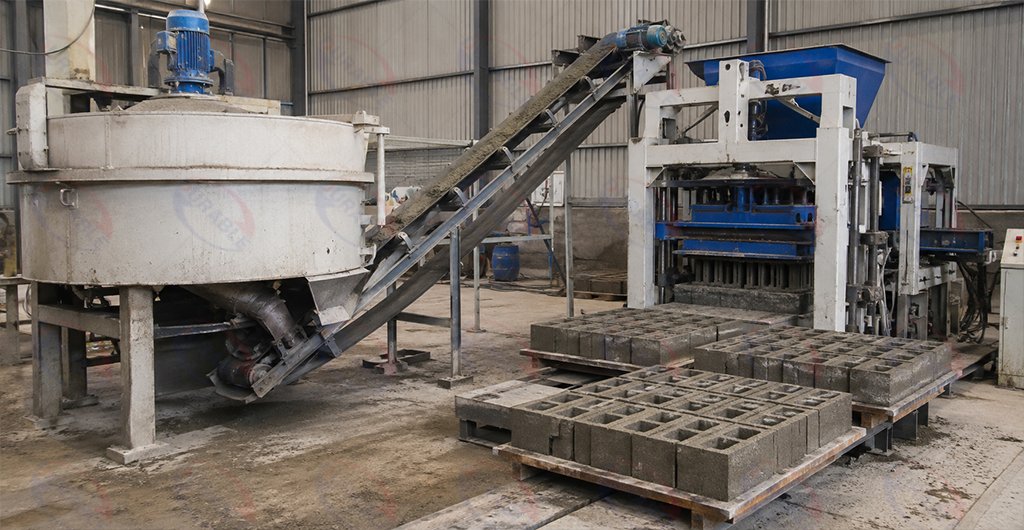
In both cases, operators may stop production to correct the problem.
The machine may be working normally, but unstable concrete reduces actual output.
Longer mixing cannot reliably correct unstable inputs. If aggregate proportions are wrong, sand moisture changes, cement dosing is inconsistent, or batching is inaccurate, the mixer cannot fully solve the problem after the batch has already been made.
Stable production starts before forming.
The objective is to make repeatable concrete that behaves predictably inside the block machine.
Mixer capacity also needs to match block machine demand. For many medium and large block factories, a Twin Shaft Concrete Mixer is used when stable, high-output mixing is required.
However, the mixer should not be selected alone. Buyers should evaluate batching accuracy, moisture control, discharge speed, feeding stability, and the forming machine demand together.
How Feeding, Pallets, and Material Flow Create Hidden Bottlenecks
The block machine sits at the center of production, but it depends on several supporting processes.
A delay in any one of them can stop forming.
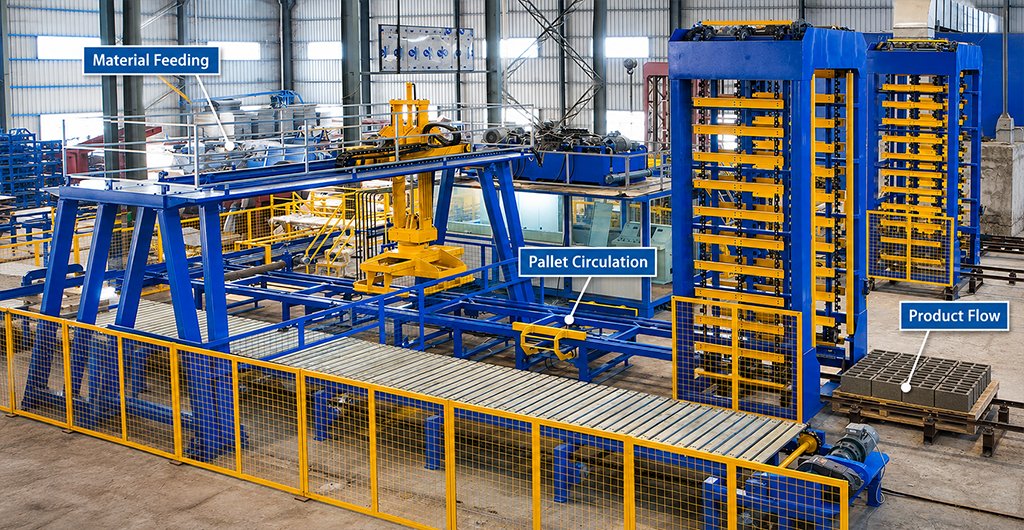
Material feeding
Concrete should reach the block machine consistently.
Irregular feeding may cause waiting between cycles, incomplete mold filling, density variation, and more operator intervention.
The mixer, conveyor, hopper, and feeding system need enough practical capacity to support continuous operation.
A fast block machine cannot maintain high output if material supply is unstable.
Pallet supply
Pallet-based machines also depend on reliable pallet circulation.
Damaged, warped, dirty, or incorrectly positioned pallets can interrupt production and affect fresh block stability.
Pallet problems may look small, but repeated stops can reduce the whole shift output.
Finished product removal
Fresh blocks must also leave the forming area fast enough.
Depending on the automation level, factories may use pallet conveyors, stackers, forklifts, curing racks, or manual handling.
If finished products cannot move away quickly enough, the forming machine has nowhere to send the next pallet.
The guide to a Solid Block Production Line explains why batching, mixing, conveying, forming, stacking, curing, and pallet circulation must operate as one connected system.
Why Faster Machine Cycles Can Reduce Saleable Output
When a factory wants more production, increasing forming speed seems like the obvious solution.
Sometimes it works.
However, if the surrounding process cannot support the faster cycle, the factory may experience incomplete mold filling, poor compaction, material shortages, damaged blocks, more interruptions, and higher wear.
The goal should not be the shortest possible cycle.
It should be the fastest stable cycle that consistently produces acceptable blocks.
If a factory increases forming speed and more blocks leave the machine each hour, the production counter may look better. But if the rejection rate also rises, saleable output may not improve.
Rejected blocks still consume materials, electricity, labor, pallets, curing space, and handling capacity.
Product changes also consume time.
A factory producing one standard hollow block may achieve different practical output from a factory frequently changing between hollow blocks, solid blocks, pavers, curbstones, and special shapes.
Mold changes, mix adjustments, pallet handling, curing requirements, and stacking methods all affect productive time.
For higher automation, an Automatic Brick Making Machine should be planned together with mixer capacity, pallet circulation, stacking, and curing space.
Why Downtime and Micro-Stoppages Reduce Daily Output
Factories usually notice major breakdowns.
Smaller interruptions are easier to ignore.
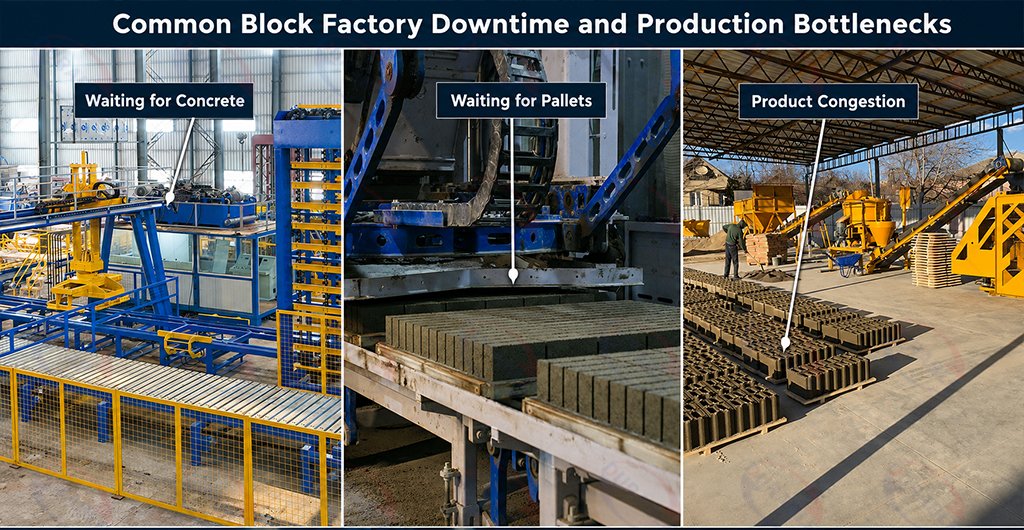
These small stops may include:
- Cleaning sensors
- Removing spilled concrete
- Correcting pallet position
- Adjusting material moisture
- Clearing a hopper
- Waiting for a forklift
- Changing a wear part
- Scraping a mold surface
- Repositioning a conveyor
Individually, these stops may appear insignificant.
Repeated throughout a shift, they create a large gap between theoretical output and real saleable output.
This is often the hidden reason why two factories using similar equipment produce different results.
A simple downtime record can reveal where capacity is being lost.
| Stop Reason | What to Check |
|---|---|
| Waiting for concrete | Mixer and batching capacity |
| Waiting for pallets | Pallet circulation and pallet condition |
| Hopper empty | Feeding and material flow |
| Poor block shape | Mix, mold filling, vibration, and compaction |
| Sensor interruption | Cleaning and alignment |
| Mold adjustment | Product setup and maintenance |
| Product congestion | Stacking, curing, and handling flow |
After enough records are collected, the factory may discover that the block machine itself is not the only constraint.
Planned downtime is different.
Cleaning, lubrication, inspection, mold maintenance, and wear-part replacement are necessary. Skipping them can create longer unplanned stops later.
How Factory Layout and Line Balance Affect Production
A poorly arranged factory forces materials, workers, forklifts, pallets, and finished blocks to travel farther than necessary.
The equipment may have enough capacity, but unnecessary movement slows the entire operation.
A practical production flow should minimize handling between:
Raw Materials → Batching → Mixing → Forming → Stacking → Curing → Finished Product Storage
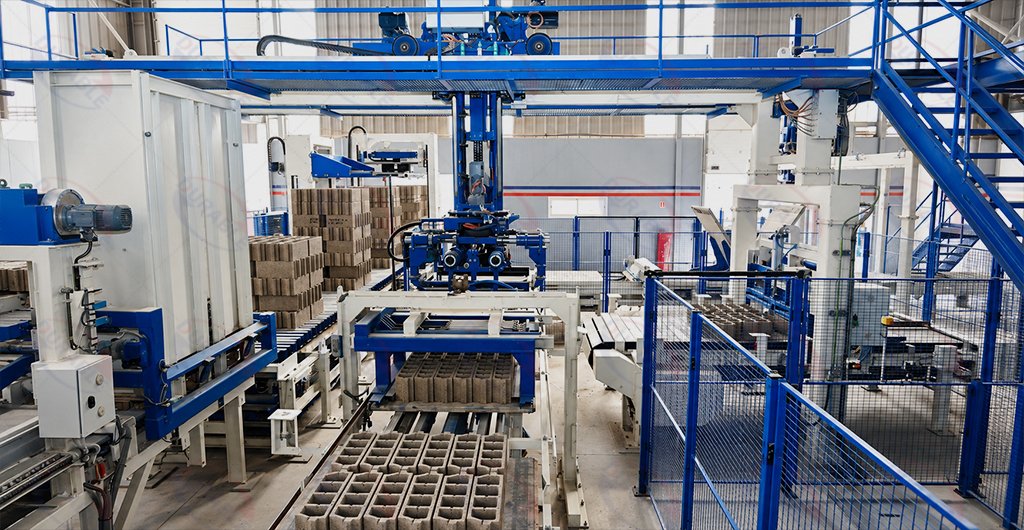
Common layout problems include:
- Aggregate trucks crossing forklift routes
- Finished blocks passing through raw material areas
- Pallets traveling unnecessary distances
- Workers repeatedly crossing equipment paths
- Curing areas located too far from forming
- Finished product storage blocking production flow
These movements do not increase product value.
They consume time and handling capacity.
Factories planning greater automation should design workflow first. This is why a guide such as How to Build an Automatic Concrete Block Factory is useful before simply selecting a faster forming machine.
The slowest stage controls the whole line.
| Line Situation | Likely Bottleneck |
|---|---|
| Fast mixer + slow block machine | Forming bottleneck |
| Fast block machine + slow mixer | Concrete supply bottleneck |
| Fast forming + slow stacker | Discharge bottleneck |
| Fast production + insufficient curing space | Storage or curing bottleneck |
| Good machine speed + frequent forklift waiting | Handling bottleneck |
Adding capacity to a stage that is already faster than the bottleneck may provide little benefit.
The better question is:
Which stage is preventing the entire line from producing more saleable blocks?
How to Increase Block Output Without Buying Another Machine
When a factory needs more output, the first step should be identifying the constraint.
Do not immediately buy another block machine.
1. Measure actual saleable output
Record shift length, actual operating time, downtime, gross blocks, rejected blocks, and saleable blocks.
This separates theoretical capacity from commercially useful production.
2. Find the largest repeated delay
Determine whether the biggest loss comes from mixing, feeding, pallets, forming, stacking, curing, maintenance, or quality rejection.
Fixing the largest bottleneck first is usually more useful than making small changes everywhere.
3. Stabilize raw materials and mixing
Keep aggregate grading, moisture, batch proportions, and mixing sequence as consistent as practical.
Fewer mix corrections mean fewer interruptions at the forming machine.
4. Improve material and pallet flow
Make sure the machine does not wait for concrete, pallets, or finished-product removal.
This may require better feeding, cleaner pallets, improved conveyor timing, or more organized product transfer.
5. Reduce rejects before increasing speed
If rejects are already high, faster production can multiply the loss.
Stabilize product quality first. Then evaluate whether the cycle can be optimized safely.
6. Plan maintenance around production
Track recurring wear and minor faults so predictable maintenance can happen during planned stops.
A Hydraulic Brick Making Machine also needs stable hydraulic response, clean molds, proper lubrication, and regular inspection to maintain repeatable forming performance.
7. Measure again after every improvement
Solving one bottleneck may reveal another.
For example, improving mixer output may make pallet handling the new constraint.
Only after these losses are understood should the factory decide whether it genuinely needs a larger mixer, faster conveying, automatic pallet handling, a stacker, more curing capacity, a higher-output block machine, or a second production line.
How to Choose Equipment and Suppliers for Stable Output
Selecting block production equipment should not begin with the highest advertised capacity.
It should begin with the target product, raw materials, factory layout, labor conditions, automation level, curing method, and required saleable output.
A supplier should help evaluate the whole line, not only the forming machine.
| Supplier Factor | What to Check | Why It Matters |
|---|---|---|
| Process understanding | Raw materials, block type, mold plan, curing method | Helps avoid wrong line configuration |
| Mixing and batching design | Mixer size, batching accuracy, moisture control | Supports stable concrete supply |
| Feeding system | Hopper, conveyor, feed drawer, material flow | Reduces waiting and incomplete mold filling |
| Pallet and stacking system | Pallet circulation, stacker, curing transfer | Prevents discharge bottlenecks |
| Maintenance support | Wear parts, molds, training, troubleshooting | Reduces long-term downtime |
| Layout planning | Material routes, forklift movement, curing space | Improves total factory efficiency |
Before requesting a quotation, prepare:
- Block type and size
- Target daily output
- Raw material type
- Cement and aggregate supply conditions
- Automation requirement
- Available labor
- Pallet system preference
- Site layout
- Power supply
- Project country
- Future expansion plan
This information helps engineers recommend a more suitable production system.
Buyer Self-Check List
Before buying a higher-capacity block machine or upgrading the factory, review these questions:
- What is your actual saleable output per shift?
- How many blocks are rejected each day?
- What are the most common reasons for downtime?
- Does the mixer keep the block machine supplied without waiting?
- Is concrete moisture consistent from batch to batch?
- Are pallets clean, flat, and returning on time?
- Can fresh blocks leave the forming area without delay?
- Is curing space limiting daily production?
- Are forklift routes creating unnecessary movement?
- Is preventive maintenance planned or mostly reactive?
- Which stage is the current bottleneck?
- Would a faster machine solve the real bottleneck, or only move it elsewhere?
These questions help buyers avoid investing in the wrong part of the production line.
Frequently Asked Questions
Why can two similar block machines produce different daily output?
Daily output depends on more than forming speed. Mixing capacity, concrete consistency, feeding, pallet supply, downtime, rejection rate, stacking, curing, maintenance, and factory layout can all change the number of saleable blocks produced per shift.
Should I increase block machine speed to produce more blocks?
Not automatically. If mixing, feeding, pallet handling, or product removal cannot support the faster cycle, increasing speed may create more interruptions or rejected blocks. Stabilize the whole line before shortening the cycle.
What is the best way to measure block factory output?
For commercial production, saleable blocks per shift are more useful than theoretical machine cycles alone because they account for downtime and quality losses.
Can better concrete mixing increase block production?
Yes, when inconsistent concrete causes forming adjustments, machine interruptions, or rejected blocks. The mixer must also have enough practical capacity to keep the block machine supplied.
When should a block factory buy a higher-capacity machine?
Consider additional capacity after measuring current operating time, downtime, rejects, mixing, pallet handling, curing, and other bottlenecks. If demand still exceeds the optimized line’s practical output, additional equipment may then be justified.
About DURABLE
DURABLE provides block-making equipment and production solutions for small workshops, commercial concrete block factories, and automated production lines.
Our equipment range includes concrete block machines, manual and semi-automatic block machines, automatic block production lines, concrete mixers, material batching systems, belt conveyors, pallet and stacking systems, and supporting block factory equipment.
A productive block factory requires more than a forming machine with a high advertised capacity.
Raw materials, mixing, feeding, forming, pallet circulation, stacking, curing, maintenance, and factory layout need to work together.
DURABLE helps buyers evaluate block type, target output, raw materials, automation level, labor conditions, site layout, and future production requirements when planning a block production system.